

Experiencing Rashid Johnson: A Poem for Deep Thinkers is such an emotional journey you need to go to therapy afterward. And at the center of the exhibition co-organized by The Modern Art Museum of Fort Worth’s chief curator Andrea Karnes and the deputy director and chief curator of the Solomon R. Guggenheim Museum, Naomi Beckwith, is angst.

Karnes has a simpler term for his work: layered.
90 examples of his collages, paintings, photography, sculpture and video covering the past 25 years are on display at the Modern through Sept. 27, when it then heads to the Museum of Contemporary Art, Chicago, where Beckwith previously worked.
Johnson is a brooding, emotional, and intellectual conceptual artist who practices in every medium and who can also get a smile out of the most morose of topics: Afrocentrism, Black history and masculinity. Overlapping with his Big Ideas are Johnson’s anxieties, like the fragility and violence of being a Black man and Johnson’s own struggles with addiction, masculinity, self-care, partnership and fatherhood. He was raised to be a deep thinker by his mother, Cheryl Johnson-Odim, the influential professor of African and African American history at Northwestern University
For him, the process is as important as the content. “He…addresses those things most associated with inner life: feelings, psychological states, fantasies, individual existential questions––things difficult to express in language,” Beckwith writes in her catalogue essay.
1 ⁄8
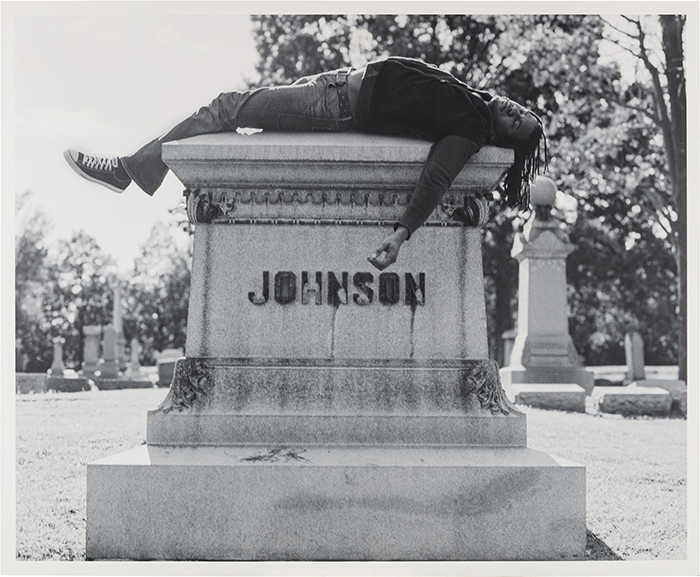
Rashid Johnson, Self Portrait Laying on Jack Johnson’s Grave, 2006. Chromogenic print mounted on panel; 40 1/2 × 49 5/8 inches, edition 1/3, 2 AP. Collection of Dr. Daniel S. Berger. © Rashid Johnson.
2 ⁄8
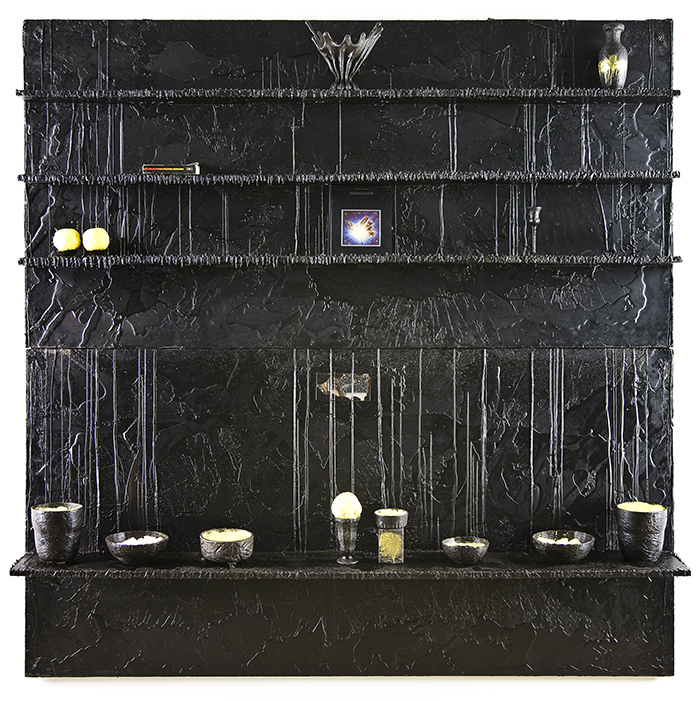
Rashid Johnson, The Crisis of the Negro Intellectual (The Power of Healing), 2008. Shelves, wax, black soap, shea butter, candles, mixed media; 96 × 96 × 12 inches. Rubell Museum, Miami and Washington DC. © Rashid Johnson.
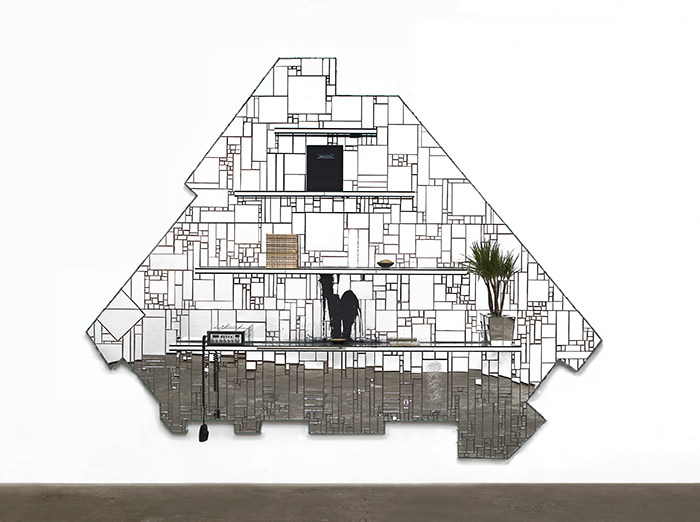
3 ⁄8
Rashid Johnson, The Shuttle, 2011. Mirror, black soap, wax, books, shea butter, oyster shells, plant, CB radio, wood panel; 96 1/2 × 125 × 11 3/4 inches. Rubell Museum, Miami and Washington DC. © Rashid Johnson. Photo: Martin Parsekian.
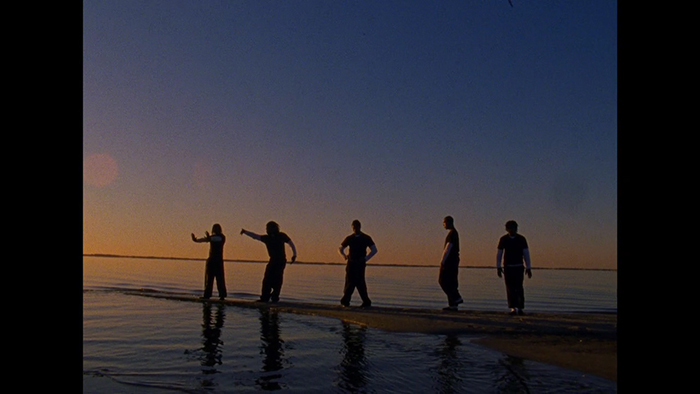
4 ⁄8
Rashid Johnson, The New Black Yoga, 2011. Color video with sound, transferred from 16mm film, 10 minutes, 57 seconds; Ed 1/3, 2 AP. Solomon R. Guggenheim Museum, purchased with funds contributed by David Shuman. © Rashid Johnson.
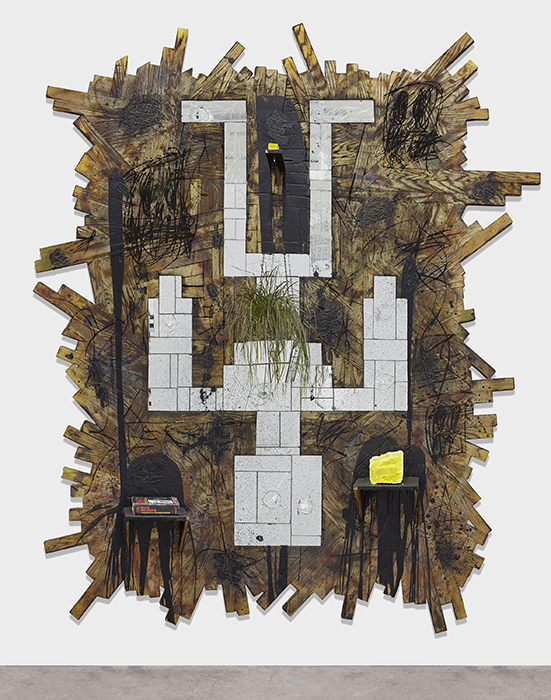
5 ⁄8
Rashid Johnson, Falling Man, 2016. Burned red oak flooring, spray enamel, mirror, shea butter, black soap, wax, plant, book; 118 × 104 × 12 inches. Collection of Marguerite Steed Hoffman. © Rashid Johnson. Photo: Martin Parsekian.
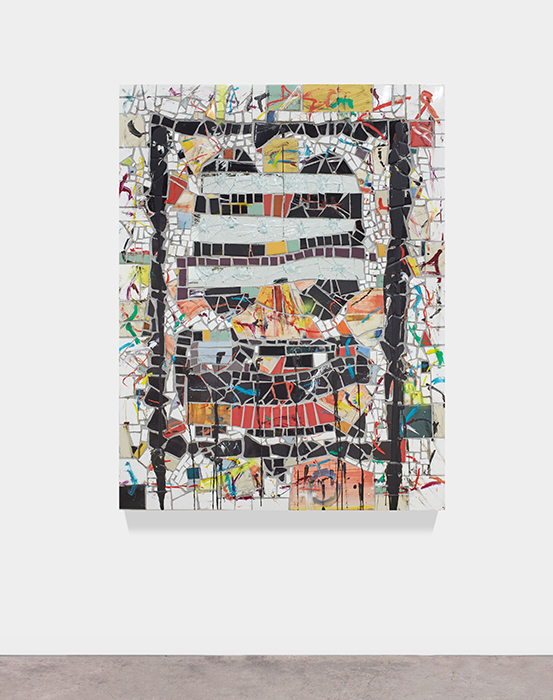
6 ⁄8
Rashid Johnson, Untitled Broken Men, 2019. Ceramic tile, mirror, spray enamel, oil stick, black soap, wax; 50 × 38 × 3 inches. The Studio Museum in Harlem, museum purchase with funds provided by Albert and Renee Laboz. © Rashid Johnson.
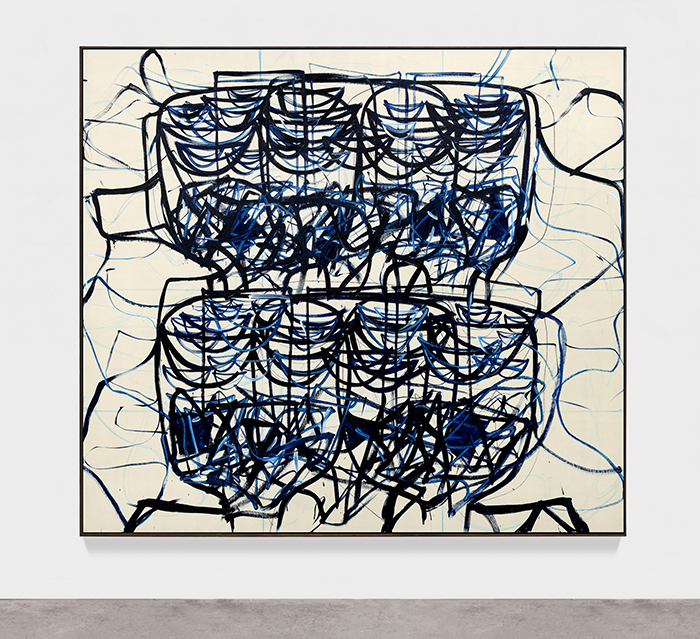
7 ⁄8
Rashid Johnson, Soul Painting “Six Souls”, 2024. Oil on linen; 96 × 108 × 1 11/16 inches. Modern Art Museum of Fort Worth. © Rashid Johnson. Photo: Stephanie Powell.
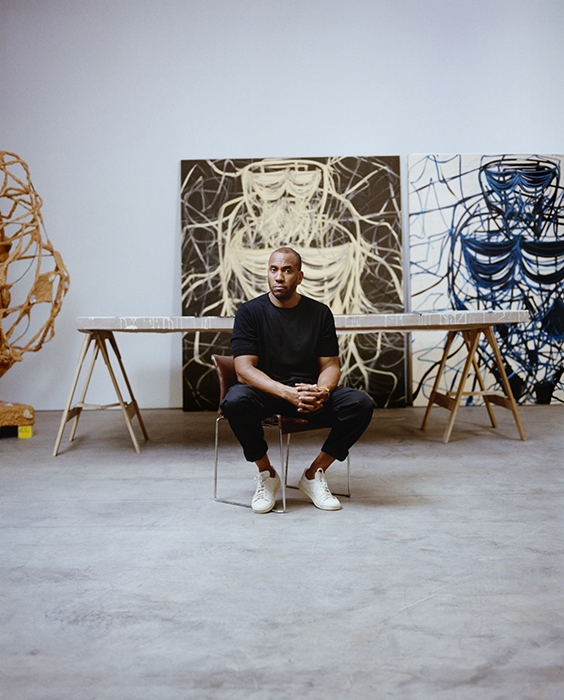
8 ⁄8
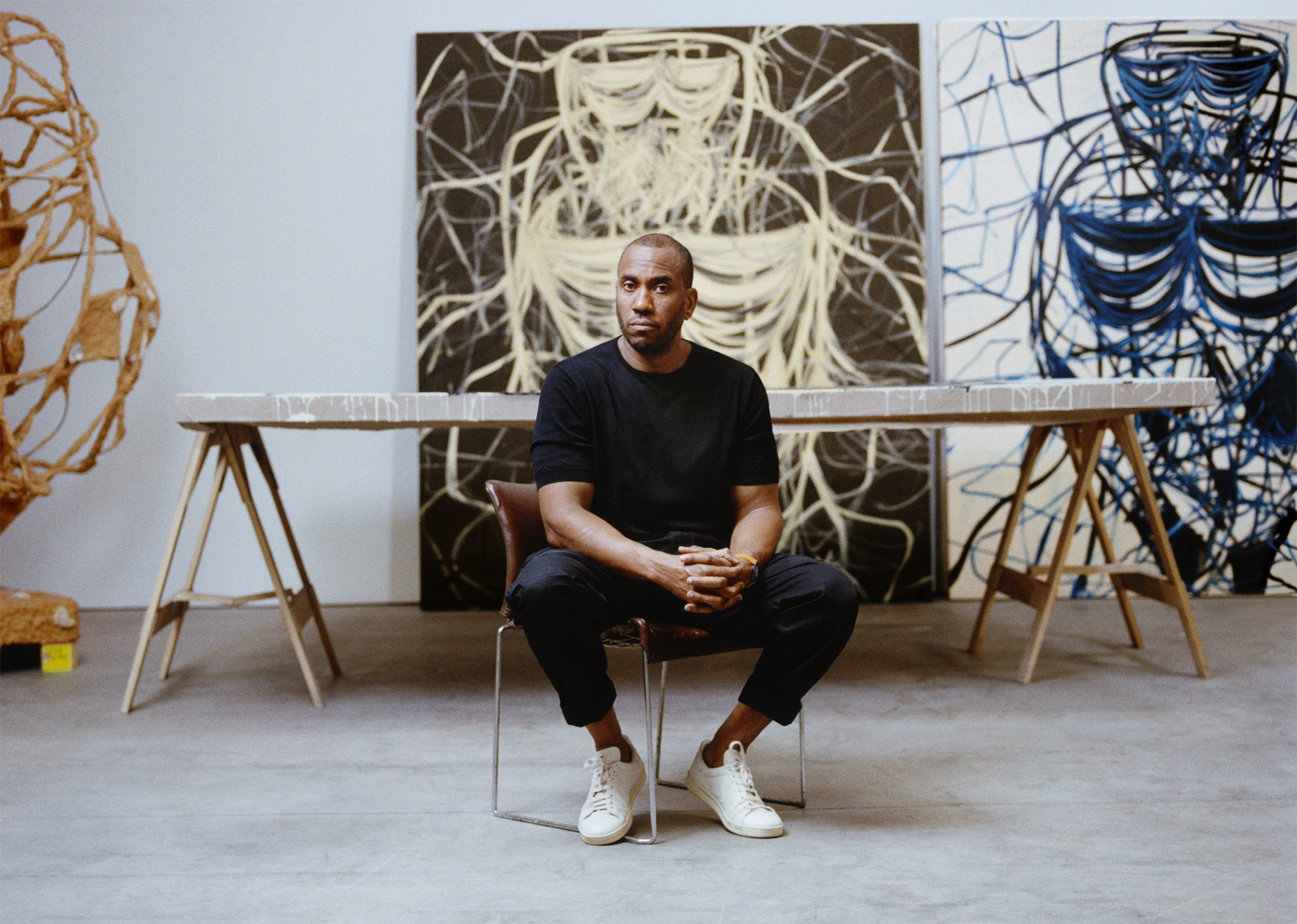
Joshua Woods, Portrait of Rashid Johnson, 2025. New York. Courtesy of the artist and Hauser & Wirth.
Language is also part of the process of creation and ultimate product and “key to understanding Johnson’s project,” art historian and curator Hendrik Folkerts writes in the catalogue.
So, fitting then that the title is taken from A Poem for Deep Thinkers, a poem by Amiri Baraka, previously known as LeRoi Jones. And it’s a reference, of course, to how words, which create a language, are a constant. He fills his sculptures’ nooks and crannies with books related to Black liberation (James Baldwin’s The Fire Next Time and Frantz Fanon’s The Wretched of the Earth) and personal experience (an Alcoholics Anonymous handbook).
Johnson is an intimate artist. He not only allows us into his world but is at his best when using his hands.
Yet he still pursued photography, perhaps one of the least hands on art forms, while still sculpting and painting-style collages. Karnes notes he embraced because to him, the medium was a way to express the feelings of the early 1990s and early 2000s.
To understand how he used photography, look at two contrasts. In Self Portrait in Homage to Barkley Hendricks (2005), which is not on display, he goes balls out: He’s posing nude. The “deadpan, humorous” reference, Karnes notes, is to Barkley Hendricks Brilliantly Endowed (Self Portrait) from 1977. In that photograph, the late Hendricks stands between two canvases, one where he’s nude and the other where he’s dressed in an all-white suit against a white canvas. For a vulnerable guy, it’s bold.
The off-putting and darkly humorous Self-Portrait Laying on Jack Johnson’s Grave (2006), which is on display, shows him lying on boxer Jack Johnson’s grave in Chicago, where he lived at the time. Again, he’s damaged, or gone, a corpse, like the boxer. But contrast death from natural causes to a different kind of death: the intentional. Across from it are “DEATH” (titled Death is Golden, 2004) and “RUN” (Run, 2008), both spray painted on enamel. All reference a different kind of metaphor for death, but tie into the perilous experience of being a Black man.

Literal expressions of anxiety appear in his best works, the Anxious “paintings,” which use everything but paint. With Untitled Anxious Audience (2017), he pieces together a collage of Black faces with almost cartoonishly big eyes and seemingly jittering teeth made from tile, soap and wax. The character is a regular figure in the ongoing Untitled Anxious Men series, which includes two from 2015 and in other media, like Anxious Mask (2019), a dark sculpture made with oil painted onto animal skin. Across the exhibition are plants, dangling across the museum and into the galleries. Some pots include this character on them, making them, ironically or not, understandably anxious.

But they’re calm. They’re enjoying each other’s company, even if they aren’t saying it. If they’re anxious, it’s likely because they’re not sure what Johnson will create next.
—JAMES RUSSELL