

Last year, I invited my mother to see the Alley Theatre’s production of Baskervilles: A Sherlock Holmes Mystery, Ken Ludwig’s comic adaptation of the Conan Doyle classic. Mom enjoyed the show, but the next morning called me with one complaint. After perusing the program, she was quite indignant that the Alley hadn’t given all credit where it was due and had left out at least one actor, maybe two, from the Playbill. Though an intelligent woman and long-time theater goer, somewhere amidst the frantic role and costume changes of this five actor/35+ characters show, my mother had imagined an extra actor into existence.

Ensembles in musicals that morph into party goers in one scene to dancing office workers in the next are such theatrical traditions audiences tend to take them for granted. But the one actor carrying multiple important roles is not often the standard, at least anymore.
One of the most daring and recent examples of this type of play, The Lehman Trilogy, has had Texas productions at both Austin’s Zach Theatre and Houston’s Stages. Derek Livingston, artistic director of Stages, and their Lehman director, notes that what we think of as traditional—the one actor/one role show—is a relatively new evolution of theater. Indeed, any member of Shakespeare’s company would expect to play more than one role in a play.
“The idea that you would cast one actor per part really was the sort of brief thing that existed in Western theater, like pre-World War II or pre 1960s, where you would cast a [different] person in every role,” says Livingston.
1 ⁄6
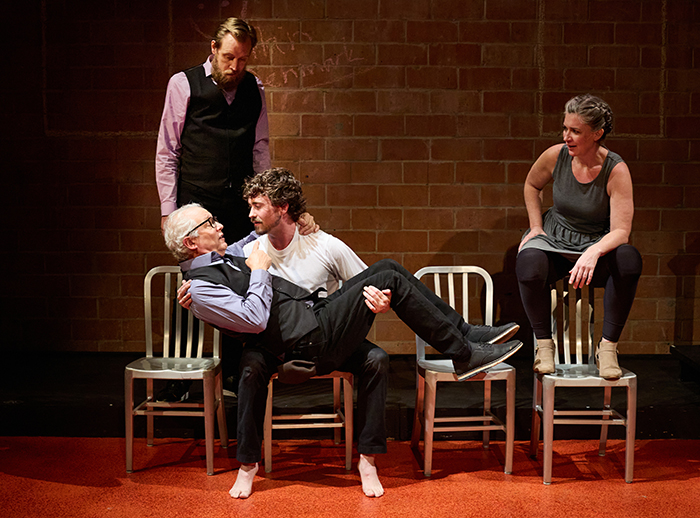
Philip Hays, Philip Lehl, Wesley Whitson and Christy Watkins in the 4th Wall Theatre production of Hamlet. Photo by Gabriella Nissen.
2 ⁄6
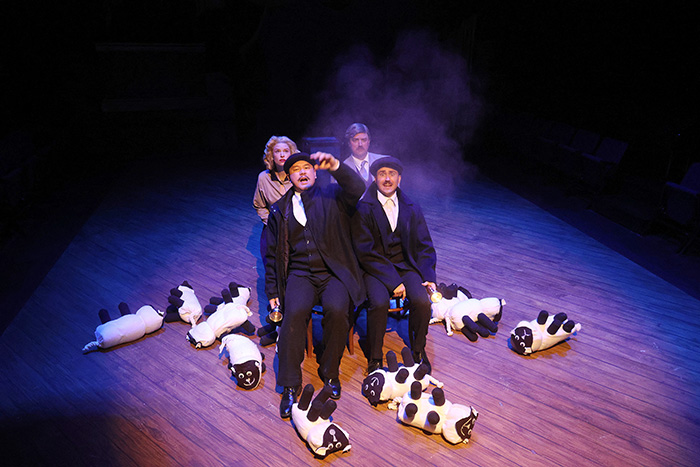
Chris Szeto-Joe, Wesley Whitson, Meg Rodgers and Kevin Crouch in the Main Street Theater production of The 39 Steps. Photo courtesy of Main Street Theater.
3 ⁄6
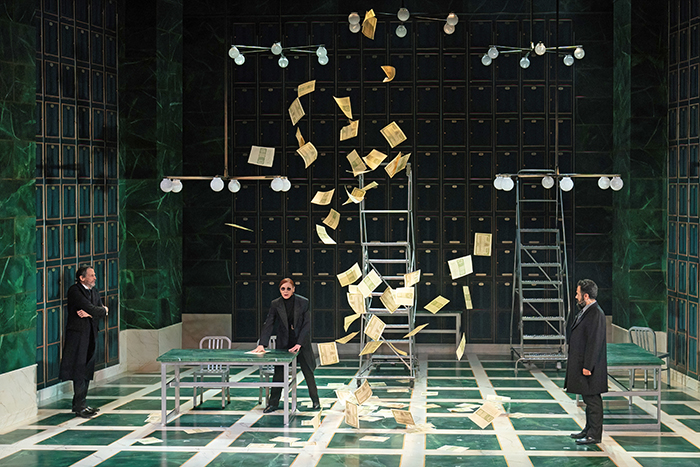
The Cast of the ZACH Theater production of The Lehman Trilogy. Photo by Suzanne Cordeiro.
4 ⁄6
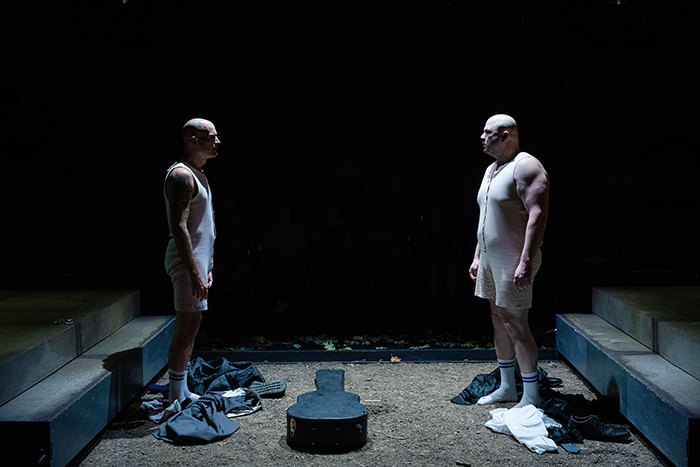
Jonathan R. Freeman and Taylor Harris in the Amphibian Stage production of Rift.
5 ⁄6
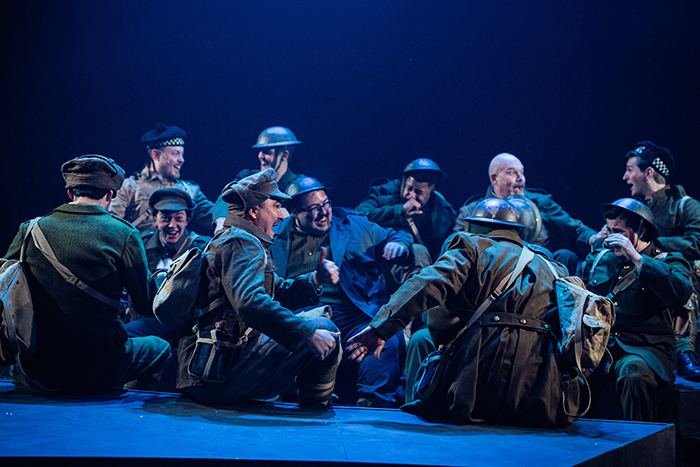
The cast of the Stage West Production of All Is Calm: The Christmas Truce of 1914. Photo by Evan Michael Woods.
6 ⁄6
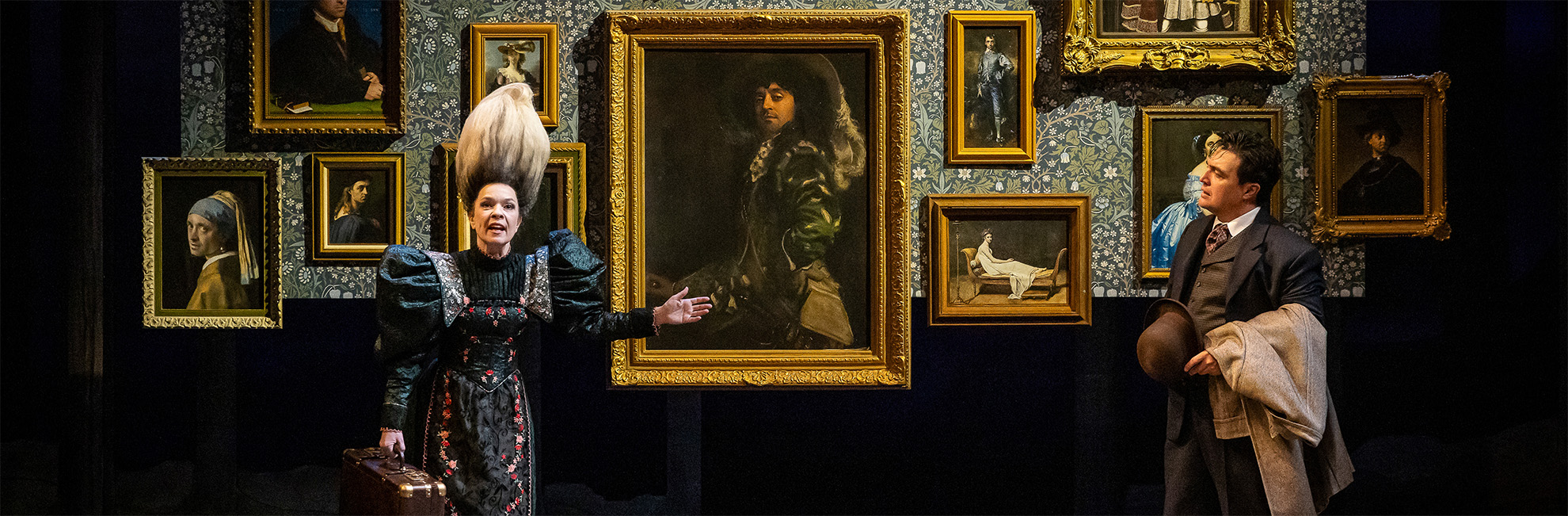
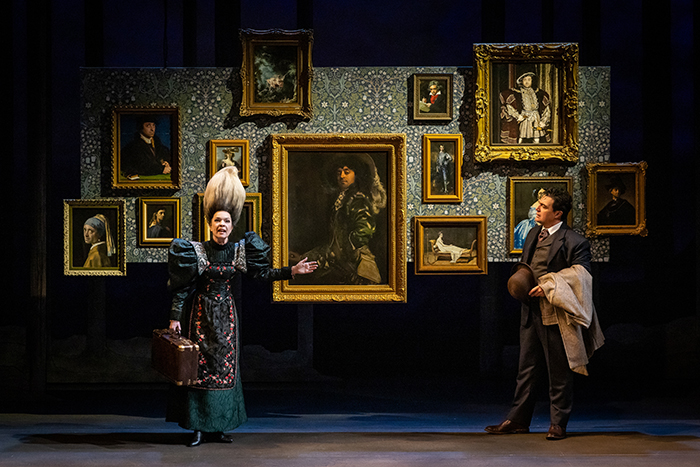
Elizabeth Bunch and Christopher Salazar in Alley Theatre's production of Ken Ludwig’s Baskerville: A Sherlock Holmes Mystery. Photo by Lynn Lane.
While one actor playing one character is definitely the norm today, there are many examples of one actor playing two roles in a show if only to keep said actor from heading to the bar after act I, when the first character dies or sails to France. This is the case for the Laurens and Lafayette roles in Hamilton. Lin-Manuel Miranda even draws both comedy and poignancy from the doubling of roles, as the actor playing Lafayette sings his way into Act 2 as Thomas Jefferson coming home from Paris, and the actor playing Laurens, who duels and survives early in the musical but then dies as a hero in the Revolutionary War, also plays Hamilton’s son Philip, who dies in a duel in Act 2.
But a small cast, playing from three to sometimes twenty roles each is a whole other level of theatrical magic that can become a kind of dance.
Playwrights who wish to lean into farce can fuel the hilarity by requiring a handful of actors to transform from one character into a clown car of additional characters. Such is the case for Baskerville, which was also recently produced at Austin Playhouse or the often produced in Texas 39 Steps and Around the World in 80 Days.
Alley resident actor, Elizabeth Bunch, who tackled many of the Baskerville women roles along with an ever increasingly elaborate set of petticoats and wigs, makes the distinction of playing multiple roles in a comedy versus a drama.
“The pressure in a comedy is that the audience knows exactly what the task is that is set before you. So, each character must have their own sense of humor, and the audience is in on the trick of watching you transform,” says Bunch.
Though Lehman does contain occasional comedy, it’s fundamentally a drama and illustrates how a multi-role show can also be a way to put an epic story onto a stage. In Lehman, three actors must inhabit generations of the Lehman family over a century. Multi-role dramas can also offer new perspectives into characters we know so well. Houston’s 4th Wall Theatre recently produced a four-actor Hamlet first created by New York’s Bedlam company. Bedlam is also the company that initially championed Kate Hamill’s adaptation of classic novels into plays that often require actors to dive in and out of a multitude of characters. Taking after my mom, I lost count at how many Texas theaters, including the Alley, Austin Playhouse, WaterTower Theatre, and 4th Wall have produced Hamill’s Sense & Sensibility or Pride & Prejudice.

Along with the fun, there are often pragmatic reasons for programming this type of play. One actor shows were particularly popular when Texas theaters reopened after the pandemic. But small cast/many character plays can just be easier to mount for regional theaters.
“They make large stories possible on a realistic budget. If a script has 50 characters but only needs 5 actors, that can be the difference between a show we can produce and one we can’t,” notes, Stage West artistic director, Dana Schultes who recently directed All Is Calm: The Christmas Truce of 1914 where 12 actors portrayed a variety of soldiers and figures during WWI.
Along with the costs, even the most creative set designer will have trouble accommodating a large amount of bodies on a small stage.
“If you want to do a big play that has more than 10 actors in it, and there’s many, many plays that fit that, you have to find solutions,” notes Philip Lehl, 4th Wall Theatre co-founder, who has acted in several productions where he played multiple characters, including that four-actor Hamlet and the narrator in The Pavilion.
Film and television will always beat theater in the ability to mimic life realistically, but live theater remains an art form that embraces the audience’s imagination and asks them to participate in its creation. Perhaps the multi-role play just hugs the audience even more enthusiastically.
Livingston says actors transforming into different characters on stage emphasizes the unique qualities of a live performance. Since no company can recreate a vast world on stage with perfect verisimilitude, unless it’s a room or two, “The audience has always been invited to come along and take a journey to fill in the pieces. I think the idea of having one actor to play multiple parts is an extension of that. It invites the audience to be further members of the storytelling and theatricality of the presentation.”

So how do actors and directors conjure such enchantment?
“As a director, I start with casting,” explains Schultes. “I look for actors who already have range in their physicality and vocals, because that becomes crucial in a multi-role piece. From there, rehearsal is about helping each character become specific and distinct. Costumes help, certainly, but so do movement, voice, rhythm, and even where and how a character appears onstage.”
Bunch also gives thanks to good designers. “For Baskervilles, rehearsing in costumes was very important to me because coats, hats, glasses, all informed the way I would move. Plus, Sarah Cubbage, the fabulous costume designer, was very open to collaborating with me,” describes Bunch.
Lehl notes that sometimes an actor can’t rely on costume changes and so a bit of unique movement for each character can distill the character.
“There is a challenge when you’re playing multiple roles of figuring out what the change for each character is going to be. It can be one thing. So, my hands are in my pockets for this guy, or my voice is a little different, but there’s an accent. I’m wearing glasses for one and a hat for another, or my gait, the way I stand, the way I walk.”
They also require vision and something like dance choreography from the director.
“I do think these shows require special attention to clarity in blocking and staging. The goal is for the shifts to feel fluid, but never confusing. The audience should be able to follow the story without issue,” says Schultes.
Most of the performing artists I talked to, even casually, said they always relish the multiple roles show, with Houston stage veteran Joel Sandal likening it to a delicious “pu pu platter” for actors.
Bunch loves the challenge, and also believes these shows give audiences additional insight into the acting process.
“The audience gets to see a full range of what I am able to do in terms of voice and physicality,” she explains.
“When the audience catches on to how quickly we have to change I think they get to feel like they are riding the rollercoaster with us. The audience loves sharing that sense of danger. Honestly, sometimes I think they love it more when they see the play actually go off the rails. That’s why it is a live art form. That beautiful sense of danger.”
—TARRA GAINES