


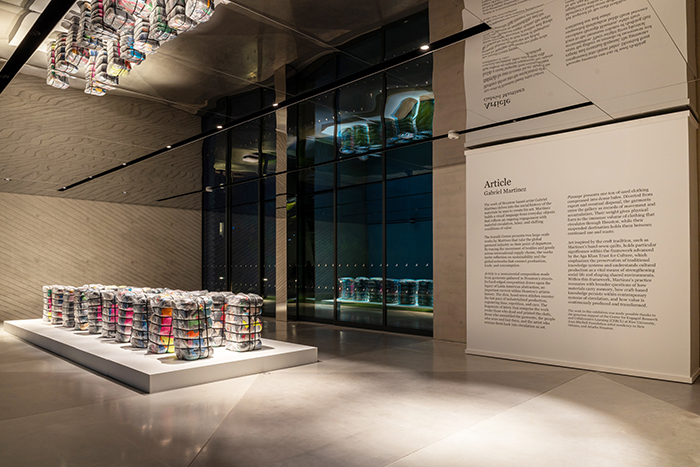
I step into the Ismaili Center—opened last December on the banks of Buffalo Bayou—and the space announces its intention immediately. The light is controlled. The quiet is profound, engineered so conversation is possible, so presence can be felt. Ruhee Maknojia, the Center’s Arts and Culture lead, describes the building simply as “a gift to the city.” The space was designed this way deliberately, part of a curatorial philosophy rooted in sustained relationships with artists rather than discrete events. Gabriel Martinez’s work was among the first pieces installed when the Center opened—site-specifically selected for the permanent collection and on view from day one. That foundational commitment continues now with Article, his exhibition on view through Jan. 10, 2027, deepening the institutional investment in his practice over time.

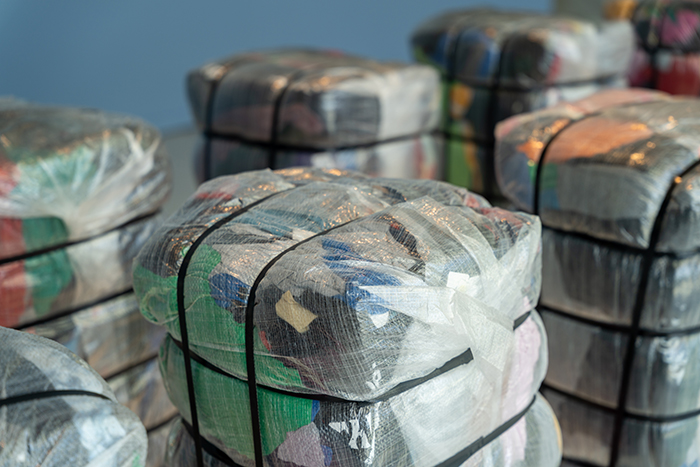
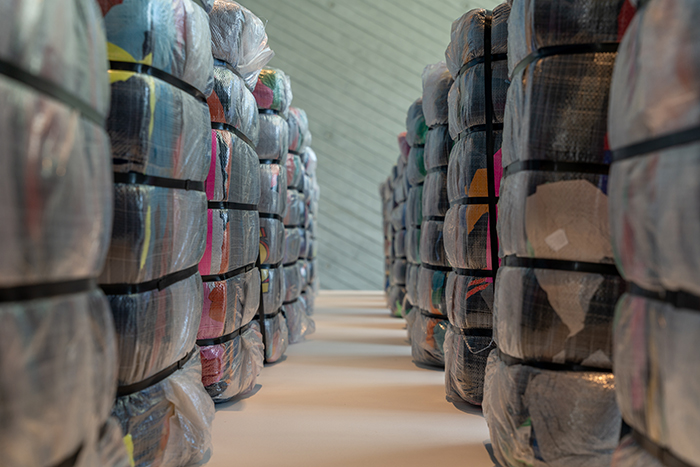
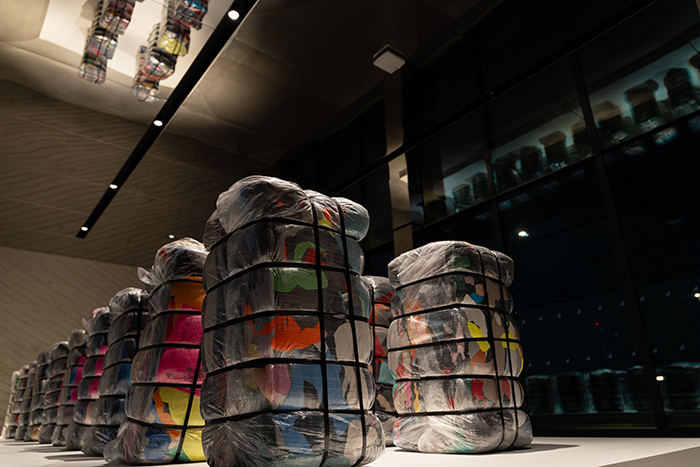
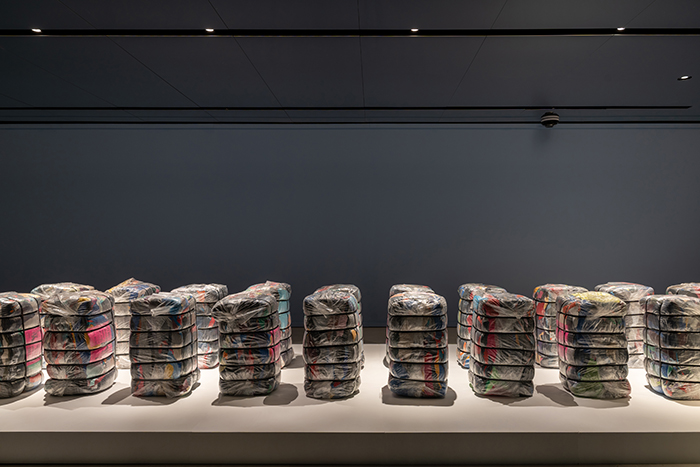
Inside, the blue wall appears—the same blue as the building’s architectural palette. On the plinth sit twenty 100-pound bales of compressed garments arranged in two rows of ten, extending into depth. At first they look almost shredded, but then I realize they’re full garments inside, compressed into blocks. One ton of clothing stretching away from me. The mirrored ceiling above multiplies them, doubles the visual weight. Walking the perimeter, the physical heft of it presses in. “All the clothes you’re seeing in the street,” Martinez notes of the street trash he gathers, “were already poisonous to produce and will continue to be poisonous long after they are out of circulation. A storm called progress.” Standing here, the cycle becomes suddenly visible in a way I hadn’t considered before. It’s bananas.
The form of those compressed blocks is immediately familiar. I recognize a similarity between these bales and bales of cotton that were once transported by ship from our ports. Texas cotton once left here bound for mills across the world. Now garments—the end product of that same cotton—are compressed into identical rectangular bales to be shipped back out. I spent time studying the garment industry, sweatshops, the labor chains that make clothing possible. But I’d never thought about this scale, the actual weight and volume of it.

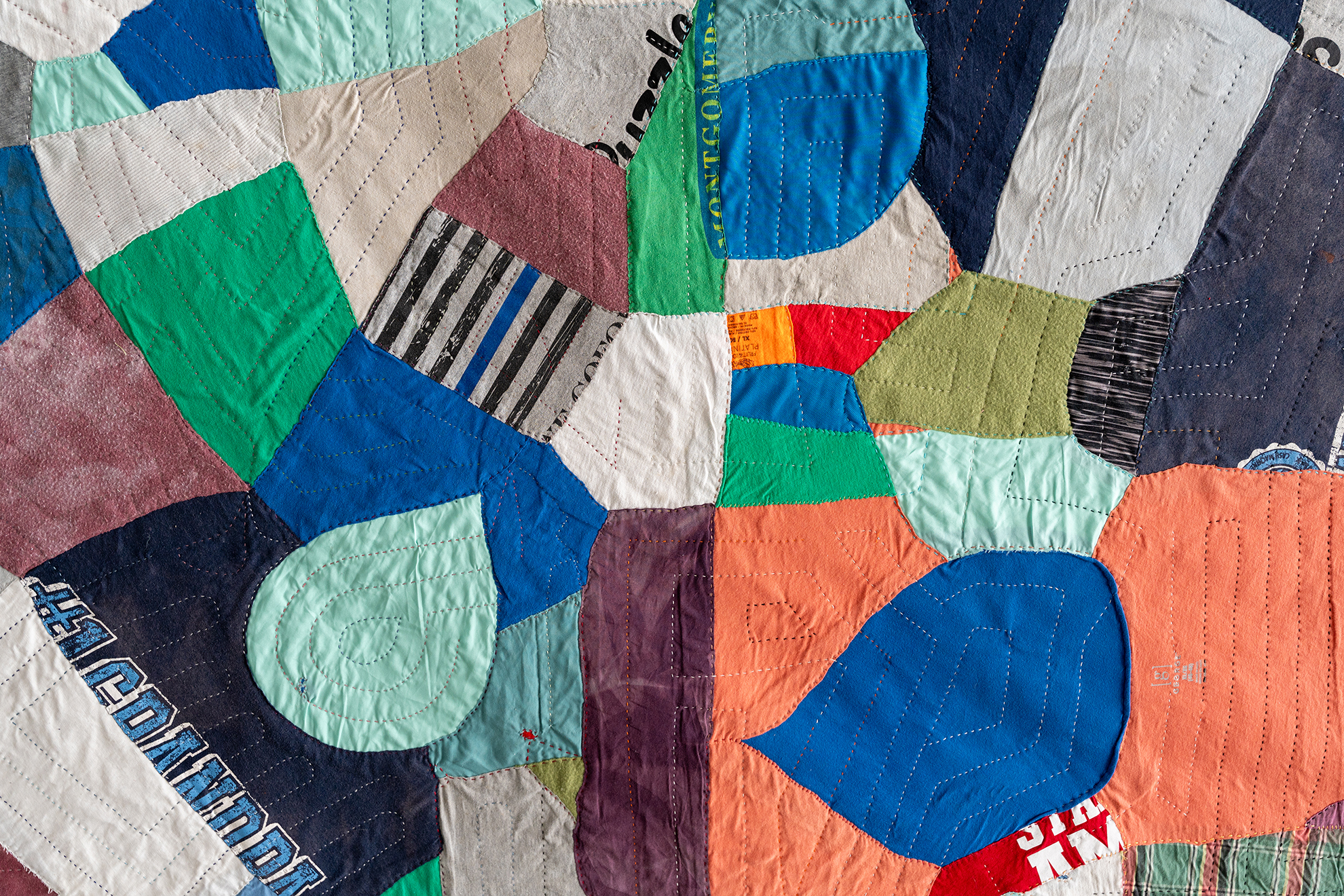
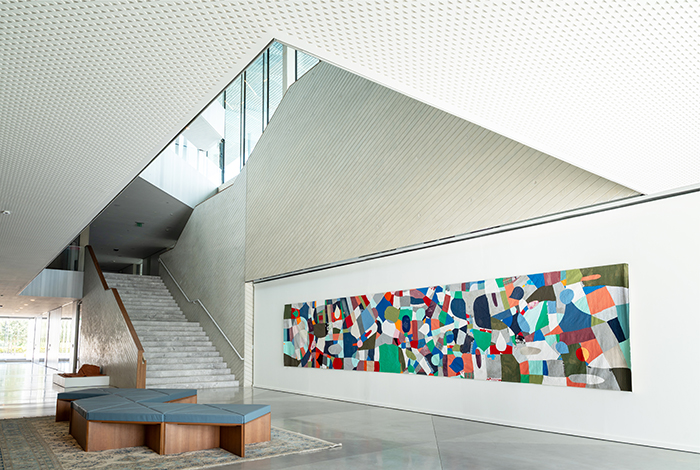
Standing between the quilt and the bales, the inherent friction of the exhibition reveals itself. The Ismaili Center is a pristine sanctuary of engineered concrete, refined glass, and meditative quiet—yet here inside it sits a ton of compressed urban trash and global labor.
Shifting these bales from an industrial warehouse—surrounded by forklift noise, fluorescent glare, and hundreds of identical stacks—into this contemplative architecture revalues them entirely. The building “changes how they contribute to an understanding of global production and circulation,” as Martinez observes. It forces this quiet architecture to hold a difficult conversation, one that aligns directly with the Center’s curatorial vision. As Maknojia notes, programming decisions aren’t just about art history, but are “more about the value structure of what the artists are creating and whether there’s alignment with the values the community wants to showcase.”
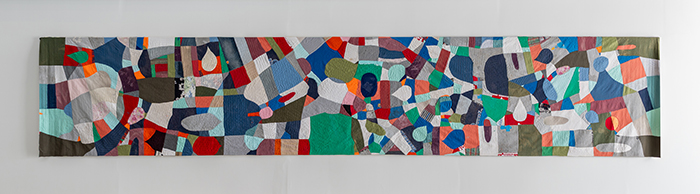
Here, that alignment confronts what is absent. The factory workers who sewed the original garments aren’t here. The sorters at the recycling facility aren’t here. The people in recipient countries reselling them aren’t here. What’s visible is what the Ismaili Center decided to show—the quilt facing outward, beautiful and precise, and behind it the raw material, the compressed weight. Both are necessary. Both are limited. Martinez documents the circulation by hand. The Center sustains that documentation through sustained investment in the artist. The quilt faces outward—aestheticized, beautiful. Step inside and you see the bales: the raw material, the system, the complexity. Both are present. What’s absent speaks too.
1 ⁄10
2 ⁄10
3 ⁄10
Gabriel Martinez, Passage [detailed image], 2026, bales of clothes, dimensions variable. Photo by Ali Khoja courtesy of Ismaili Center.
4 ⁄10
Gabriel Martinez, Passage [detailed image], 2026, bales of clothes, dimensions variable. Photo by Ali Khoja courtesy of Ismaili Center.
5 ⁄10
6 ⁄10
7 ⁄10
Gabriel Martinez, Article, 2026, found garments, 67 x 352". Photo by Ali Khoja courtesy of Ismaili Center.
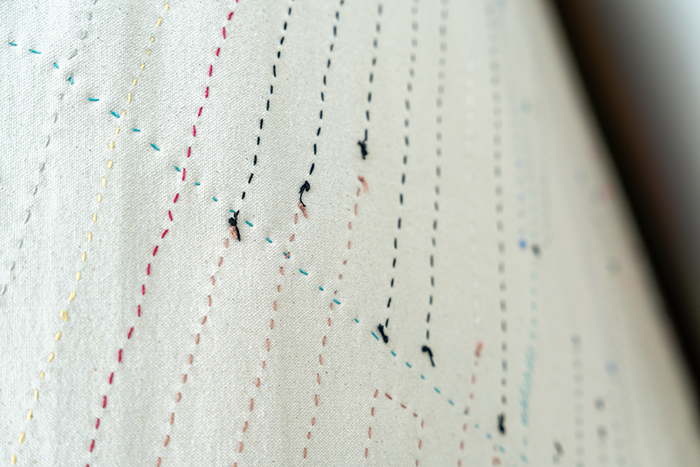
8 ⁄10
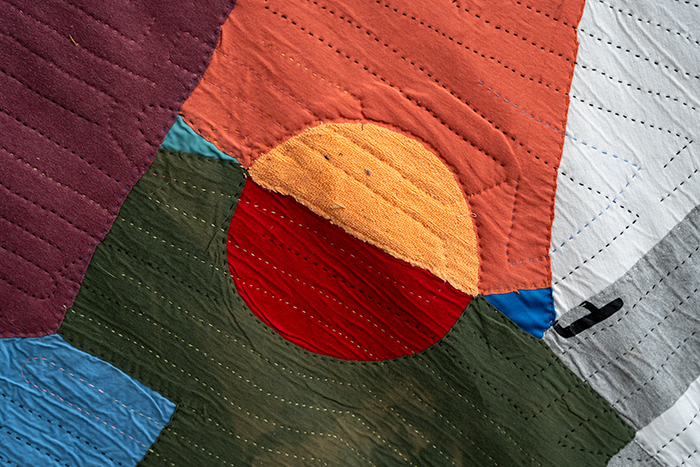
9 ⁄10
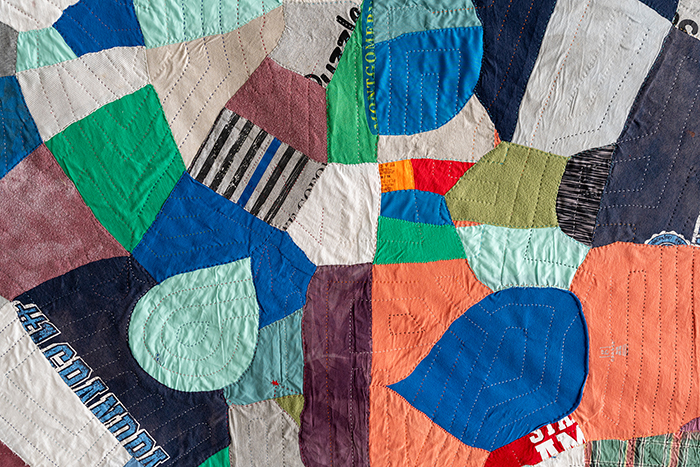
10 ⁄10
Gabriel Martinez
Article [detailed image], 2026, found garments, 67 x 352". Photo by Ali Khoja courtesy of Ismaili Center.
What this exhibition reveals is that sustained attention doesn’t resolve the system. It witnesses it. Construction workers volunteered their time to align the walls precisely. The textile recycling company—which sorts and ships those bales worldwide—shares Martinez’s mission: giving discarded material new life. The afterlife is complicated. Some garments get broken down for thread recycling. Some are resold cheaply to people who depend on them. Some end in landfills. The system continues exactly as designed.
Exhibitions here can travel between sister institutions in London, Toronto, Dubai, and Lisbon, keeping artists connected so work isn’t abandoned when a show closes. That sustained attention doesn’t change the global garment economy. But it creates a rare, triangulated resistance within our shared complicity: the artist refusing the speed of the market, the institution refusing the ephemerality of the exhibition cycle, and the viewer refusing the comfort of looking away. That matters. Not as revolution, but as resistance within complicity.
And once you step back out into the Houston heat, past the pristine glass of the sanctuary, you see it—another stray thread of synthetic neon caught in the gutter, waiting for the cycle to begin again.
—JON HOPSON