

The Apollo Chamber Players were taking part in a festival in Seattle when violinist Matthew Detrick, the group’s founder and artistic director, slipped away for a hike in nearby mountains. Amid the sunshine and forest vistas, his thoughts turned to Apollo. Over the past few years, the group had offered musical reflections on American society and issues, from the ideals of liberty and democracy to hot-button issues such as censorship. Now a new season was on the drawing board. Where should Apollo take it?

Detrick had found the thread that ties together the quartet’s 2026-27 season: The group aims to help its audiences escape the grip of doomscrolling and in-your-face social media. As with the previous years’ looks at social issues, Detrick says, Apollo’s goal is “getting the conversation going…getting people to ask these questions and reflect on them.”
A new work by Anthony Brandt, composition professor in Rice University’s Shepherd School of Music and co-founder of the Musiqa new-music group, will tackle the tumult in the season opener (Oct. 3). Brandt’s Resting States, Detrick says, begins “in kind of a chaotic sound world,” as witness the opening movements’ subtitles: “Too much conflict” and “Too much running around.” But the work reaches a “more serene and tranquil place by the end,” Detrick adds.
Illusion to Resolution will meld improvisation and Indian ragas with Western classical elements, Detrick says. With Brandt’s and Ravikiran’s scores side by side, he adds, “I think it’s going to be really interesting for the listener to take that journey and (experience) how different cultures find calm.”
Apollo’s second concert (Nov. 21) will take on the question of “how can we focus deeply when we’re (typically) tied to our phones and electronic devices?” Detrick says. A new work by Tian Qin, a native of China who earned a master’s from the Shepherd School, will offer a Buddhist vantage point.
In a twist on the usual concert format, the centerpiece will be a panel discussion titled “What Creates Flow?” led by Leila-Scott Price, co-founder of The Center for Healing Arts & Sciences. Qin, Apollo players and others will take part. Detrick thinks the atmosphere of the Live Oak Quaker Meeting House, with its James Turrell Skyspace opening to the heavens, will lend a meditative aura, as will Debussy’s Quartet in G minor. “I think French Impressionism in music can create a kind of serenity in our listening experience,” Detrick says.
1 ⁄4
Anthony Brandt, composer for Tranquility at Zilkha Hall, Oct. 3, 2026. Photo courtesy of the artist.
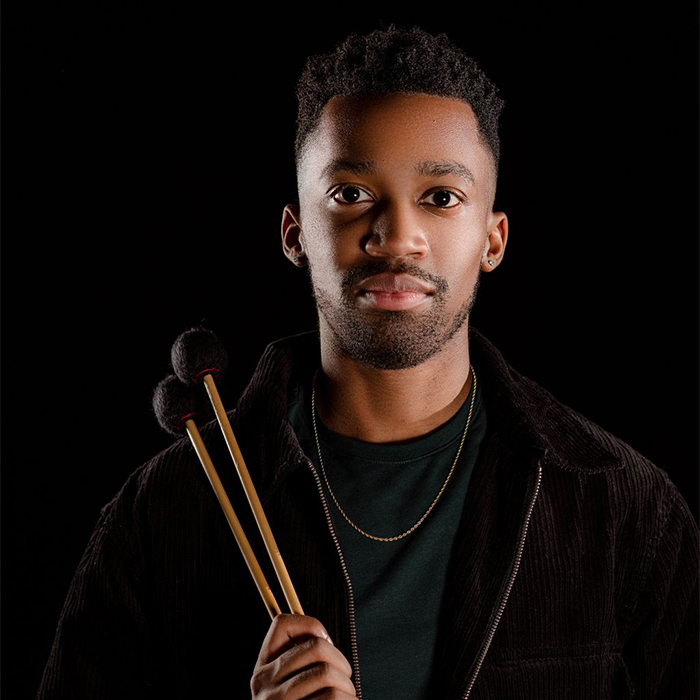
2 ⁄4
Jalen Baker, composer and vibraphonist for VOICE: Living Democracy at Rothko, Feb. 4 2027. Photo courtesy of the artist.
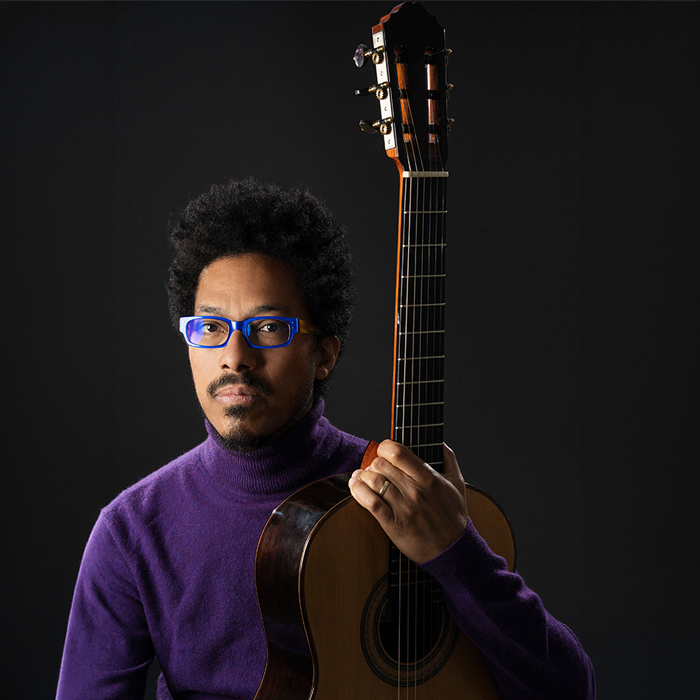
3 ⁄4
João Luiz Rezende, guitar, Reflection at MATCH, May 28, 2027. Photo by Drew Bordeaux.
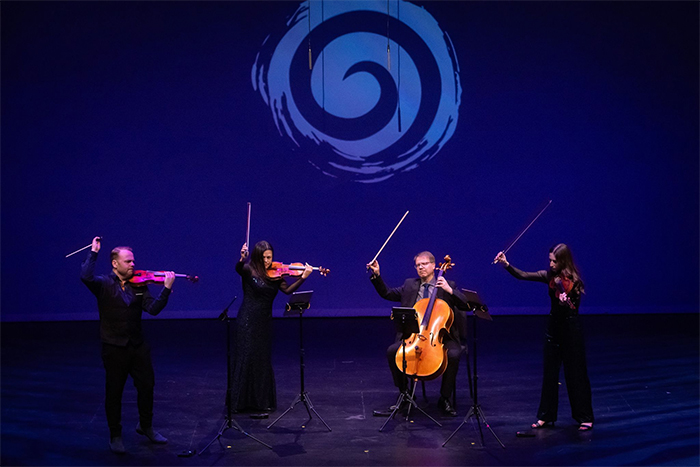
4 ⁄4
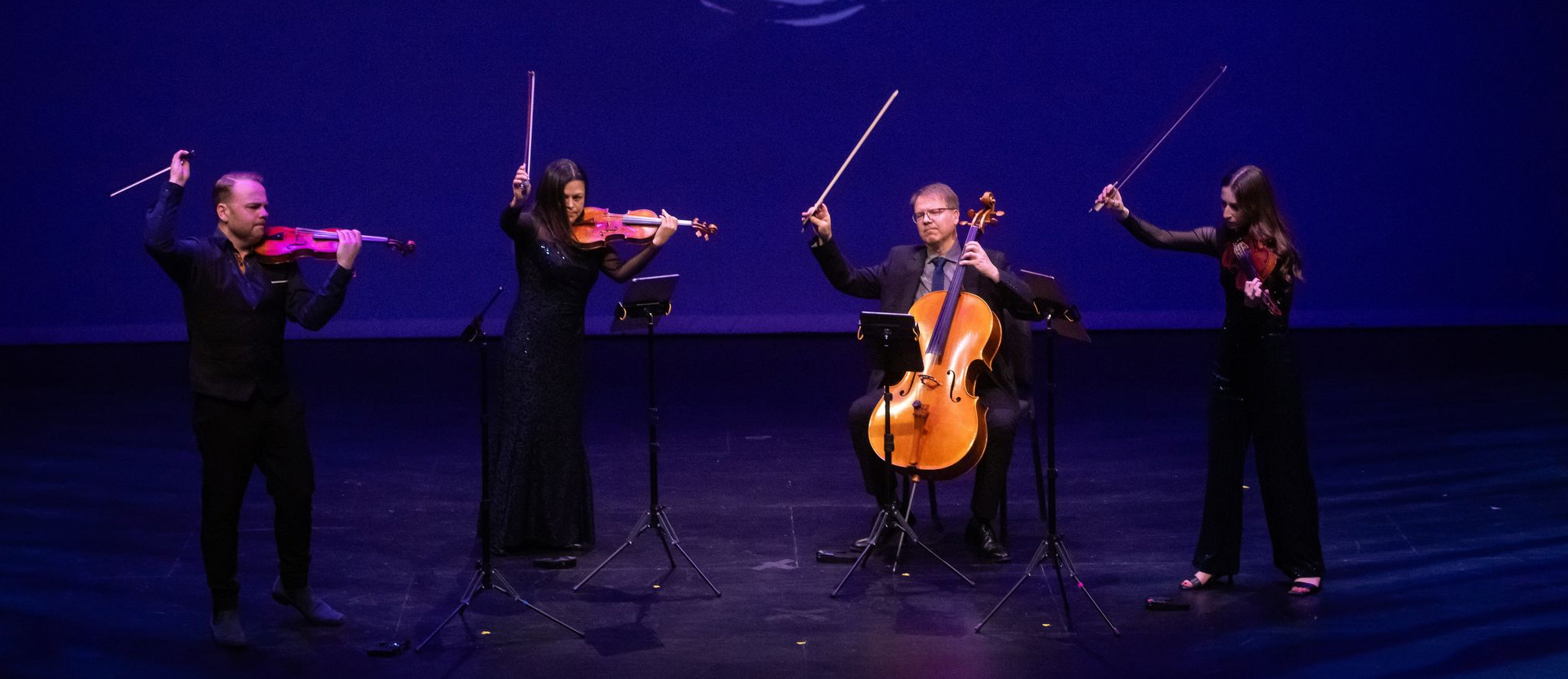
Apollo Chamber Players: Matthew J. Detrick, violin; Anabel Ramirez, violin; Matthew Dudzik, cello; and Aria Cheregosha, viola. Photo by Lynn Lane.
In keeping with the chapel’s season-long programming theme—”We the People: Art, Faith & the Sacred Work of Democracy”—Apollo will reprise some of its past commissions illustrating the topic. And it will premiere a work saluting “Broken Obelisk,” the Barnett Newman sculpture rising from the far end of the chapel’s reflecting pond.
The art work’s circuitous path to the chapel—including a dispute over dedicating it to the memory of Martin Luther King Jr.—is not only a Houston story, but it resonates “in the larger national conversation on civil rights, on where we are today, on current political challenges,” Detrick says. The musical portrait will be Apollo’s second new work by jazz composer and vibraphonist Jalen Baker: “He’s from the Third Ward, he’s trained in Houston, he’s touring the world. Really amazing,” Detrick adds.
Two composers’ musical reflections—one work a classic, the other a premiere—will dominate the final concert (May 28). Beethoven’s Quartet in F major, Op. 135, dating from the year before his death, unleashes an explosion of dissonance marked in the score with the words “Must it be?” But optimism prevails.

Beyond its main series, Apollo’s schedule includes its annual holiday program (Dec. 19), an MLK concert (Jan. 16) and other performances across the city. And the group will return to the Czech Center Museum Houston for its 10th annual visit. The bill of fare includes Antonin Dvořák’s Quartet No. 13, written after the composer returned home from his 1890s stint teaching in the United States. “It’s a wonderful piece we’ve never performed,” Detrick says. “We’ve been wanting to do it for a long time.”
—STEVEN BROWN