

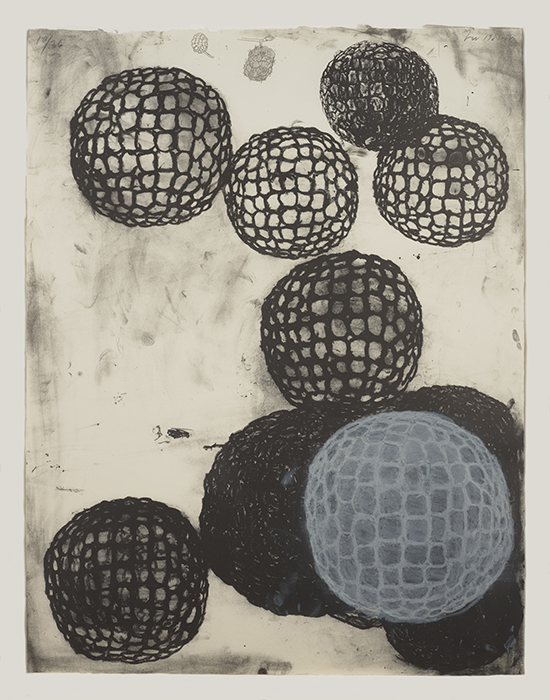
A cluster of rounded forms gathers on a sheet of paper. They press against one another, suggesting cells dividing, a seed head swelling, something small seen close enough to become a world. Elsewhere, circles overlap and accumulate, their repeated contours opening passages through an apparently flat surface. There is something familiar in these shapes, though familiarity offers little certainty. What first appears to be a body might become a constellation. What seems solid begins to loosen.

Terry Winters: Vitalized Geometry, on view at the Menil Collection through April 4, 2027, brings together 44 prints and works on paper that explore this unsettled territory. Organized in close consultation with the artist by Sophie Asakura, Curatorial Associate at the Menil, the exhibition spans work from the early 1980s to his 2024 portfolio Azimuth. Across these decades, Winters draws from the structures of nature and the systems people devise to understand them: biological diagrams, mathematical knots, astronomical charts, and digital networks.
“There are shifts, certainly, but all of the work looks into this same space,” Asakura said. “It’s different paths of this same mountain. That central concern for Terry is the same across all media.”
The exhibition celebrates two groups of gifts that have expanded the museum’s holdings. In 2024, photographer Jack Shear and the estate of his late husband, Ellsworth Kelly, gave the Menil 51 works by Winters. The artist followed with a gift in 2026 that included Azimuth, the painting Round (2022), and the lithograph Red Stone (2019). Together, these gifts allow the museum to consider printmaking as an essential part of a practice whose ideas move continually between drawing, painting, and the graphic studio.
These early works began with an interest in biology at a microscopic scale, though, as Asakura explained, their sources do not determine what the finished images depict. A diagram might provide the initial architecture, but the work develops through the artist’s decisions about marks, materials, and space. What emerges carries the suggestion of life without settling into an illustration of it.
That distinction becomes more consequential as Winters’s sources expand. Mathematical and computational structures might seem distant from the organic clusters of the Morula prints, yet they offer another means of approaching the same mystery. Each system makes something visible while leaving something beyond its reach. A chart describes a relationship; it cannot exhaust the world that relationship belongs to.
For Winters, printmaking offers its own set of possibilities and limits. Asakura cautioned against treating his prints as a single category, since lithography, woodcut, screenprinting, and engraving each introduce different ways of developing an image.
“Reproducibility for Terry is not the point of printmaking,” she explained.
The edition follows the image. What matters first is what the process allows him to discover. Lithography is particularly revealing in this regard. Its surface accepts marks that can retain the apparent immediacy of drawing, while successive layers allow Winters to construct an image over time. Asakura described his first print portfolio, Folio (1985–86), as requiring more than 100 lithographic stones. The labor behind those sheets complicates their resemblance to spontaneous drawings: a mark may appear immediate even as the space surrounding it has been painstakingly assembled.
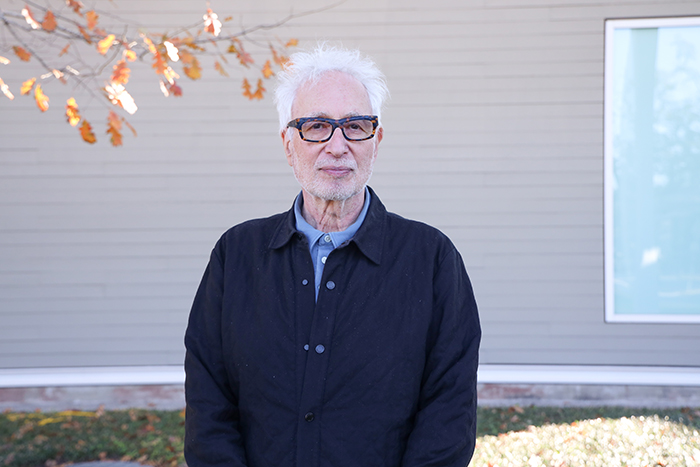
1 ⁄7
Terry Winters at the Menil Collection, Houston. Photo: Sarah Hobson
2 ⁄7
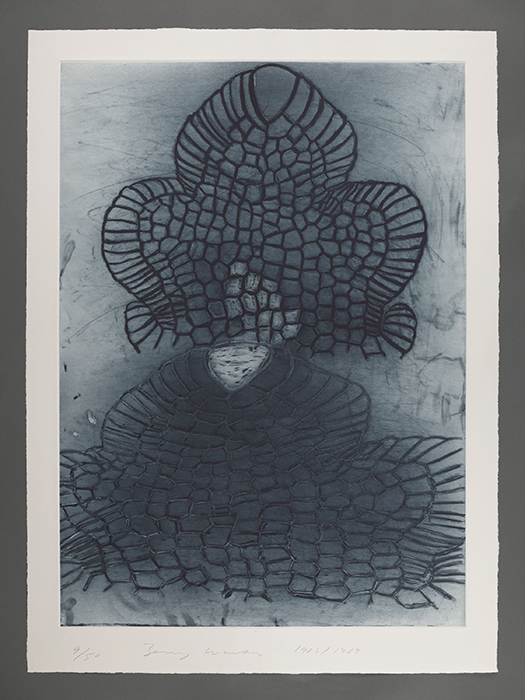
Terry Winters, Novalis, 1983–89. Etching and aquatint, 42 1/2 × 31 in. (108 × 78.7 cm). The Menil Collection, Houston, Gift of Jack Shear. © Terry Winters. Photo: Caroline Philippone
3 ⁄7
Terry Winters, Morula III, 1983–84. Lithograph, 42 × 32 1/2 in. (106.7 × 82.6 cm). The Menil Collection, Houston. Gift of Jack Shear. © Terry Winters. Photo: Caroline Philippone
4 ⁄7
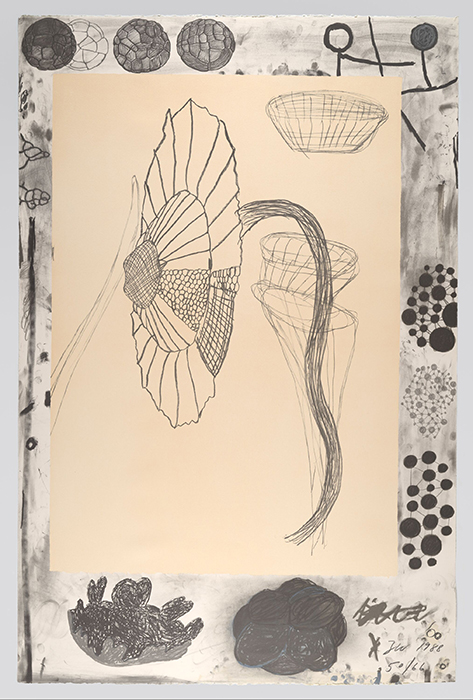
Terry Winters, Marginalia, 1988. Lithograph, 48 × 31 ½ in. (121.9 × 78.7 cm). The Menil Collection, Houston, Gift of Jack Shear. © Terry Winters. Photo: James Craven
5 ⁄7
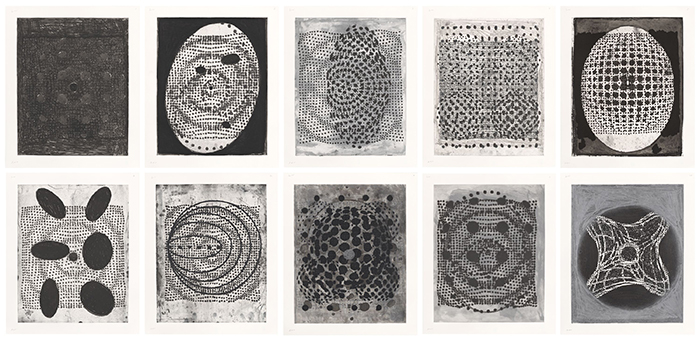
Terry Winters, Azimuth, 2024. Etching and engraving 23 1/4 × 19 1/4 in. (59.1 × 48.9 cm) (each). The Menil Collection, Houston, Gift of the artist. © Terry Winters. Photo: Courtesy of Two Palms
6 ⁄7
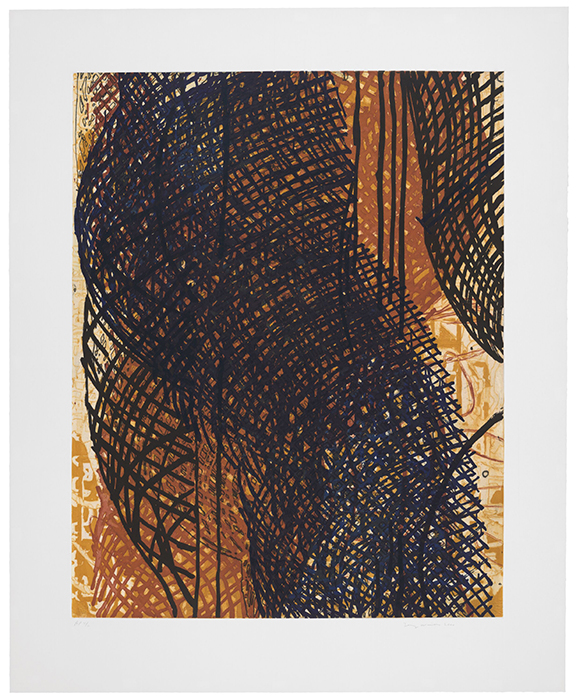
Terry Winters, Amplitude, 2000. Aquatint and etching, 53 3/8 × 43 1/2 in. (135.6 × 110.5 cm). The Menil Collection, Houston, Gift of the artist. © Terry Winters. Photo: Courtesy of Universal Limited Art Editions (ULAE)
7 ⁄7
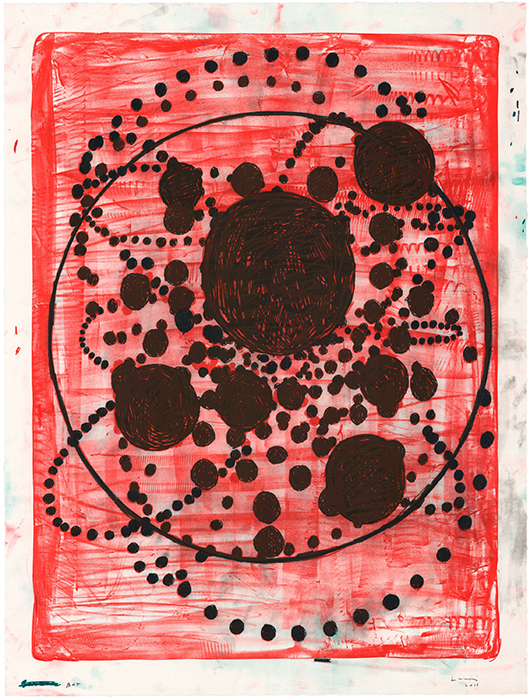
Terry Winters, Red Stone, 2019. Lithograph, 51 3/4 × 39 in. (131.4 × 99.1 cm). The Menil Collection, Houston, Gift of the artist. © Terry Winters. Photo: Courtesy of Universal Limited Art Editions (ULAE)
“The mark is related to drawing, but the archaeology or the architecture of the image is related to painting,” Asakura said.
That architecture gives the prints a sense of depth beyond the arrangement of recognizable shapes. A line can establish an edge, then disappear into a field of other marks. Layers carry the history of the image’s construction, even when that history is difficult to separate by eye. Looking becomes a kind of excavation, a search through the surface for the decisions that brought it into being.
In Furrows (1989), Winters made the material itself part of this construction. He printed an uncarved oak block to establish a field of wood grain, then overprinted a central image carved into mahogany, turning the direction of the grain 90 degrees. The resulting woodcuts bring two structures into contact: the growth recorded in the wood and the form introduced by the artist.
Here, nature is present in the physical substance of the work as well as in its associations. The grain supplies a rhythm that the image must inhabit. Winters’s sensitivity to materials allows the process to participate in what the work becomes.
This exchange between mediums continues in Round and Azimuth 8 (2024). Both use an arrangement of overlapping circles that suggests interlocking spheres. In Round, the composition develops through magenta and azure oil paint on paper; in Azimuth 8, etching and engraving carry it into black and silver ink. The shared structure makes their differences more apparent, offering two ways to experience the space those circles generate.
Asakura noted that the painting and the Azimuth prints followed a drawing series. An idea moves through these works without reaching a definitive version. Each medium opens another direction, allowing the composition to acquire a different weight, atmosphere, or sense of movement.
This uncertainty can be demanding. Winters’s forms offer entry points, but they rarely reward looking with a stable identification. Their scientific sources might encourage a search for an explanation when the work asks for sustained attention to something less conclusive.
“For me, the great honor would be that someone really invests in a work rather than coming away with a lesson,” Asakura said. “There’s so much in each of these works of art in terms of material, in terms of space, in terms of the kind of spiritual sensibility. And I think they’re each worth a real deep dive.”
A cluster remains a cluster. Ink remains on paper. Yet a little time can change the distance between those materials and the life we sense within them. We follow a line, return to a swelling form, find an opening where a moment ago there seemed to be an edge. The image stays still while our understanding moves through it.
—MICHAEL McFADDEN