
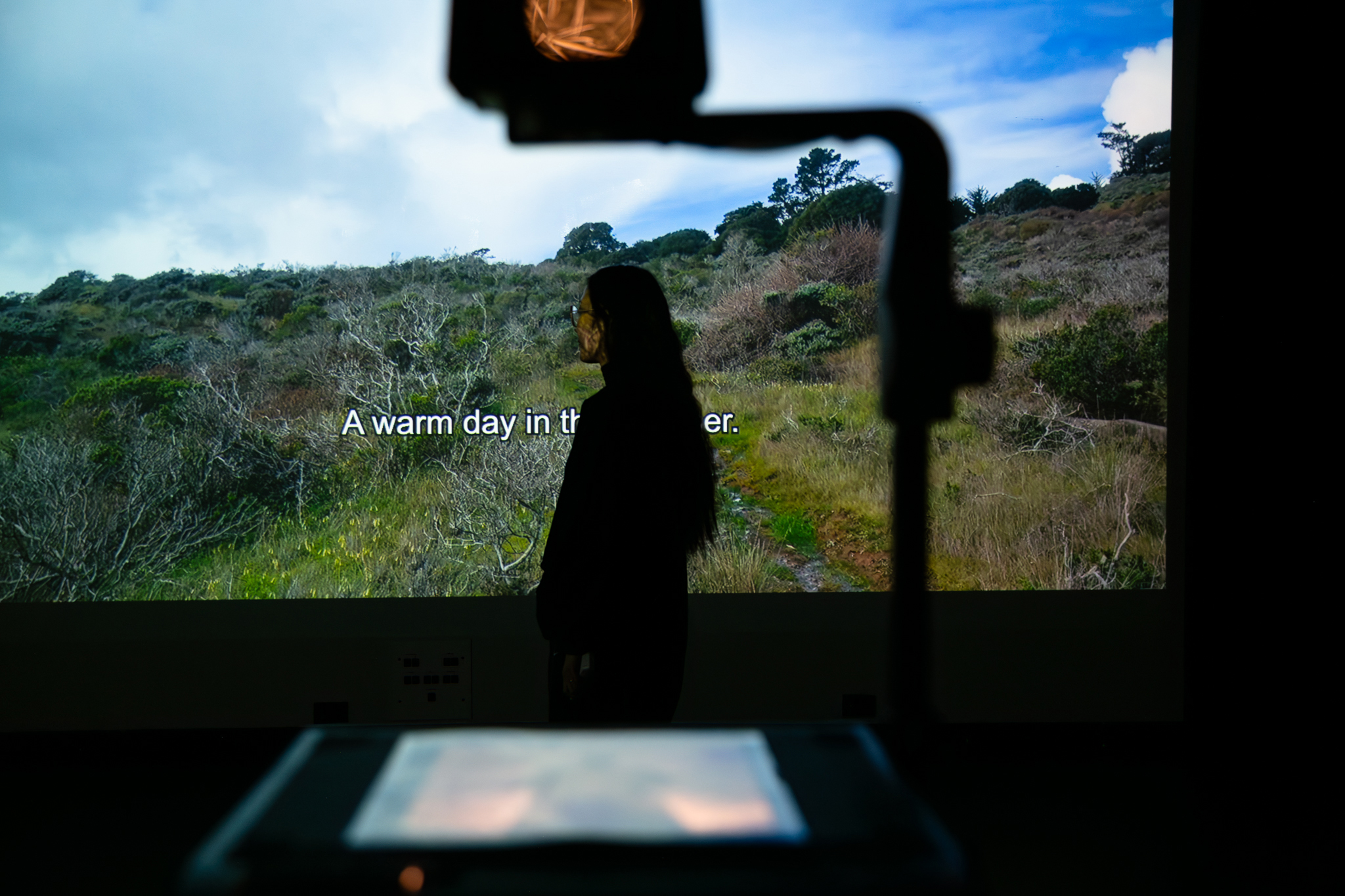

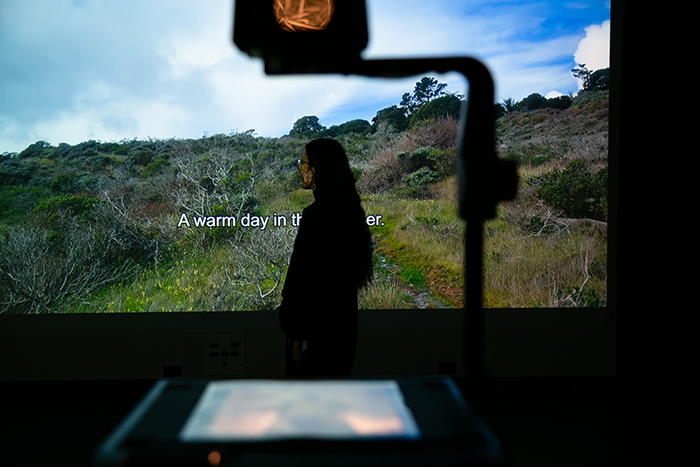
The black box theater at DiverseWorks’ MATCHBOX 1 is dark except for four massive video projections—twelve feet tall, twenty feet wide—filling each wall. North, South, East, West. The only sound is ambient: wind moving through brush, footsteps crunching gravel, birds calling, and beneath it all, something I don’t immediately recognize. The room is cool, maybe thirty feet square, and at its center sits an overhead projector on a waist-high pedestal, its analog light barely visible—six small LED tap lights tucked inside the lamp box casting a warm glow through a transparency. A downward-angled photograph printed in monochrome: a human silhouette, head to calf, cast across grass.

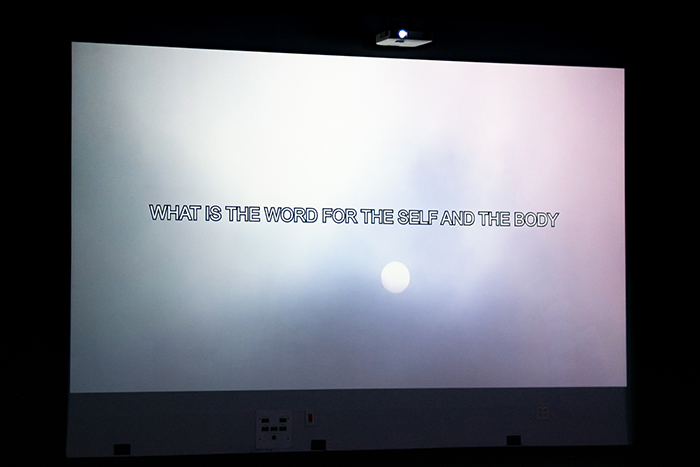
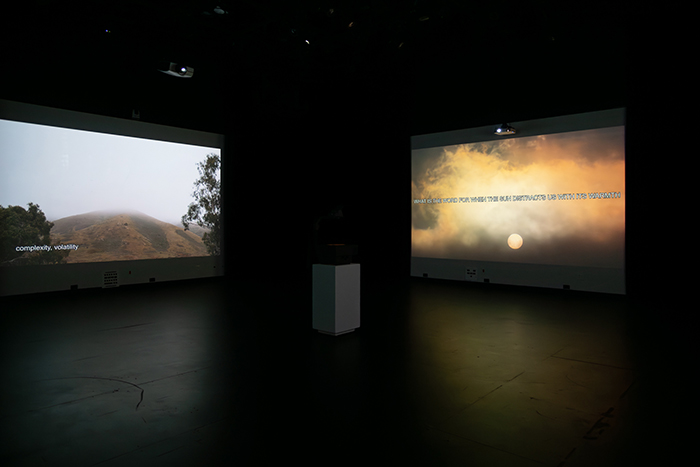
On the front wall, a dim sun hovers behind fast-moving misty clouds, neither rising nor setting, held outside time. Questions appear over it in white text, no punctuation. On the right, a sideways view: someone walking, scenery passing right to left, moving forward and backward simultaneously. Four-line poems run in multiple directions—bottom to top, top to bottom, radiating from corners. The back wall shows an uphill trail through scrubby brush and gray rock, the camera moving steadily forward though no figure appears. The left wall holds a single static image: an olive-green mountain, handheld camera barely drifting, mostly centered.
Other visitors cluster uncertainly in the middle of the room before settling into a partially arranged seating area—five rows of chairs flanking a central aisle, all facing north. I don’t sit. I move to the corners, then back to center, trying to understand the spatial logic. The overhead projector isn’t projecting—its warm internal glow illuminates the transparency but doesn’t reach the wall. It’s a sculptural presence, a lighthouse without enough power to send its beam across the room.
And that sound I couldn’t identify at first: distant waves crashing against shore, conjuring Angel Island in a Houston black box theater.
1 ⁄4
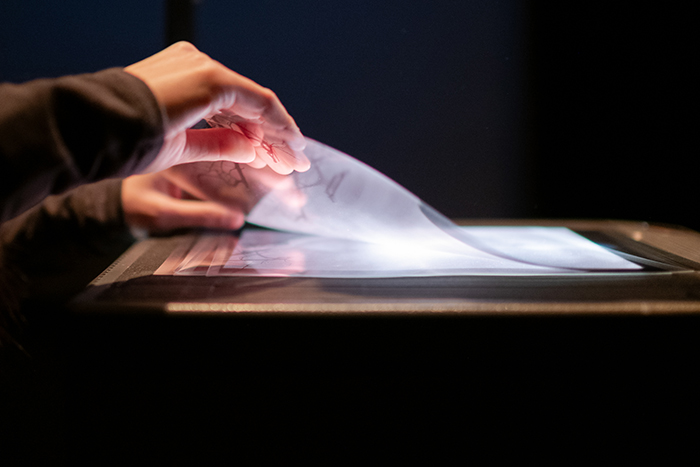
Hong Hong, “心 (Heart)”, 2026. Photo: Tati Vice. Courtesy of DiverseWorks and the artist.
2 ⁄4
Hong Hong, Image Stills from North, South, East, West, 2025-2026. Photo: Tati Vice. Courtesy of DiverseWorks and the artist.
3 ⁄4
Hong Hong, Installation View: The Past Does Not Need You, But It Borrows Your Mouth, DiverseWorks, March 17-18, 2026. Walls: North, South, East, West, 2025-26, Center: “心 (Heart)” (2026). Photo: Tati Vice. Courtesy of DiverseWorks and the artist.
4 ⁄4
Hong Hong, Installation View: The Past Does Not Need You, But It Borrows Your Mouth, DiverseWorks, March 17-18, 2026. Walls: North, South, East, West, 2025-26, Center: “心 (Heart)” (2026). Photo: Tati Vice. Courtesy of DiverseWorks and the artist.
Hong Hong’s The Past Does Not Need You, But It Borrows Your Mouth (March 17-18, 2026), extends from months of durational performance on Angel Island, the San Francisco Bay immigration detention site where Chinese immigrants were interrogated and imprisoned under the Chinese Exclusion Act from 1910 to 1940. Detainees carved poems into the wooden barracks walls—fragmentary testimony that survives when official records obscured or erased their presence entirely. Hong Hong walked the island’s perimeter repeatedly, circumambulating the site as both research methodology and embodied reclamation. The resulting work, commissioned by DiverseWorks and supported by a Guggenheim Fellowship, offers dual formats: daytime installation visitors navigate at their own pace, and premier evening performance that condenses months of walking into thirty minutes of manual image-making. I’m here for both.
I spend the first thirty minutes moving between screens, taking inventory. The right screen shows a lateral strafing view, scenery passing as someone walks. The back screen climbs uphill steadily. The left screen holds mostly still: an olive-green mountain, handheld camera barely drifting. It anchors the space, contrasting with the kinetic opposite wall. Poems appear and disappear across all four screens—four lines at a time, sometimes reading top-to-bottom, sometimes bottom-to-top, sometimes radiating clockwise from the corners. When I try reading them in reverse, they still make sense. That can’t be accidental.
Around minute thirty, seats begin to fill for the evening performance. I’m deaf in my right ear, so I choose the aisle seat just right of the overhead projector—good ear toward where the artist will stand, clear view of both action and projection. The room feels like a quiet nature setting. I let the sound wash over me—wind, footsteps on gravel, birds, and beneath it all that white noise I still can’t quite identify.
The front screen keeps pulling my attention. The sun wobbles behind fast-moving clouds, neither rising nor setting, held outside time. Text appears over it in all caps, no punctuation: WHAT IS THE WORD FOR WHEN THE SUN DISTRACTS US WITH ITS WARMTH. Then: WHAT IS THE WORD FOR UNSPEAKABLE MIRACLES. Then: WHAT IS THE WORD FOR EXCRUCIATING YEARNING. The questions address me directly, a narrator outside time. The poems on the other screens whisper in lowercase, reversible, appearing in stillness and motion—voices transmitting from detention to this black box theater.

Then Hong Hong emerges from the darkness at the back of the room. Her energy is stoic, focused. She doesn’t acknowledge the audience. She approaches the overhead projector, and a dim downlight slowly illuminates her head and shoulders. The movements feel ritualistic—deliberate, unhurried. She removes the pre-show transparency, the photographed silhouette on grass. Opens the projector housing. Removes the LED tap lights one by one. The setup takes about a minute. The only sounds are footsteps on gravel and distant waves, the mechanical opening and closing of the projector box, then the spring-resist power button clicking on.
The overhead projector’s lamp turns on. A bright rectangle of warm light hits the north wall like sunlight through a window. Hong Hong places the first transparency: a misty sun behind fast-moving clouds. Then two tint sheets, darkening the image. A waning crescent moon appears. Another slide of the same moon. Two more tints. Tree branches enter at the top of the frame. Another slide, same branches. More tints layering. Then, about sixteen slides in, a high-contrast photograph of the back of a left hand—black on transparent background, details of knuckles and tendons visible. She continues adding tints over it. The hand remains visible beneath the accumulating layers, blocking the celestial light even as night falls over it. More tints. Eventually, total black.
She reverses. Thirty transparencies removed, one by one, revealing the hand again as she works backward through night into day. Then forward again—thirty slides building into a second night. Then backward once more—thirty slides returning to sun. The pacing is steady, deliberate. You can hear the transparency sheets sliding across glass, her fingers occasionally visible as silhouettes at the projection’s edge. The ritual of manual time-making unfolds: day and night compressed into minutes, the impossibility of representing two years made visible through repetition.

After the downlight fades and Hong Hong retreats, she walks back to the front of the theater. A DiverseWorks staff member introduces her. “Thanks everyone for coming,” she says, then asks, almost uncertainly, “Am I supposed to say anything?” She proceeds to explain: the performance references day-night cycles. The poems in the videos are meant to be read in any direction. Her ideal would be to replicate the full duration—approximately two years, the longest anyone was detained on Angel Island. She acknowledges this is impossible. The math alone is prohibitive: 17,532 hours compressed into thirty-minute performances would require nearly 585 hours of continuous manual transparency work. No performance duration could replicate detention’s temporal reality—the work acknowledges this gap rather than attempting to bridge it.
The gap between the artist’s stated intention and my experience of the work isn’t a failure—it’s where the meaning lives. She told me what she made. I encountered what it became in that black box theater over ninety minutes on a specific night with specific strangers breathing the same manufactured island air. The carved Angel Island poems survive because they were never meant to be complete explanations. They’re fragments, reversible, readable from multiple directions precisely because official records tried to foreclose meaning. Hong Hong’s dual structure does the same thing: it offers two incomplete modes of encounter, neither sufficient on its own, both necessary. The installation lets you lose yourself in duration. The performance makes duration countable, mechanical, impossible. Together they don’t resolve—they expose what can’t be resolved.
Shadows appear throughout this work because shadows are what remain when official records fail. The carved Angel Island poems are shadows of hands laboring against wood, leaving traces when institutional documentation tried to erase Chinese presence entirely. The photographed silhouette on the overhead projector—shadow of a body cast across grass. My own shadow merging with the walking videos when I moved through the installation space—present witness temporarily overlapping with documented past. Hong Hong’s hands visible at the edges of the projected light during performance—ephemeral silhouettes creating and destroying celestial time. And that hand transparency, the back of a left hand blocking sun and moon alike, black on clear, seen from the perspective of the person raising it. All of them insist: I was there. I am here. We exist in time even when institutional memory denies us.
The work’s power isn’t in successfully representing two years of detention—an impossible task Hong Hong names directly. Instead, it offers two different modes of failing. The installation immerses you in ambient duration where time becomes unmeasurable, closer to the months she spent walking Angel Island’s perimeter than to any discrete historical period. The performance compresses that duration into countable units, 121 manual transparency manipulations that make visible the absurdity of trying to contain historical trauma in gallery hours. Digital video gives way to analog projection. Seamless loops become discrete slides. Immersion becomes demonstration. Neither format captures what it references, but together they reveal something more urgent: the gap between archive and embodiment, between what can be documented and what must be physically transmitted through repeated action, through bodies in space, through voices borrowing our mouths to speak across time we can measure but never truly represent.
—JONATHAN HOPSON