
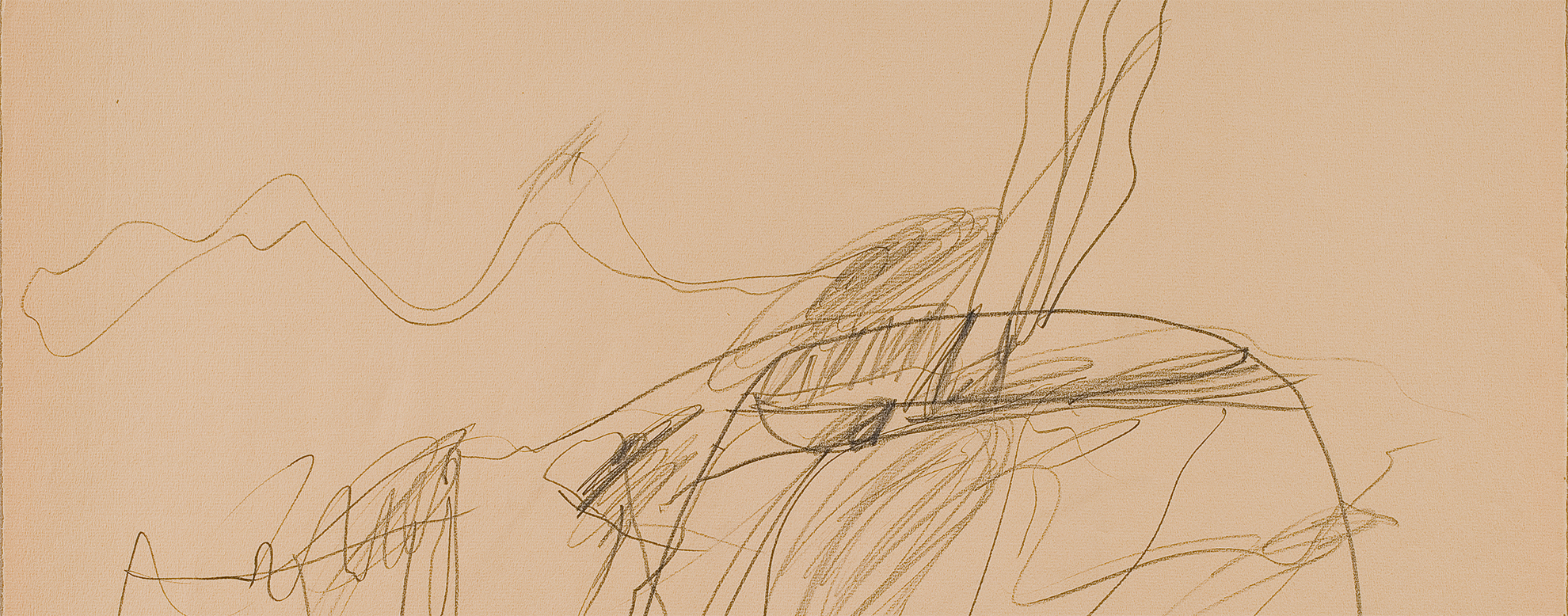

There is a moment, standing before a work by Cy Twombly, when language begins to loosen. A line trembles, repeats, dissolves into a field of gesture. A word emerges, half-formed, then retreats into the surface. The page does not present an image so much as it stages an encounter, between writing and drawing, memory and mark, the ancient and the immediate. It is less an object than an atmosphere, one that asks the viewer to linger, to read, to drift.

For curator Edouard Kopp, the exhibition began as both an opportunity and a necessity. “Typically we plan exhibitions three to five years in advance,” he explained. “And we received this gift a few months ago. We didn’t want to wait too long to at least signal the gift. So this exhibition is really our way to show to the world that we received, and Houston in a way received, this massive gift.”
That urgency shapes the exhibition’s structure. Rather than attempt a comprehensive display of the more than one hundred works now in the Menil’s collection, Kopp distilled the presentation to its essentials.
“We decided to focus on some of the high-quality pieces, but also what we wanted to do was to show the range of Twombly’s mark making,” he said. “It’s my belief that he’s one of the most consequential draftsmen of the 20th century. One of his claims to fame is the incredibly innovative approach to mark making. Another thing that he really deserves praise for is his deep exploration of the relationship between drawing and writing.”
1 ⁄7
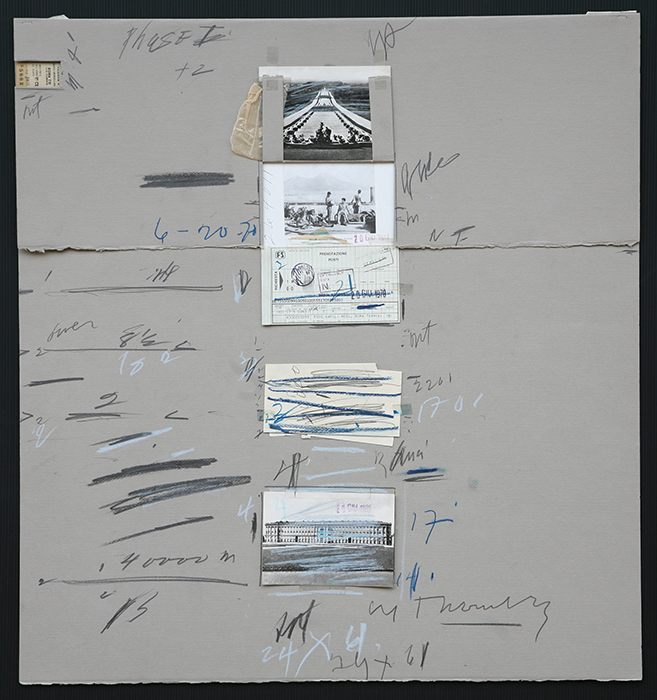
Cy Twombly, Untitled, 1970. Collage of postcards, tickets, and tape, with wax crayon, graphite, and ink on paper, 29 1/2 × 27 5/8 in. (75 × 70.1 cm). The Menil Collection, Houston, Gift of the Cy Twombly Foundation. © Cy Twombly Foundation
2 ⁄7
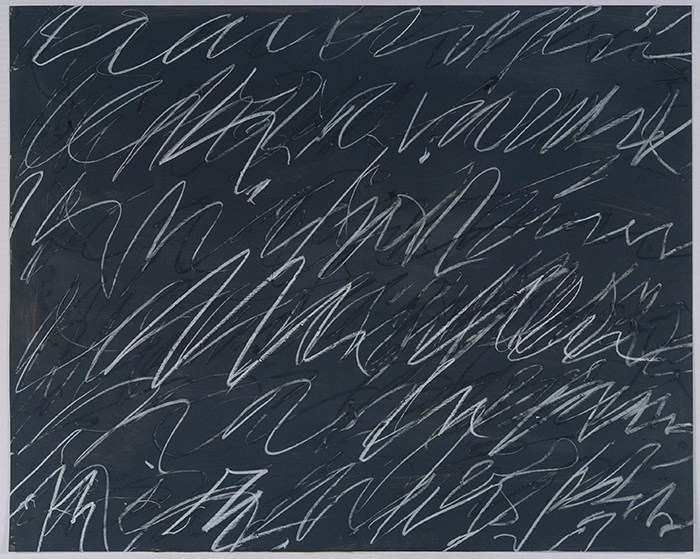
Cy Twombly, Untitled, 1970. Oil and wax crayon on paper, 27 1/2 × 34 1/2 in. (69.9 × 87.6 cm). The Menil Collection, Houston, Gift of the Cy Twombly Foundation. © Cy Twombly Foundation
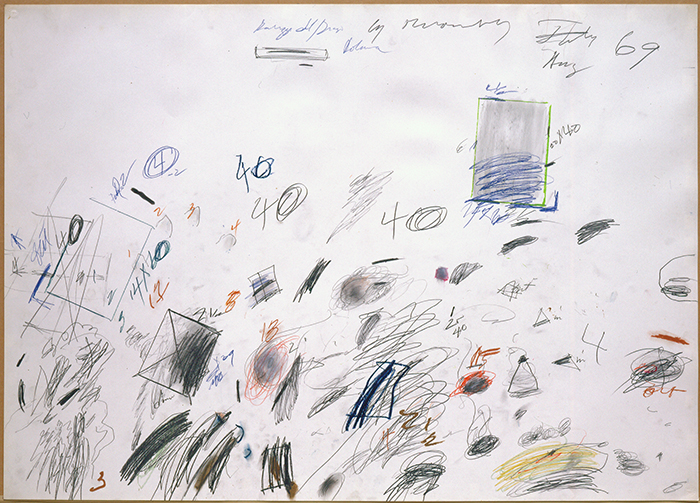
3 ⁄7
Cy Twombly, Untitled, 1969. Graphite, wax crayon, colored pencil, and felt-tip pen on paper, 28 1/2 × 40 in. (72.4 × 101.6 cm). The Menil Collection, Houston, Gift of the Cy Twombly Foundation. © Cy Twombly Foundation
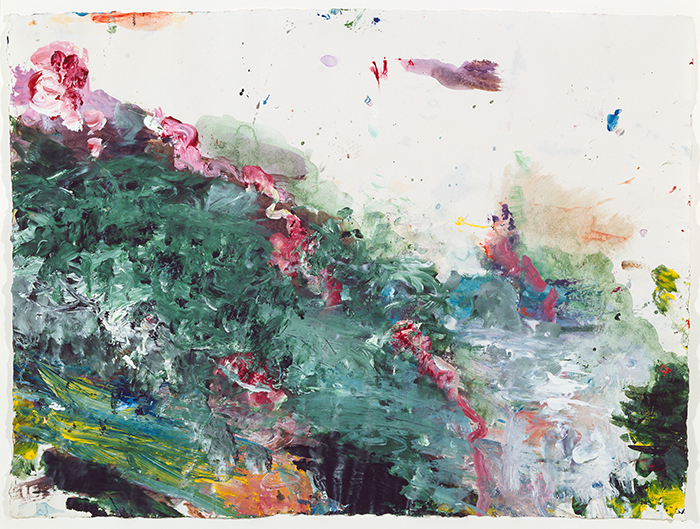
4 ⁄7
Cy Twombly, Untitled, 1986. Acrylic and oil on handmade paper, 21 × 28 in. (53.3 × 71.1 cm). The Menil Collection, Houston, Gift of the Cy Twombly Foundation. © Cy Twombly Foundation
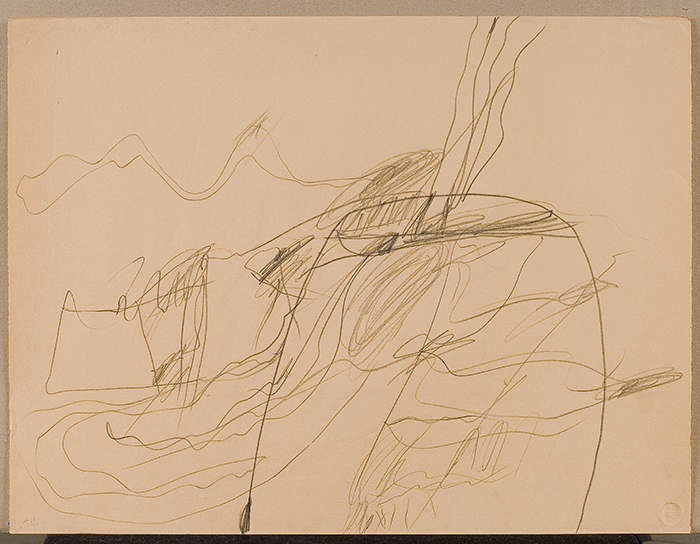
5 ⁄7
Cy Twombly, Untitled, 1954. Graphite on paper, 19 × 25 1/8 in. (48.3 × 63.8 cm). The Menil Collection, Houston, Gift of the Cy Twombly Foundation. © Cy Twombly Foundation
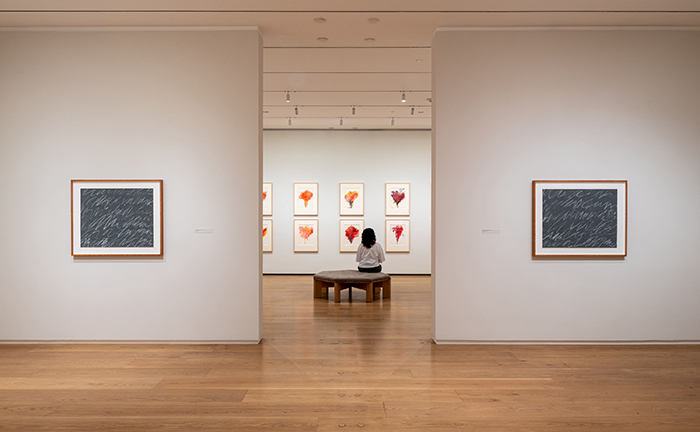
6/7
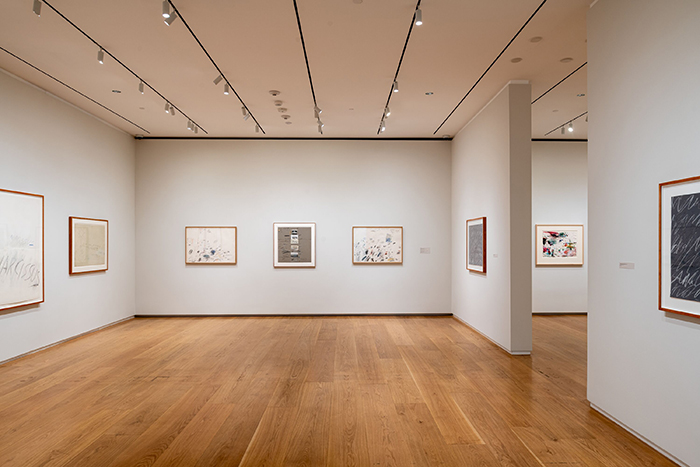
The Gift of Drawing: Cy Twombly at The Menil Drawing Institute, installation view. Courtesy of The Menil Collection. Curated by Edouard Kopp, John R. Eckel, Jr. Foundation Chief Curator, Menil Drawing Institute. March 27–August 9, 2026.
7 ⁄7
The Gift of Drawing: Cy Twombly is curated by Edouard Kopp, John R. Eckel, Jr. Foundation Chief Curator, Menil Drawing Institute.
That relationship unfolds across the exhibition’s two primary rooms. In the first, the works lean toward the graphic: looping lines, hesitant scratches, and what Kopp describes as “blind drawings,” made without looking. These works carry a sense of searching, as if the hand moves ahead of thought, or perhaps alongside it.
“It’s an art of mark making, but also the process of discovery,” Kopp said. “He’s trying to grapple with an idea that he may have in his mind’s eye, but without the ability of seeing what he does. There are other drawings where he draws with the lights on, but where he’s really trying to come up with a kind of new form of language on a sheet of paper that doesn’t necessarily exist.”
That idea of drawing as a form of discovery rather than execution sits at the core of Twombly’s practice. Trained in both classical and experimental settings, from the School of the Museum of Fine Arts in Boston to Black Mountain College, Twombly absorbed a wide range of influences before turning toward a more intuitive, exploratory mode.
“I think he’s really trying to unlearn what he’s learned or tap into other ways of making drawing,” Kopp reflected. “The idea of discovery is exploration, but also discovery. These notions are very, very important, even more than creation and control. And the act of discovery is not just his own; it becomes ours. He lets us in, but without any sense of resolution.”
This openness extends to the viewer, who is invited to participate in the work’s unfolding. Twombly offers fragments, names, references, gestures, but rarely resolves them into a fixed meaning. Instead, the drawings operate as fields of possibility, where interpretation remains fluid.
“He gives us cues, but hardly resolved notions,” Kopp said. “He may give you a word, may quote through a collage, an image of part of his life in Rome or Naples. He creates this field of illusions, and he wants to let us in and have a part in it.”
“Some of these works actually are arguably paintings on paper,” Kopp noted. “He applies a lot of acrylic paint, partially with his own fingers directly on the sheet. The paper becomes a three-dimensional object, a wavy sheet that exists in space.”
This material transformation underscores Twombly’s refusal to adhere to medium-specific boundaries. Drawing, in his hands, becomes expansive, capable of absorbing gesture, text, and pigment into a single, unstable surface.
At the same time, the works remain deeply rooted in history. Classical antiquity, with its myths, poets, and ruins, threads through the exhibition, not as illustration, but as a layered presence. In Virgil, for instance, the poet’s name appears and reappears, partially obscured by paint, inscribed into and over the surface.
“He’s interested in the lost world of antiquity and how we understand it in fragmented, layered ways,” Kopp said. “When you’re in Rome, you see the modern metropolis, but also remnants of ancient Rome. You get a sense of the layers in between. Some of his drawings are built exactly in that way. He’s creating a kind of contemporary ancient work.”
For Twombly, history is not distant. It is immediate, almost tactile. “He said, for me, all historical art is virtually contemporary,” Kopp recalled. “There’s historical time, but in the way we experience these works, there’s almost a way to collapse these two times. There’s a remarkable freshness and curiosity.”
That collapse of time mirrors the exhibition’s own position within the Menil’s collection. Before the recent gift, the museum held a modest group of Twombly drawings. Now, the scope has expanded dramatically, allowing for a more complete understanding of his practice.

That sense of joy, of freedom even, lingers in the exhibition’s quieter moments. A looping line, a repeated name, a surface worn and reworked. Each gesture carries a trace of the artist’s hand, but also an invitation to follow it, to read it, to enter its rhythm.
“I would invite visitors to marvel at the incredible free spirit of his mark making,” Kopp said. “The drawings can be inviting to think that every time we write a word, we also draw. It’s about thinking about the boundary between drawing and writing.”
In Twombly’s world, that boundary never settles. It flickers, shifts, dissolves, leaving behind a space where language becomes image, and image becomes something like memory.
—MICHAEL McFADDEN