

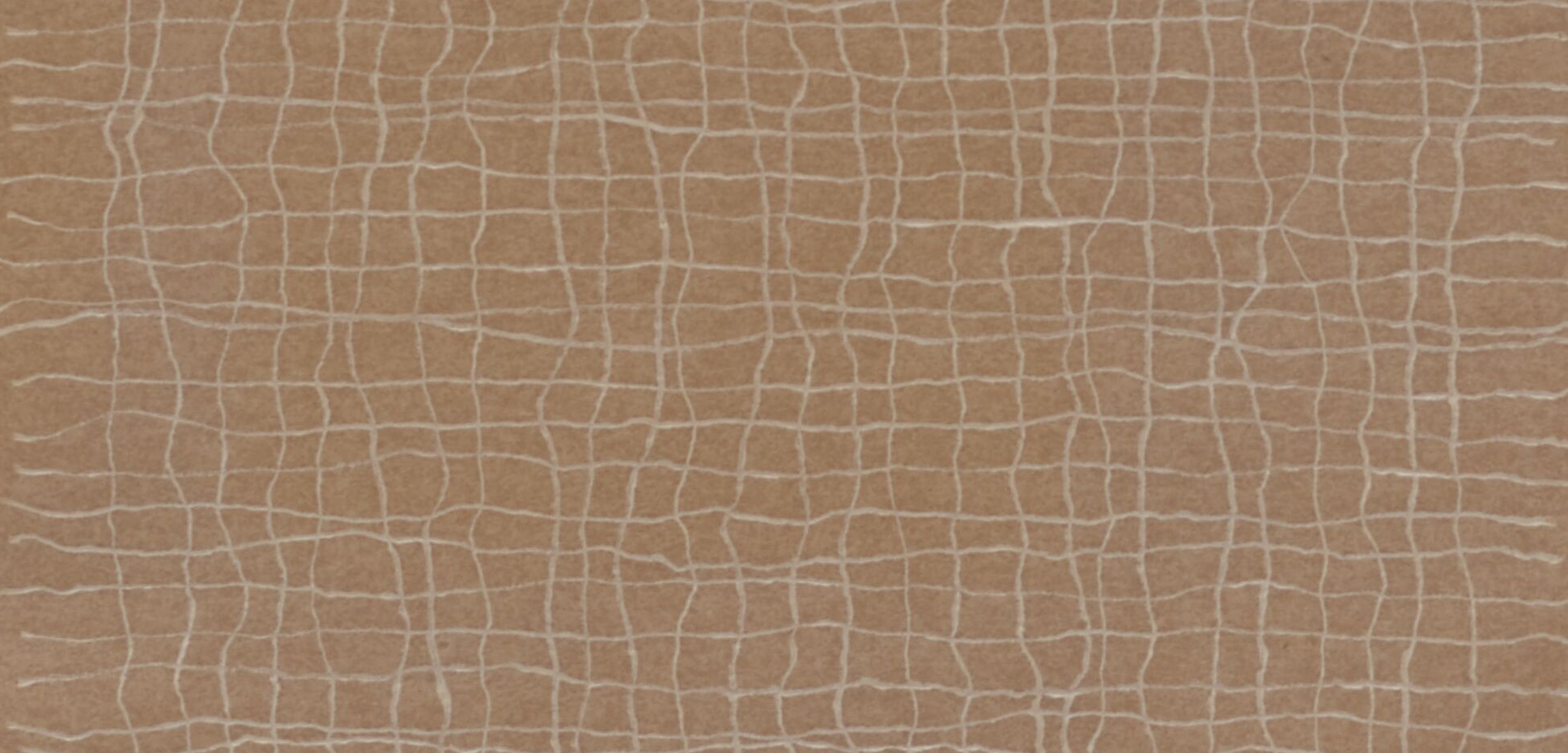

A needle passes through a sheet of paper and leaves behind a wound no wider than its point. Light catches along the raised fibers. Repeated hundreds of times, these punctures gather into a composition: marks made not by adding material to the surface, but by breaking through it.

Fragility, on view at the Menil Drawing Institute from Sept. 10, 2026, through Jan. 24, 2027, considers paper as more than a passive surface for an image. Curated by Kelly Montana, the exhibition instead approaches it as a material with its own physical properties, histories, and contradictions.
“What started to strike me over multiple research projects was noticing a pattern or similarity in how artists would talk about their work with paper,” Montana explained. “There was often this juxtaposition, or artists talking about this tension or seeming dichotomy that really drew them to work with paper. It was this tension between the fragility of the media, but also its ability to withstand a lot of artistic processes.”
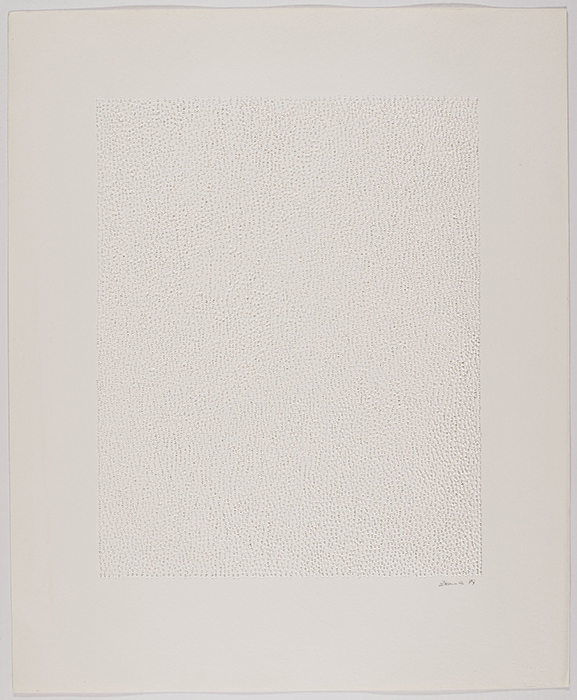
A work by Zarina provided an early foundation for Fragility. In a series created during the late 1970s, the artist pierced fine paper with a sewing needle, forming intricate patterns through hundreds of pinpricks. There are no other marks on the sheet. The punctures create subtle bursts in its surface, producing shadows without graphite, ink, or pigment.
“She’s someone who talked about paper being like skin, as fragile and resilient as the skin that holds our insides together,” Montana said. “It’s also a permeable surface. The idea for the show comes directly from her words. She’s quoted as saying paper is fragile and resilient, and that’s what drew her to work with it as the primary medium of her entire artistic practice.”
Zarina made the series after her husband’s death. She remained in her studio producing the pin drawings, turning toward isolation, concentration, and repetitive labor as part of a grieving process. Her husband had also been one of her last connections to India, her birthplace, binding personal loss to the distance of exile.
1 ⁄9
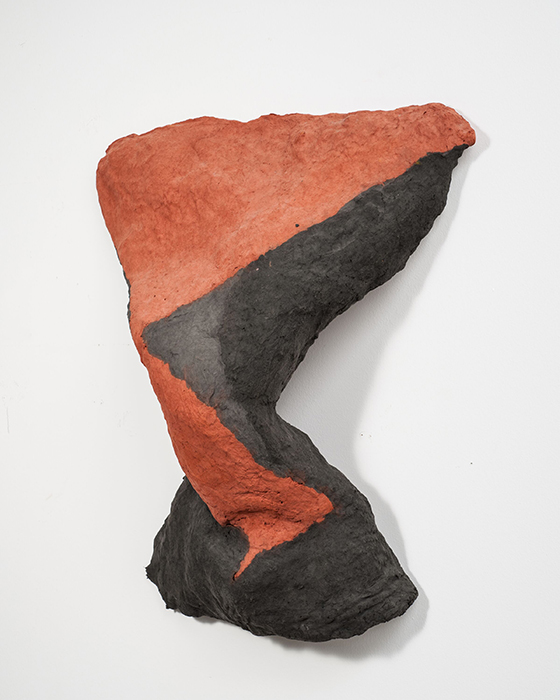
Lynda Benglis, Mold, 1979. Paper and pigment, 29 1/2 × 24 3/4 × 10 1/4 in. (74.9 × 62.9 × 26 cm). The Menil Collection, Houston, Bequest of William F. Stern. © Lynda Benglis / VAGA at Artists Rights Society (ARS), NY. Photo: Paul Hester
2 ⁄9
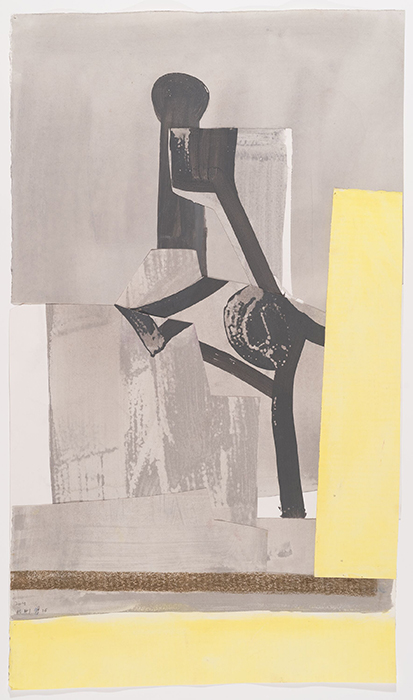
Amy Sillman, Rome #1, 2014. Pastel and gouache on collaged papers, 36 3/4 × 21 1/2 in. (93.3 × 54.6 cm). The Menil Collection, Houston, Purchased with funds provided by the John R. Eckel, Jr. Foundation. © Amy Sillman. Photo: Paul Hester
3 ⁄9
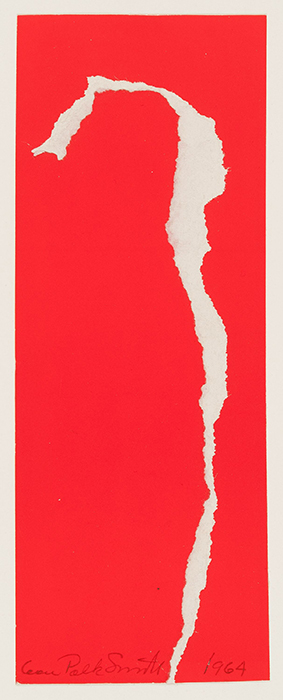
Leon Polk Smith, Untitled, 1964. Torn red paper, 8 7/16 × 3 3/16 in. (21.4 × 8.1 cm). The Menil Collection, Houston, Gift of the Leon Polk Smith Foundation. © The Leon Polk Smith Foundation/VAGA at Artists Rights Society (ARS), NY. Photo: Paul Hester
4 ⁄9
Zarina, Untitled, 1979. Pierced laminated paper, 26 1/2 × 22 in. (67.3 × 55.9 cm). The Menil Collection, Houston, Purchased in part with funds provided by Mark Wawro and Melanie Gray. © Zarina; Courtesy of the artist and Luhring Augustine, New York. Photo: Paul Hester
5 ⁄9
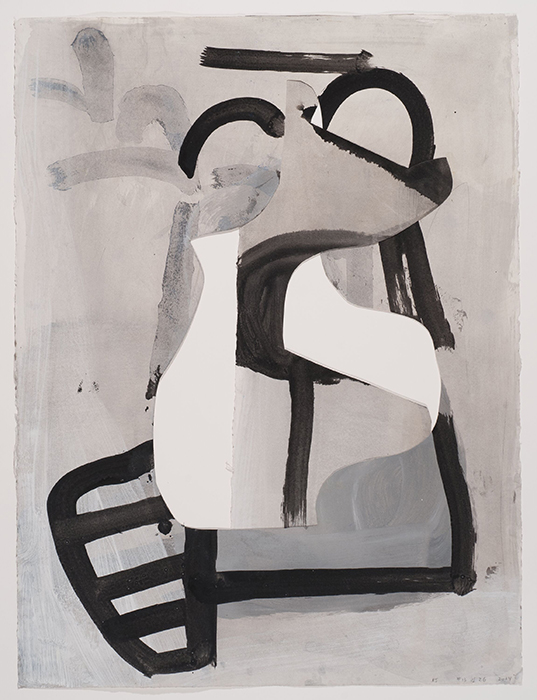
Amy Sillman, Rome #13, 2014. Gouache on collaged papers, 30 × 22 3/4 in. (76.2 × 57.8 cm). The Menil Collection, Houston, Purchased with funds provided by the John R. Eckel, Jr. Foundation. © Amy Sillman. Photo: Paul Hester
6 ⁄9
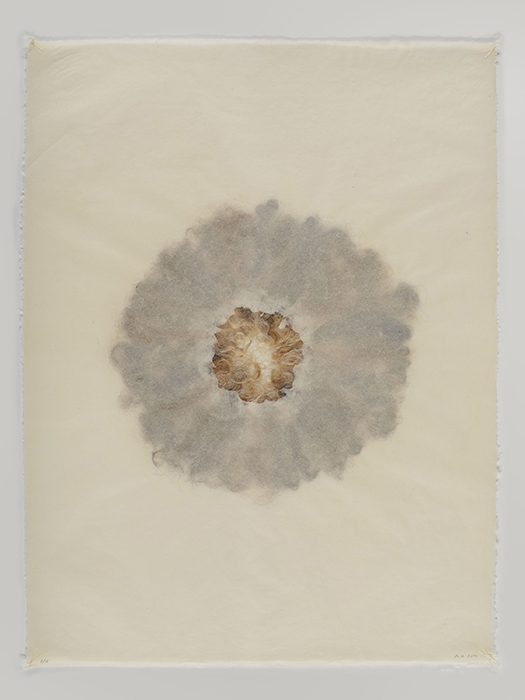
Ann Hamilton, in collaboration with Dieu Donné, poche, 2014. Paper, sheep wool, and thread, 24 × 18 in. (61 × 45.7 cm). The Menil Collection, Houston, Gift of Dieu Donné. © Ann Hamilton. Photo: Caroline Philippone
7 ⁄9
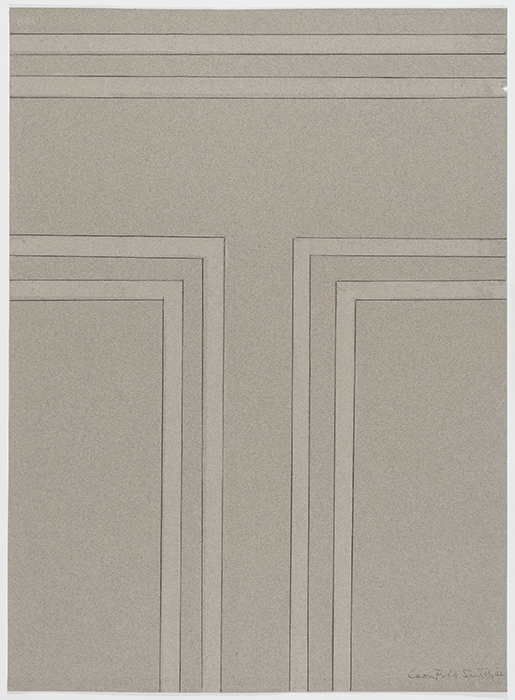
Leon Polk Smith, Untitled, 1946. Colored pencil and graphite on abraded paper, 29 5/8 × 21 5/8 in. (75.2 × 54.9 cm). The Menil Collection, Houston, Gift of the Leon Polk Smith Foundation. © The Leon Polk Smith Foundation/VAGA at Artists Rights Society (ARS), NY. Photo: Paul Hester
8 ⁄9
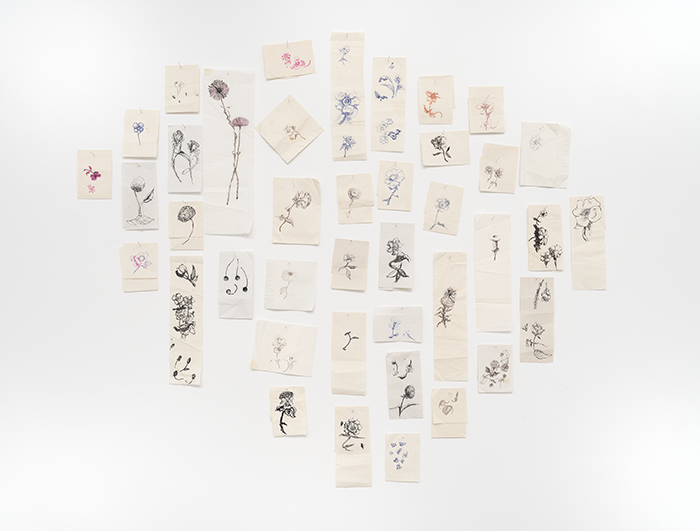
Jim Hodges, A Diary of Flowers (WHAT WE SHARE for Felix), 1993. Ink on paper napkins, 45 5/8 × 53 1/4 in. (115.8 × 135.3 cm). The Menil Collection, Houston, Purchased with funds provided by the Board of Trustees in honor of Rebecca Rabinow on the occasion of her tenth anniversary as Director of The Menil Collection. © Jim Hodges. Courtesy the Artist and Gladstone
9 ⁄9
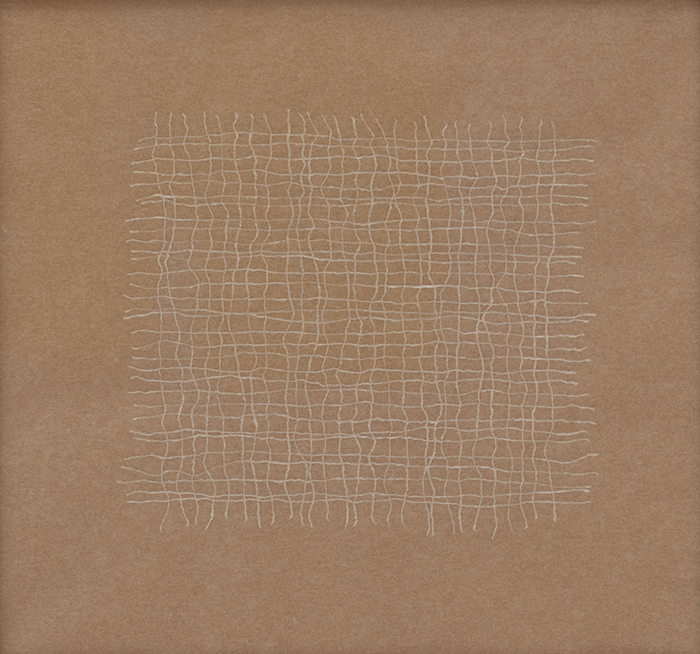
Mona Hatoum, Drawing Heat I (1), 2017. Parchment paper, 11 1/4 × 11 5/8 × 1 3/8 in. (28.6 × 29.5 × 3.6 cm). The Menil Collection, Houston, Gift of the artist. © Mona Hatoum. Photo: Paul Hester
Throughout the exhibition, touch ranges from tenderness to aggression. Ann Hamilton’s collaborative work poche (2014) encloses soft wool between stitched sheets of handmade paper, reflecting on the pocket as a place of storage and bodily protection. Other works are cut, burned, stapled, ripped apart, or stepped upon.
Lee Krasner’s work reveals destruction as part of the creative process. A relentless critic of her own art, Krasner frequently destroyed drawings and paintings that failed to meet her standards. Rather than discarding their remnants, however, she preserved them as material she could later reconsider and reconstitute.
“I think it speaks to the tensions of putting yourself out there as an artist and making work, and what it means for that work and therefore you to be seen in that way,” Montana said. “Even though it has this very aggressive or destructive way of making, I think it also speaks to the same kind of poetries as the Zarina work. It really speaks to the life of an artist in the studio and the emotional turmoil that can give off before a work comes to its final form.”
The exhibition opens with a compendium of processes: perforations, folds, burns, tears, and incisions. Other sections examine paper weathering unstable circumstances, falling apart and coming together, traveling through the mail, or assuming sculptural dimensions. The installation will shift between spare, poetic galleries and more muscular sections that demonstrate paper’s surprising robustness before returning to the body and its precarity.
“The through line for me is seeing the ways in which a number of artists turned to paper specifically because it is an analog for the fragility of the human condition,” Montana reflected. “It is a poetic way to turn towards these broader themes about humanity, human life, and our relationships with each other in our communities.”
—MICHAEL McFADDEN