

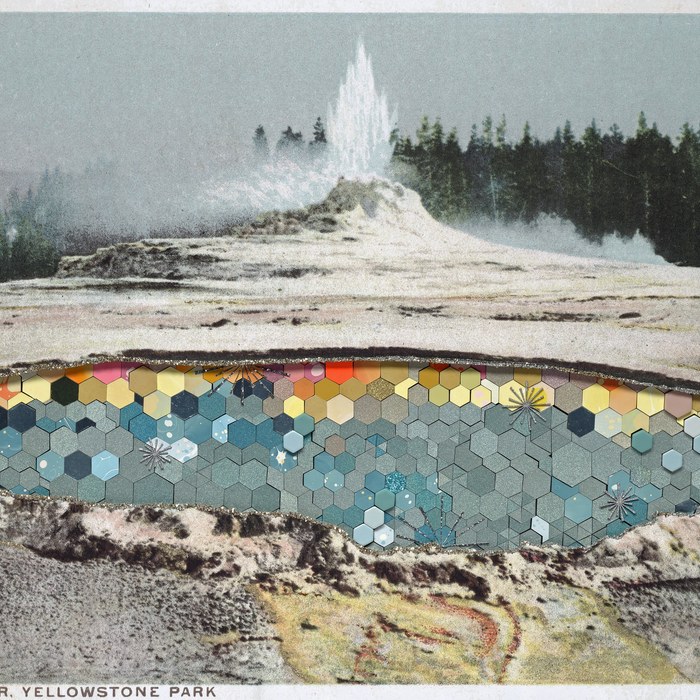
A pool opens in the earth, its blue depths broken into small, fitted pieces. Along the rim, pinks and yellows catch the eye, bright as candy against the pale ground. Beyond it, a geyser rises before a line of trees. The landscape has the faded familiarity of a postcard, a place someone visited and wanted to remember. But the water has become something else: a surface that promises depth while holding us at its edge.

In Kelly O’Connor’s Castle Geyser, Yellowstone (2026), the invitation to look comes with uncertainty about what we are looking into. The pool might offer a passage into the landscape, or seal it off. Its arrangement of hexagons interrupts the photograph, drawing us toward the part of the scene that could never have been there.
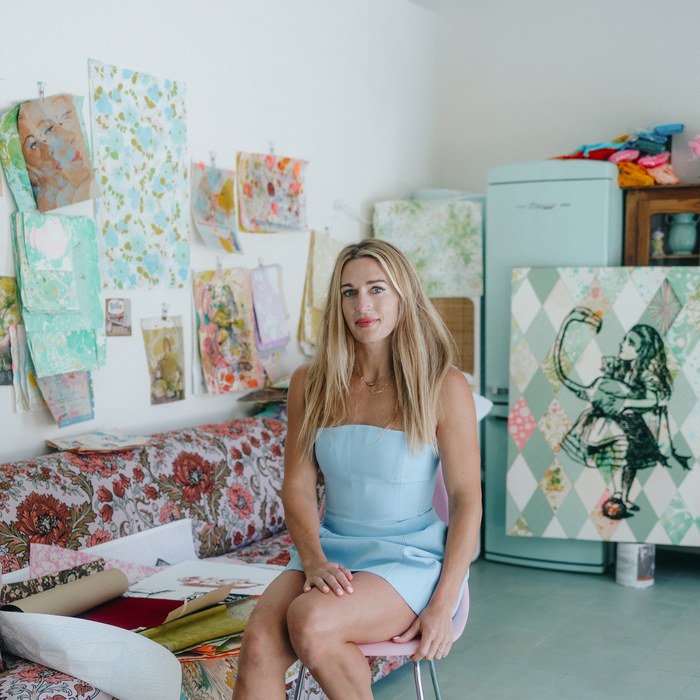
For nearly two decades, the San Antonio-born artist has worked between recognition and estrangement. Her collages and site-specific installations gather images from fairy tales, vacation destinations, advertising, and domestic life – the worlds through which generations have learned to imagine happiness.
“I grew up going to all these environments,” O’Connor recalled. “I consumed all these folktales and movies and all things Disney when I was little. Every year my dad would get us so excited about our summer vacations through vacation guides and brochures and all this printed memorabilia.”
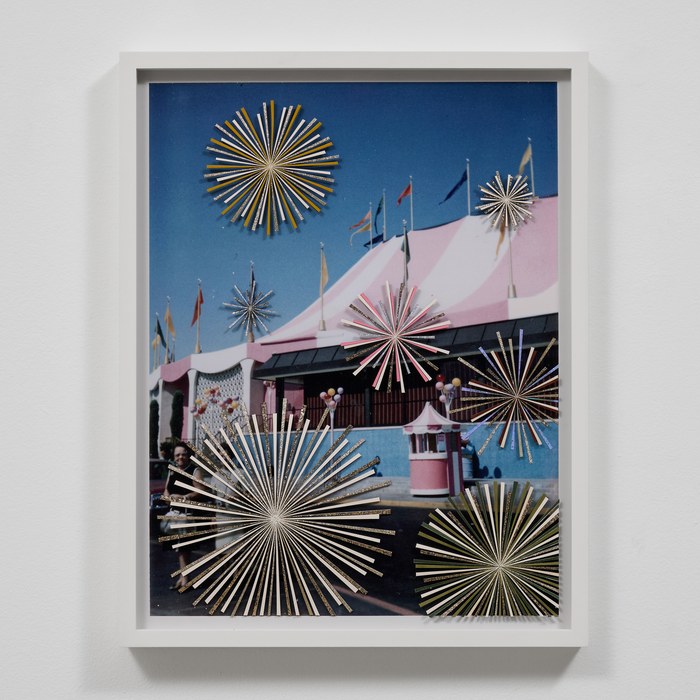
Those trips included national parks as well as Disney destinations. Before she encountered these places, their images gave anticipation of a landscape. Later, while studying at the University of Texas at Austin, she began examining artificial environments and their psychological effects. A research grant allowed her to study Disney World’s landscapes and architecture.
“That really started to interest me, that tension between something that I truly loved and then this sort of negative side of it,” she said. “I still love them. I think it’s both. I love them, but I also understand the sort of darker nature behind them.”
That affection gives her work a tenderness that a straightforward critique of manufactured happiness might miss. An experience can be carefully controlled and still become meaningful. The fabrication of a place does not make the memory of being there any less real.
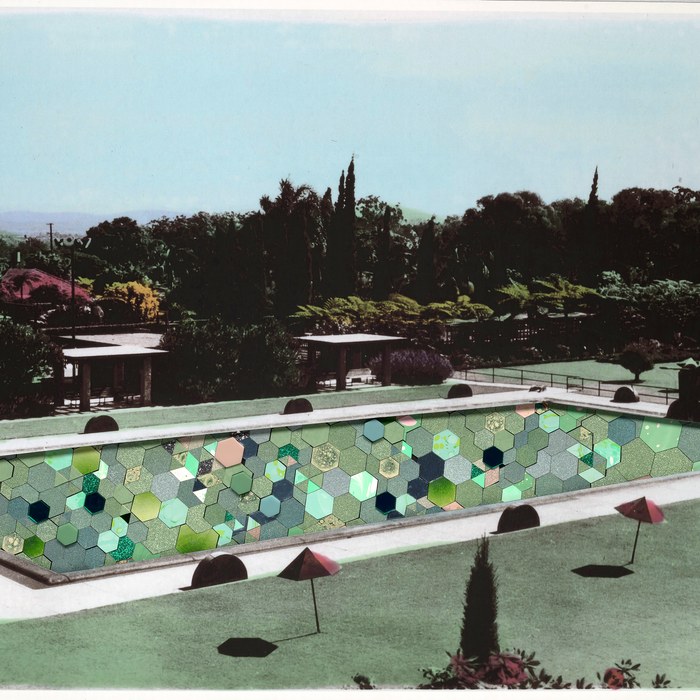
In The Oasis: Queensland (2026), a swimming pool sits within manicured grounds. Umbrellas dot the lawn. O’Connor fills the water with colored fragments, transforming a resort amenity into a luminous enclosure. Alongside the Yellowstone work, it complicates the distinction between natural and constructed destinations: both arrive as images offering somewhere else to be.
“The nostalgia is a good anchor point for you to kind of enter the piece,” O’Connor explained. “But then, as you start to look at it closer, what am I staring at? Am I being hypnotized? Am I going into a portal or a void? I want there to be many different layers that the piece keeps giving to you.”
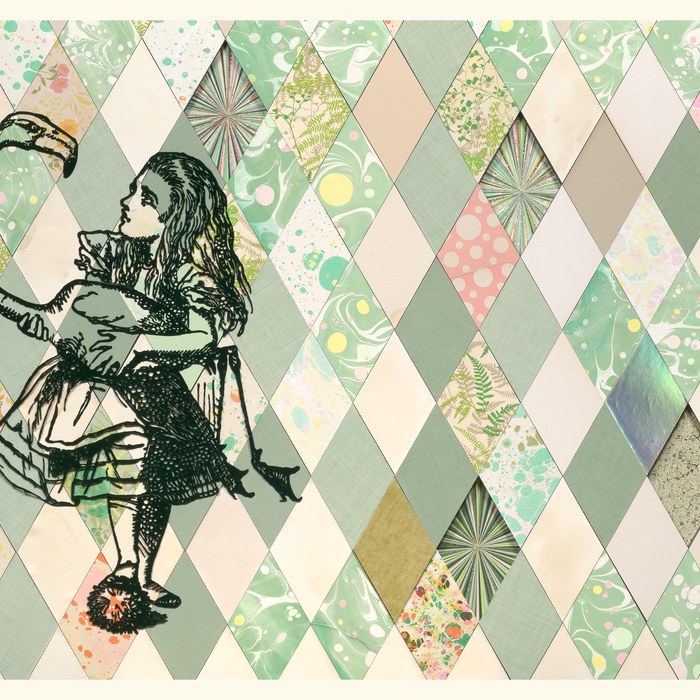
Alice has provided another point of entry since O’Connor’s undergraduate years. Although she grew up watching Disney’s adaptation, her enduring interest developed through John Tenniel’s illustrations at UT’s Harry Ransom Center. Their darkness unsettled the story’s familiarity. In Alice’s face, she saw a knowledge that seemed to exceed the girl’s age.
At Sala Diaz in San Antonio in 2010, O’Connor enlarged the image of Alice growing too big for a house until it occupied an entire wall. The character’s predicament became architectural: a body exceeding the space intended to contain it. The illustrations have continued to offer new associations as O’Connor’s life has changed.
“My daughter is going through puberty right now,” she said. “I’m in the middle of doing this piece with Alice when she grows really tall. That image of her stretching, all contorted, is such a great image to represent puberty. There are so many layers in those pieces.”
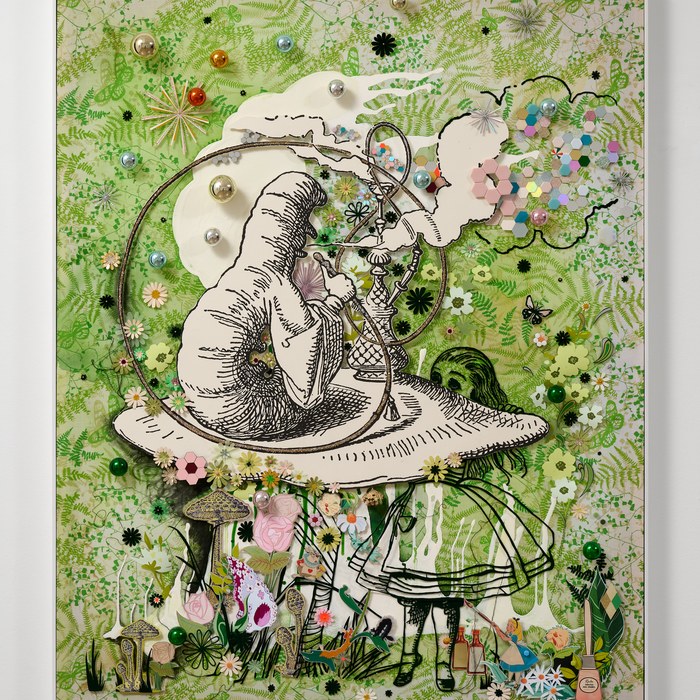
In Metamorphosis (2026), the hookah-smoking caterpillar occupies an oversized mushroom amid ferns, flowers, reflective ornaments, and colored fragments. Tenniel’s Alice appears beneath the cap; a smaller Disney Alice enters near the lower edge. A fern-patterned bedsheet designed by Vera Neumann supplies the greenery, bringing the intimacy of a bedroom into the fantasy.
The accumulation is exuberant, though looking can also feel crowded. Decorative elements compete with the figures, reproducing something of the overstimulation O’Connor finds in fabricated environments.
Recently, she has begun loosening the control within her own process. Her intricate collages require countless small cuts, taking a physical toll on her neck. Paper marbling has offered a more fluid way of working.
“I had developed this process of working with collage where it’s almost like a mosaic,” she explained. “All these little pieces cut with an X-Acto knife. Everything is so precise and purposely put into a specific place. I wanted to kind of break free from that rigidity and introduce something a little more surprising and fun.”
In Follies: Pool of Tears (2026), marbled colors drift across an illustrated page, surrounding Alice and interrupting the text. The story remains partly legible, its progression loosened by patterns that suggest cells, stone, or distant bodies.
“The paper marbling is mimicking all these patterns in nature,” O’Connor said. “Obviously it looks like marbling in a table, but it also looks like the cosmos. It looks cellular.”
Chance enters the architecture of the collage. After years examining worlds designed to guide an experience, O’Connor is allowing more of her own experience to remain undetermined. A familiar story can change; a remembered landscape can open again. At the edge of the Yellowstone pool, the pieces remain carefully fitted together. Looking longer, we begin to wonder how deep it goes.
—MICHAEL MCFADDEN