

How well do you know the Haas Brothers? Niki and Simon. I caught their exhibition Snails in Comparison at Lora Reynolds Gallery back in the spring of 2023. I remember the press release leaned heavily into big, quiet themes—pandemic isolation, family, mortality, the weight of human fragility captured in carved marble and blown glass following the birth of Niki’s son, Fox, and the long separation of lockdown. Walking through the gallery’s space on West 6th Street, I found the work genuinely funny. I admired the technical flex of pairing blown glass bodies with shells hand-carved in stone. But I walked out realizing I hadn’t quite grasped what those objects were trying to do to me as a viewer. I’ll get another shot at it this fall. Haas Brothers: Uncanny Valley at the Blanton Museum of Art runs Sept. 27 -Jan. 2027 in Austin.

As their mid-career survey moves to Austin, previous critical responses have predictably split. Design press flattens the show into a “weird, wonderful world” of quirky forms while stepping around the candy-colored gastropods sprouting explicit genitalia. Establishment critics write off the lewd forms and punning titles as tiresomely juvenile. Both miss the point entirely. One sanitizes the work into safe luxury decor; the other dismisses it as an expensive prank. In 2023, I fell for a variation of that same trap.
The survey’s title names the apparatus outright. In robotics, the “uncanny valley” marks that eerie threshold where an artificial figure becomes almost—but not quite—human, triggering revulsion instead of connection. Simon Haas points to the escape: “When a robot is humanoid with an extra dose of cuteness, empathy for the object skyrockets.” Blanton curator Carter Foster frames it similarly as a deliberate destabilization: “To me, it’s the line between the familiar and the unfamiliar—you think it’s one thing, and then it’s something else.” Cuteness—and their punning titles like Christofur Walken or Hairy J. Blige—isn’t a style choice. It’s a Trojan horse. It disarms your defenses just enough for their biomorphic critters and exposed anatomical forms to do their work.

Laura Mott, the show’s organizing curator and an Austin native herself, sees the hometown framing as anything but incidental. It’s “completely normal,” she says, for an institution taking on a touring show to make it ‘slightly their own’—the checklist of works doesn’t change, but the frame does. Cranbrook’s own materials lean academic, by her account, because she’s the scholar who wrote the accompanying catalog; the Museum of Arts and Design’s lean toward craft and design, in keeping with its mission. Blanton’s lean toward hometown-hero territory is no less deliberate.
For Central Texas, Uncanny Valley arrives as a 15-year homecoming—one shaped not just by the artists, but by Mott as well. Long before their work reached the Met or Hollywood’s elite, the twins spent formative years in 1990s Austin—learning stone carving from their father and creative storytelling from their TV-writer mother. It was a city where, in 1995, I grabbed a couple slices at Conan’s, rounded the corner to Toy Joy for some patchouli incense, then caught a burgeoning Wilco at Antone’s across the street—a texture that shaped their ribald worldview and mine. Now the Blanton, a university museum in Texas defined by civic decorum, presents work fundamentally built on an anti-decorum posture.
Mott ties that friction to something more specific than nostalgia. Growing up in Texas means growing up around taxidermy as ordinary decor— “you go a few doors down to a restaurant,” she says, “and you’re going to see something like taxidermy.” That familiarity, in her account, was built into the Beasts from the start: the gap between a stuffed animal you’d cuddle and a mounted one you’d flinch from is exactly the space the creatures occupy. A New York or Michigan audience needs that distinction introduced to them. An Austin one already lives inside it.
1 ⁄7
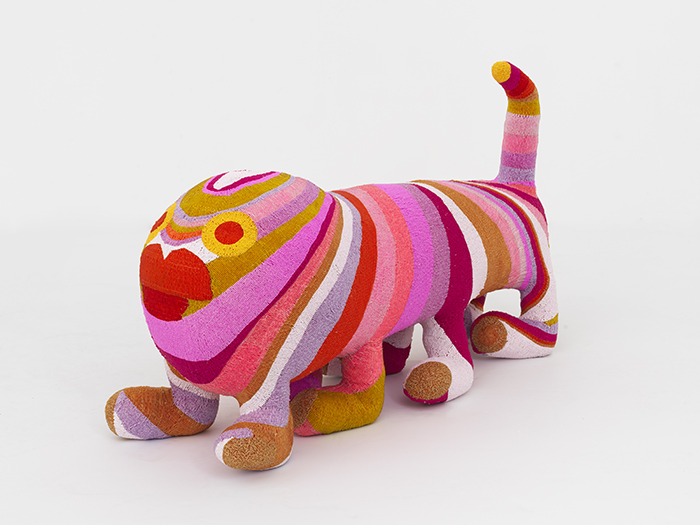
Haas Brothers, Centripeter Shire, 2019, Glass beads, wire, mixed fiber stuffing. Photo: Object Studies. Courtesy of Marianne Boesky Gallery, New York and Aspen.
2 ⁄7
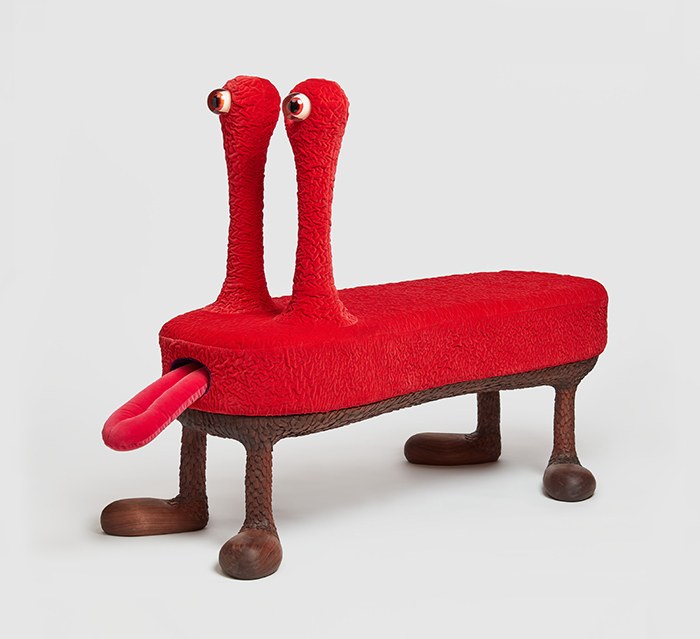
Haas Brothers, She's So Ducky, 2018, Solid carved walnut, lush velvet, glass, and electrical lighting components. Photo: Lee Thompson. Courtesy of Marianne Boesky Gallery, New York and Aspen.
3 ⁄7
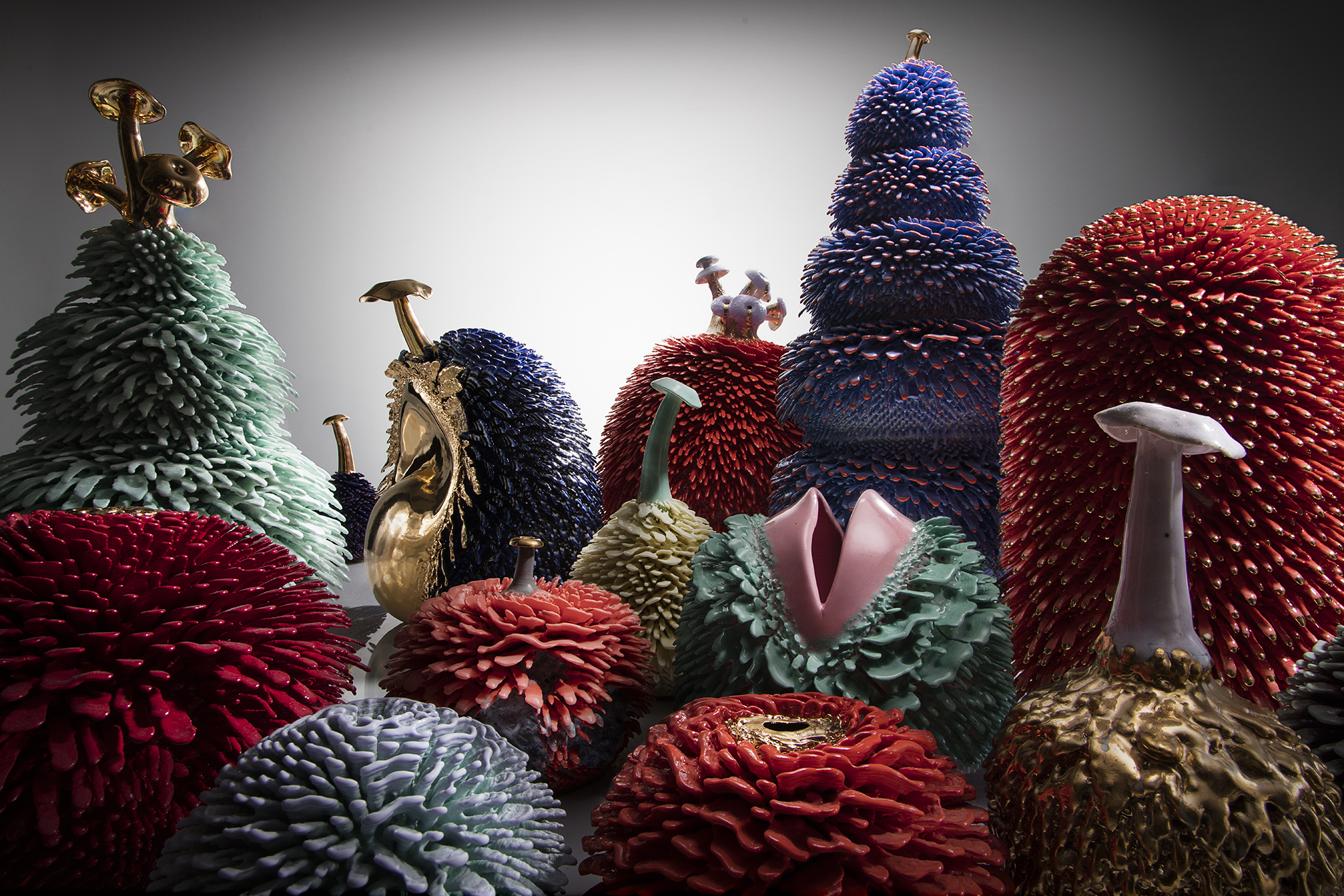
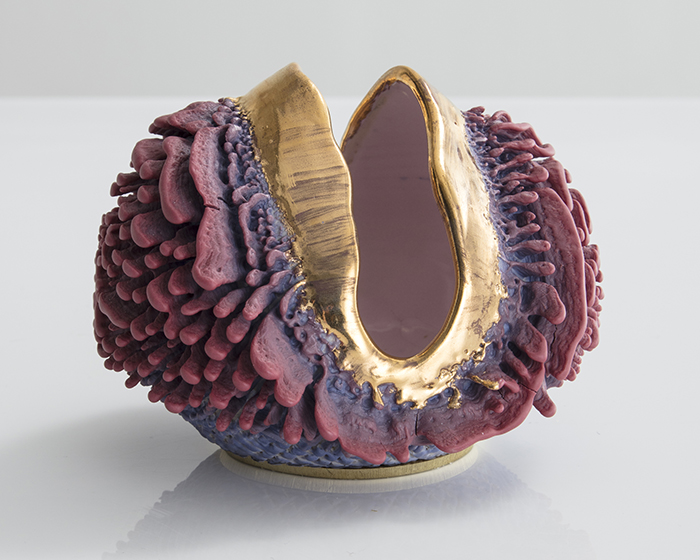
Haas Brothers, Bruce Willis Beyonclé, 2016, Hand thrown and accreted porcelain, gold luster, and brass plate. Photo: Joe Kramm. Courtesy of R & Company. © Haas Brothers
4 ⁄7
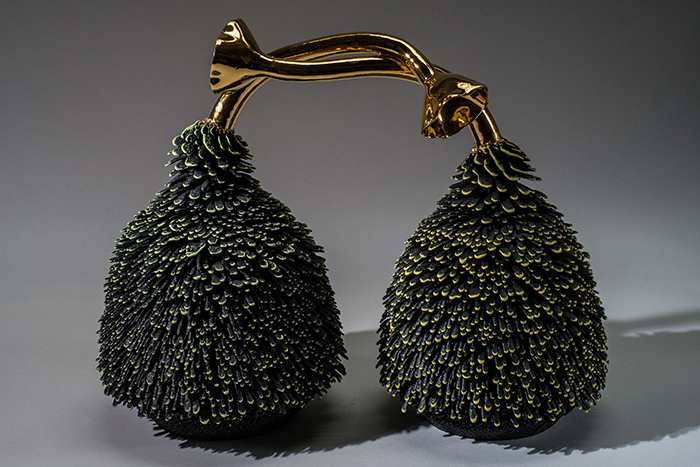
Haas Brothers, Father Partner, 2017, Hand thrown and accreted porcelain, gold luster, and brass plate. Photo: Justin Corbett. © Haas Brothers.
5 ⁄7
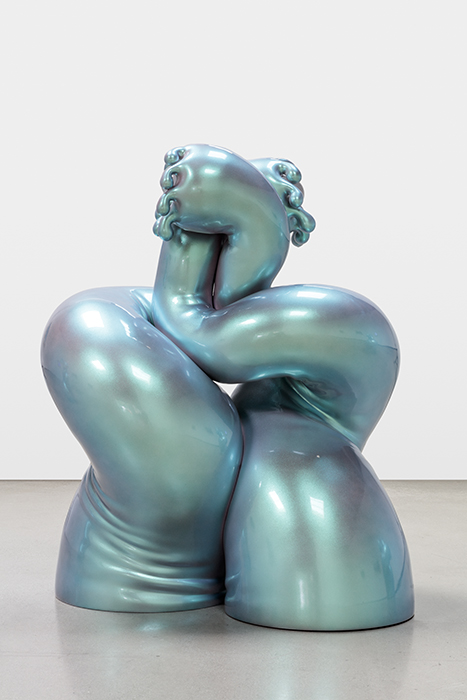
Haas Brothers, Cyberzoid 3, 2023, 3D-printed Nylon, automotive paint, and glow in the dark blown glass. Photo: Charles White. Courtesy of Jeffrey Deitch. © Haas Brothers.
6/7
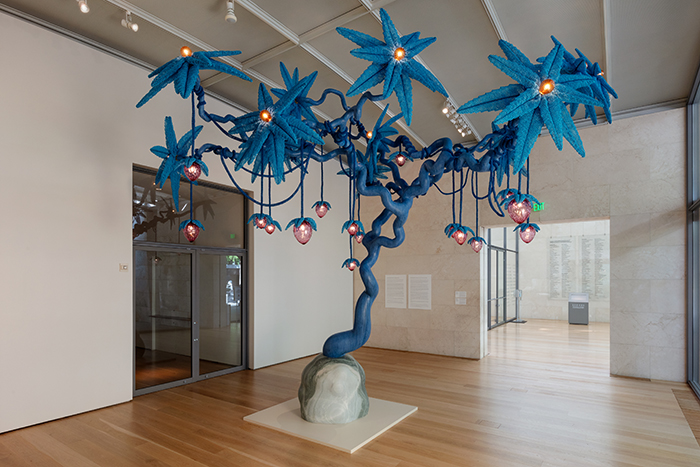
Haas Brothers, The Strawberry Tree, 2024; Installation view of Haas Brothers: Moonlight, Nasher Sculpture Center, May 11-August 25, 2024. Patinated bronze, Pele de Tigre marble, glass beads, hand blown glass, electrical components. Photo: Kevin Todora. Courtesy of Nasher Sculpture Center.
7 ⁄7
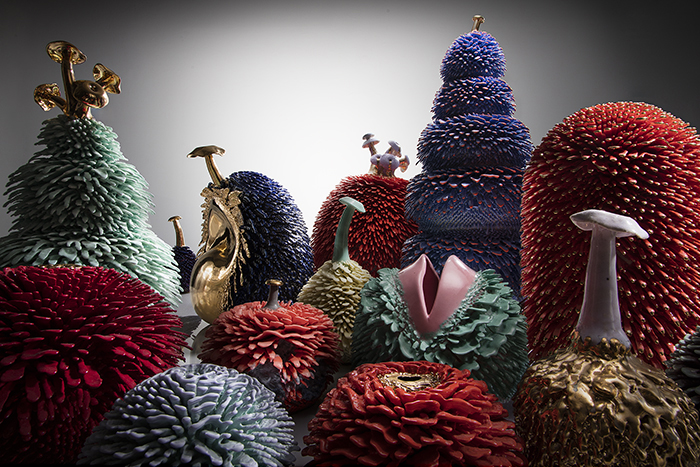
Haas Brothers, mixed Accretions, Hand thrown and accreted porcelain, gold luster, and brass plate. Photo: Joe Kramm. Courtesy of Haas Brothers.
This creates a classic anthropological collision: placing what Mary Douglas called “matter out of place” inside an institution designed to contain it. When asked about navigating that tension with works like the explicitly titled King Dong, Foster pointed to spatial choreography rather than censorship: “We’re sensitive to our audiences… We’re not going to hide anything, but we think about placement—putting it in a back corner with a wall in front of it so people can navigate it on their own terms.” A preview’s job is to pose questions rather than answer them before the doors open, so the critical test remains: Can the museum framework hold their subversion, or will the gallery environment domesticate it into something comfortable for art patrons?
When the doors open in September, the work will demand something of you that most museum experiences don’t: a willingness to sit with discomfort long enough to understand what it’s trying to dismantle. The craft pulls you in. The cuteness builds empathy. Before you notice what’s happening, your assumptions about taste, decorum, and shame have been quietly taken apart.
I missed this in 2023. I won’t miss it this time.
—JON HOPSON