

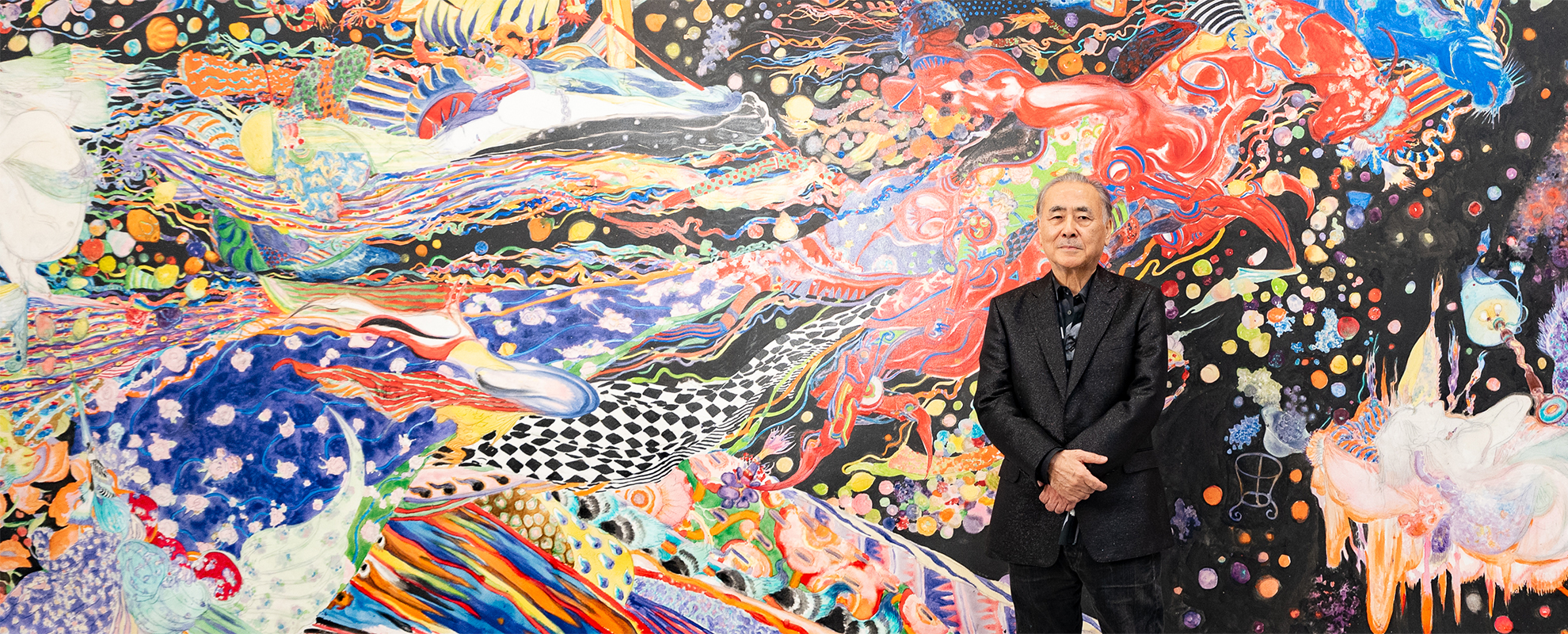

I am not swiping through digital images or peering into a paperback book; I am standing—as the first viewer to see Yoshitaka Amano: Big Bang at Asia Society Texas Center fully installed, where it runs through Feb. 7, 2027—in the quiet, pristine light of Yoshio Taniguchi’s architecture, confronted by raw scale, chemical reaction, and the unyielding physical friction of human labor on a gallery wall.

What becomes immediately legible in this unified space is how curators Owen Duffy and Samina Iqbal have chosen to hold the work together. They install roughly forty works spanning Amano’s 30-year studio practice within a single, continuous gallery, refusing to separate his commercial iconography from his fine-art canvases. As curator Owen Duffy notes, “It seems like the commonality between all of it is storytelling and an appreciation for not just his own culture and its cultural production like paintings, history, but of the world.”
The decision to refuse partition carries weight because institutional erasure has a personal history. For years, I misremembered my own first encounter with Amano, believing I was ten years old in 1990, using his wispy watercolor sketches in the Final Fantasy instruction manual to fill in the visual gaps left by blocky 8-bit NES pixels. But retro-gaming history tells a stranger story. In 1990 and 1991, Nintendo of America systematically scrubbed Amano’s line work from Western releases, replacing his fluid Japanese watercolors with Western comic art and photographed clay models.

Standing before Spring (1996), Duffy identifies it as the exact moment Amano broke free from commercial studio pipelines. The timing is fitting—1996 was the year his work first reached my screen, but for Amano, it was his line of demarcation. “He was getting tired of making art for other people’s commercial endeavors,” Duffy notes. “This represented freedom.” What AST has assembled isn’t a commercial illustrator dabbling in fine art, but the physical record of an artist reclaiming his own hand.
Decades later, The Warehouse in Dallas ran the same institutional playbook, splitting an Amano survey into two separate phases, locking fine-art canvases away from commercial illustration as if they couldn’t coexist. Asia Society Texas’s undivided layout is a direct refusal of that logic. The unified space reveals something both corporate marketing and institutional partition obscured: narrative continuity doesn’t depend on scale or material or institutional category. It depends on the hand telling the story.
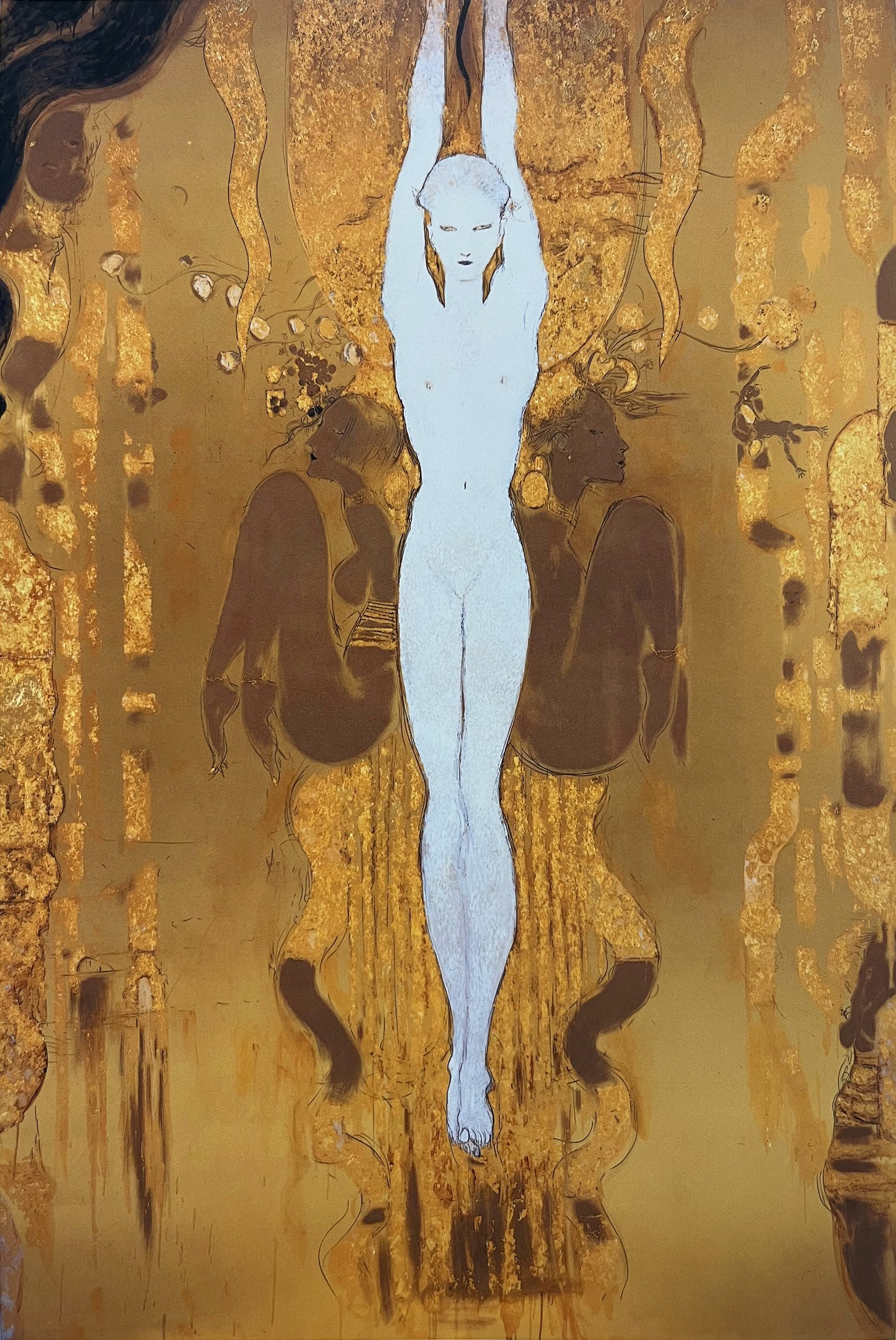
Standing alone in front of the Shitennō panels before the public arrives, the ambiguity of the making becomes immediately legible. Gold leaf scraped away to define the figures—but when exactly? I can’t decide whether the line was created first and the gold leaf placed over it, or whether the line is the scratch work itself, carved through the surface after application. The pencil or crayon mark continues up off the edge of the panel. The minerality—the sulfurous iron-oxide moto pigment he mixes himself—bleeds and fogs where the sumi layers rewet and overlap. The scratching is so fine in some areas I lose track of what I’m looking at. The hand is visible, but the sequence of the hand’s arrival is obscured.
The Mozart series demands a different kind of attention. Here, the adhesive itself becomes a compositional element. He applies adhesive, sometimes with gold leaf on top, sometimes without. Where there’s no gold, the brushwork of the adhesive alone changes the reflection, the sheen, subtly shifting how light moves across the surface. Fingerprints press into the gold leaf—the hand active, present, unguarded. The burnished areas are impossibly smooth; the scratched areas reveal texture. Some of the fine scratches in the gold leaf seem to carry pencil or crayon marks that continue beyond them, layering materials in ways that shouldn’t technically work.
1 ⁄7
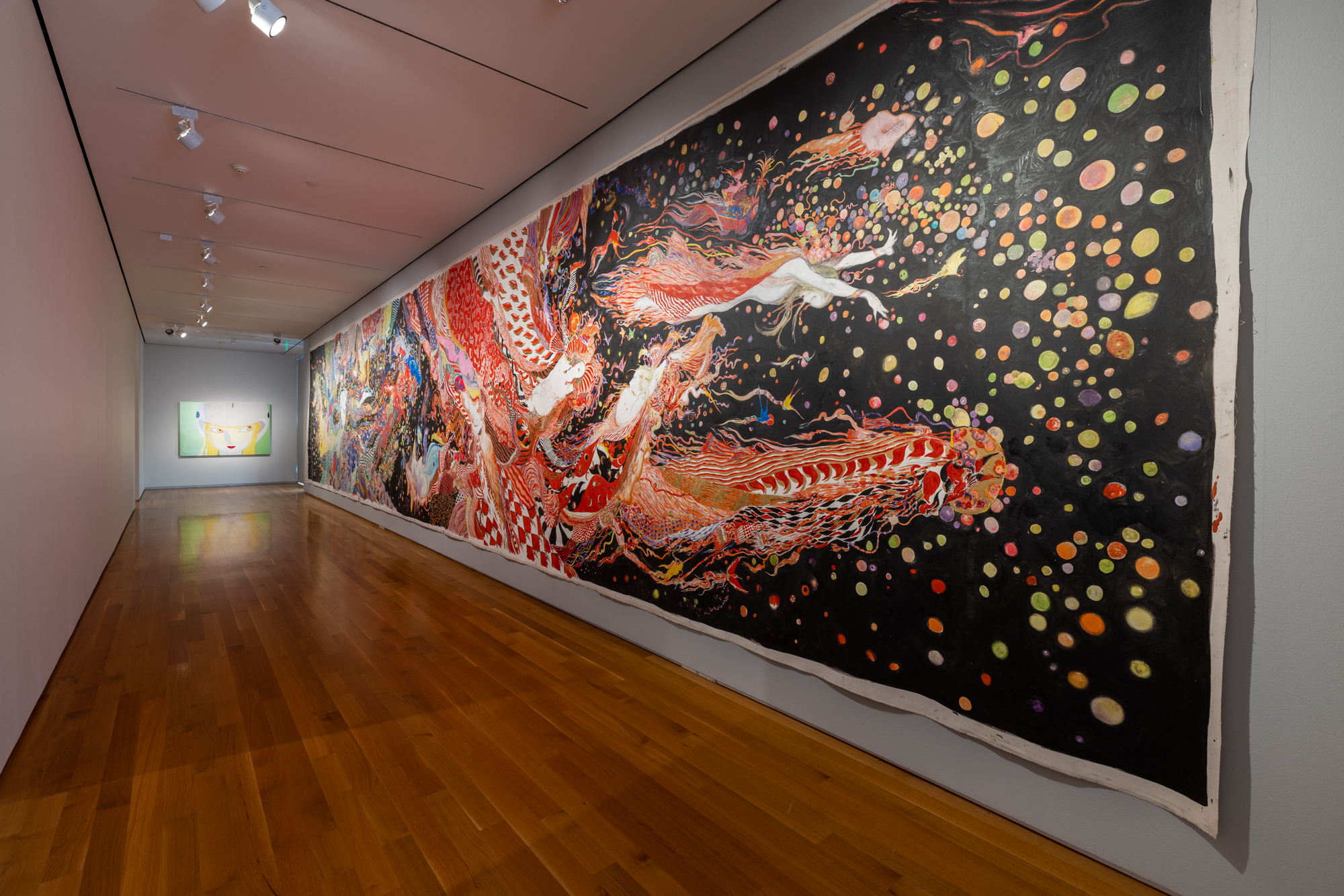
Yoshitaka Amano: Big Bang, Asia Society Texas Center. Photo courtesy of the Asia Society.
2 ⁄7
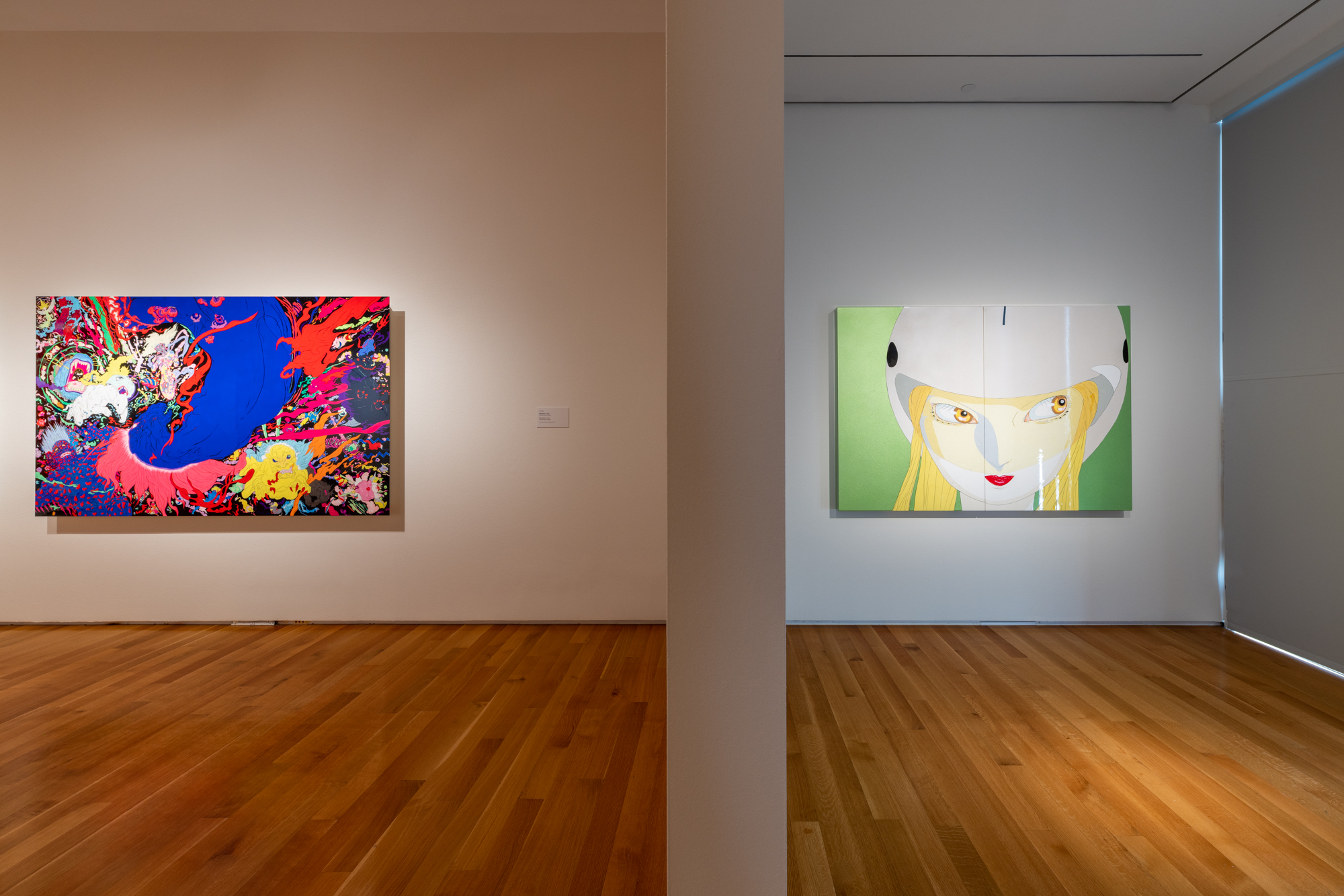
Yoshitaka Amano: Big Bang, Asia Society Texas Center. Photo courtesy of the Asia Society.
3 ⁄7
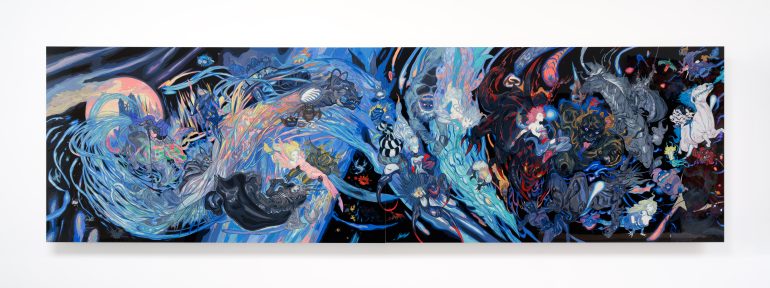
Yoshitaka Amano, Big Bang, 2018. Automotive paint on aluminum. Courtesy the artist and LOMEX, New York. Photo by Kevin Todora.
4 ⁄7
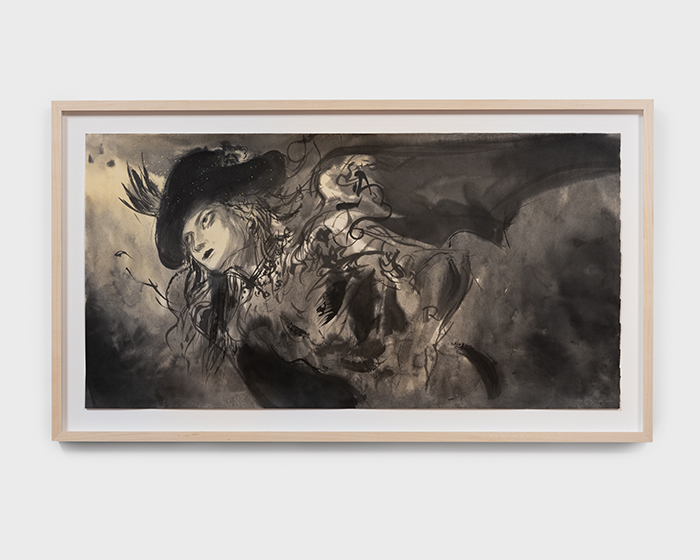
Yoshitaka Amano, Apocalypse – Ascending, 2013. Sumi on washi. Courtesy the artist and LOMEX, New York.
5 ⁄7
Yoshitaka Amano, Mozart (Panel 6), 1997. Crayon, pigment, tar, and gold leaf on wood panel. Courtesy the artist and LOMEX, New York.
6 ⁄7
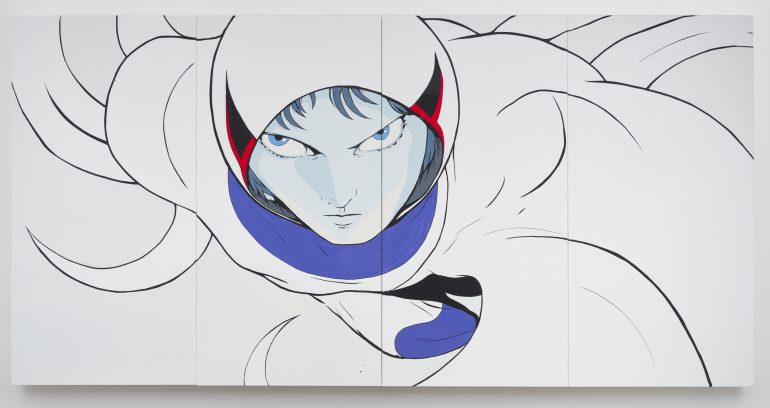
Yoshitaka Amano, Take off, 2006. Automotive paint on aluminum. Courtesy the artist and LOMEX, New York.
7 ⁄7
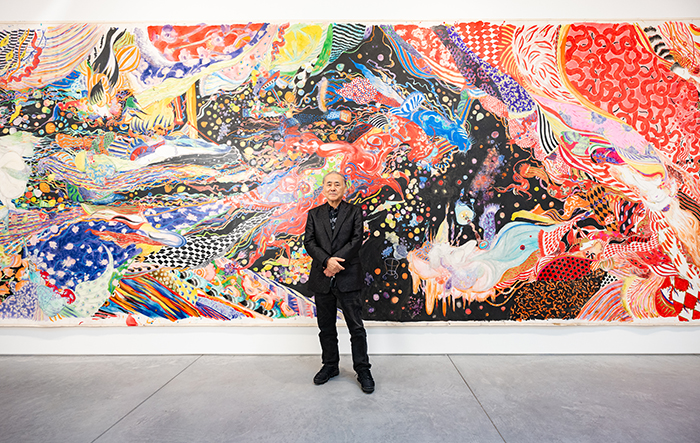
Yoshitaka Amano, photo by Kevin Todora, courtesy The Warehouse.
Both series operate on the same narrative principle. The story doesn’t change because the scale changes or the material changes. The delicate watercolor line and the industrial automotive paint tell the same story. The animation cell enlarged to monumental scale tells the same story. The 50-foot scroll I walk through—that’s animation unfolding in real time, where, as curator Owen Duffy describes it, “the story continues from one end to the other, the imagery evolves as you walk down it.”
Take Off, which looks simultaneously like an animation cell and an enlargement, demonstrates this principle perfectly. A detail from character design becomes the entire composition. The brushstroke invisible at animation scale becomes monumental at gallery scale. Neither version is lesser; both are storytelling. The work doesn’t distinguish between commercial design and fine art because narrative logic doesn’t recognize that partition. The hand that sketched character concepts for Japanese animation is the same hand that painted monumental aluminum panels.
What becomes visible in this undivided gallery is what institutional partition always concealed: that Amano’s practice operates on a single principle across all registers. As scale shifts and materials change, commercial work and fine art cease to be opposing camps; they reveal themselves as points along a single, unbroken continuum. Standing in Asia Society Texas’s undivided space as the first visitor to see it complete, I encounter forty years of narrative unfolding at whatever scale the story demands. The partition would have been a lie—one that interrupted the very thing Amano’s hand has been insisting on all along.
—JON HOPSON