

For nearly 20 years, the Contemporary Art Dealers of Dallas (CADD) has provided a supportive space for local gallerists to trade ideas, set standards, and share inspiration with peers.

This region-wide exhibition, competition, and fundraiser was designed to help nurture artists during the delicate window between finishing graduate school and joining the gallery system. CADD reached out to nine universities offering MFA programs within 100 miles of Dallas, bridging these programs and the contemporary art community. Gallerist Cris Worley of Cris Worley Fine Arts (who served as treasurer in CADD’s very first year and has recently returned to the role) says the idea has surprisingly deep roots.
“Years ago, we used to do something called the CADD fund, which was a soup dinner,” Worley recalls. “We’d get restaurants in the area to donate, and people would buy tickets to listen to students give a presentation on an unrealized artwork they’d like to have funds to make happen. The last one we did was during COVID, then it petered out, so we decided to bring back a form of that. But we made it a little more streamlined by engaging the professors to nominate students.”

“The enthusiasm has come from there, because they were excited for an opportunity for their students to be seen by the community at large,” Roth explains. “The interest in general was strong, and the opportunity to work together in this way with our colleagues in CADD is a great thing for us as well. I think this is one of the things that shows the community is friendly. We collaborate, we care about our cultural ecosystem, and we can work together well to make something like this happen.”
Faculty from Southern Methodist University, Texas Christian University, Texas Women’s University, the University of Dallas, the University of North Texas, the University of Texas at Dallas and Arlington, Texas A&M Commerce, and the University of Texas at Tyler handled nominations. Once students learned of their selection, they were encouraged to submit one or two images for consideration. Organization members judged the 23 submissions on a 20-point scale covering artistic voice, aesthetic, and cohesion, and the tight contest resulted in 11 finalists that were attached to a member gallery for a September presentation. Each accepted piece (ranging from sculpture to drawing, painting to installation) offered a uniquely personal viewpoint that reflected the age and experiences of its maker.
Worley says she was thrilled by the enthusiasm for the project not only from the institutions and students, but also from the arts community at large. She also displayed the work of her choice: a surrealistic illustration of a poppy by the UTD student Olga Arseniev Johnson.
1 ⁄3
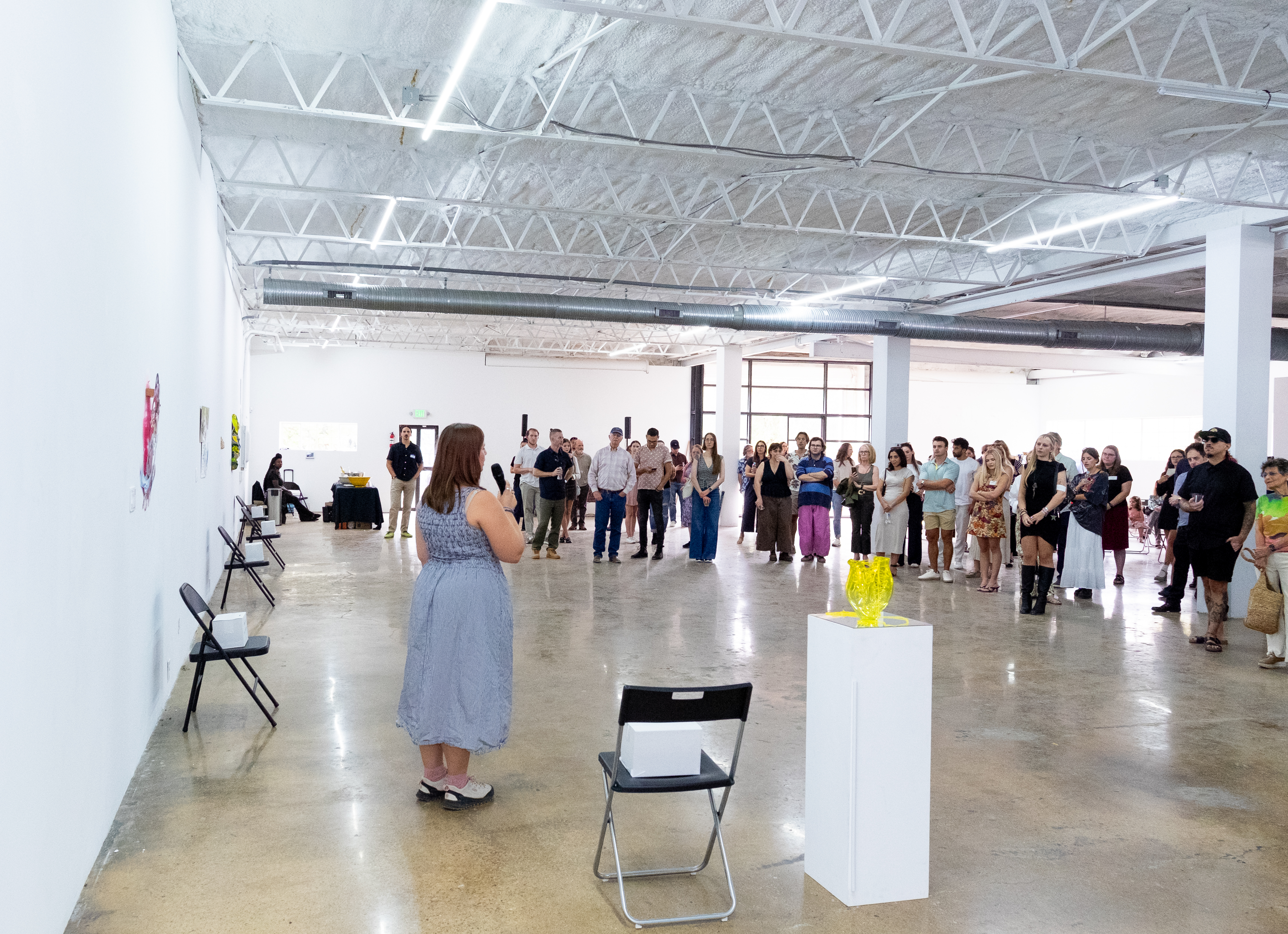
Gretchen Stark of Texas Christian University addressing the crowd at the CADD MFA Showcase. Photo by Karina Coscia Cedillo.
2 ⁄3
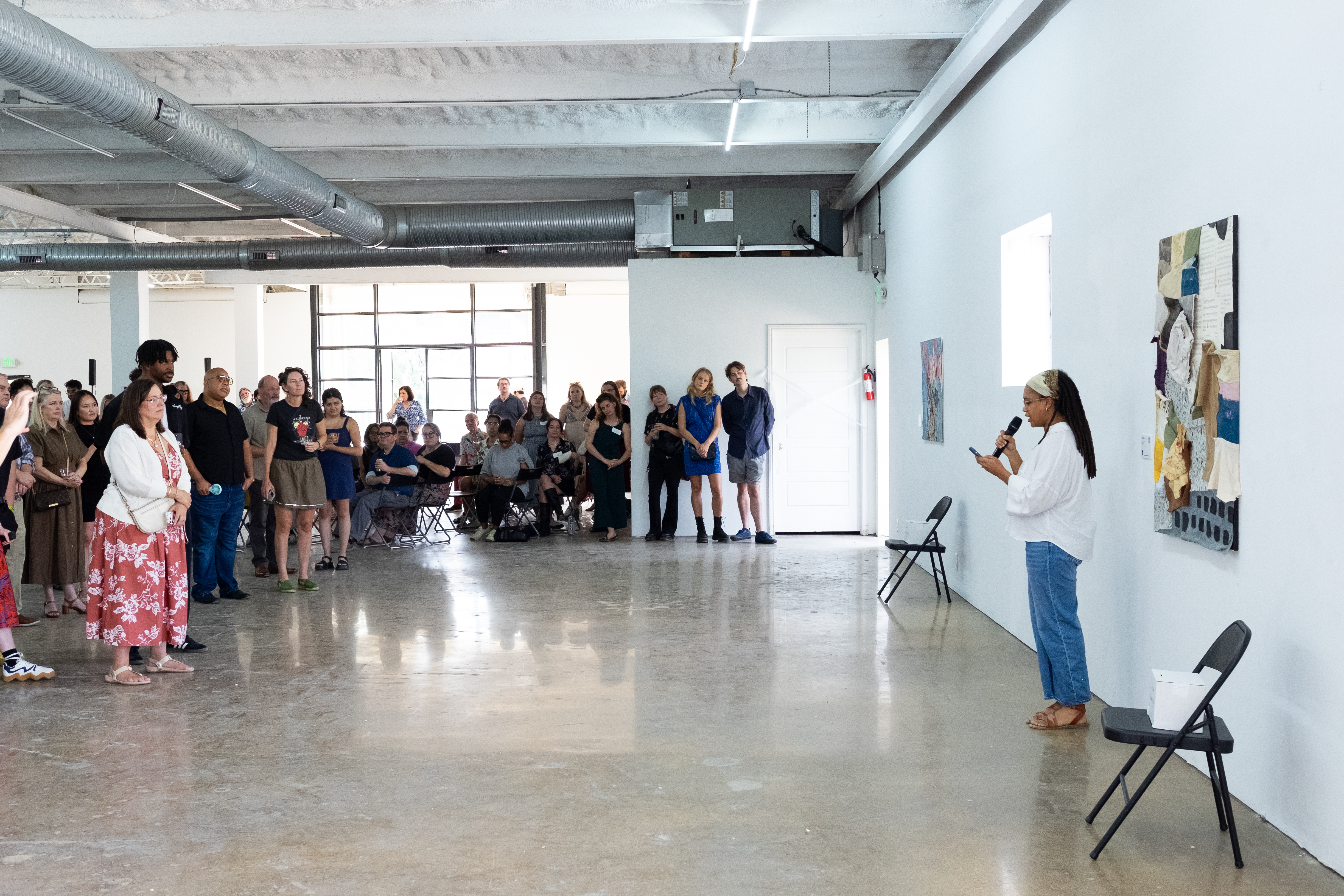
Niel Brandon of Texas Woman’s University addressing the crowd at the CADD MFA Showcase. Photo by Karina Coscia Cedillo.
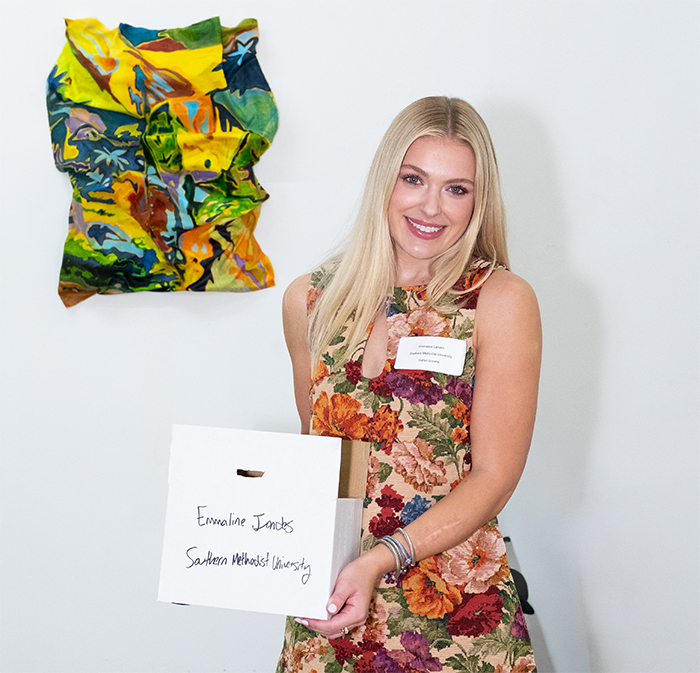
3 ⁄3
CADD MFA contest winner Emmaline Landes of Southern Methodist University. Photo by Karina Coscia Cedillo.
“I got really lucky with one of my top choices,” she says. “Her work is deeply connected to ecology and our natural world, and she does these incredible drawings.”
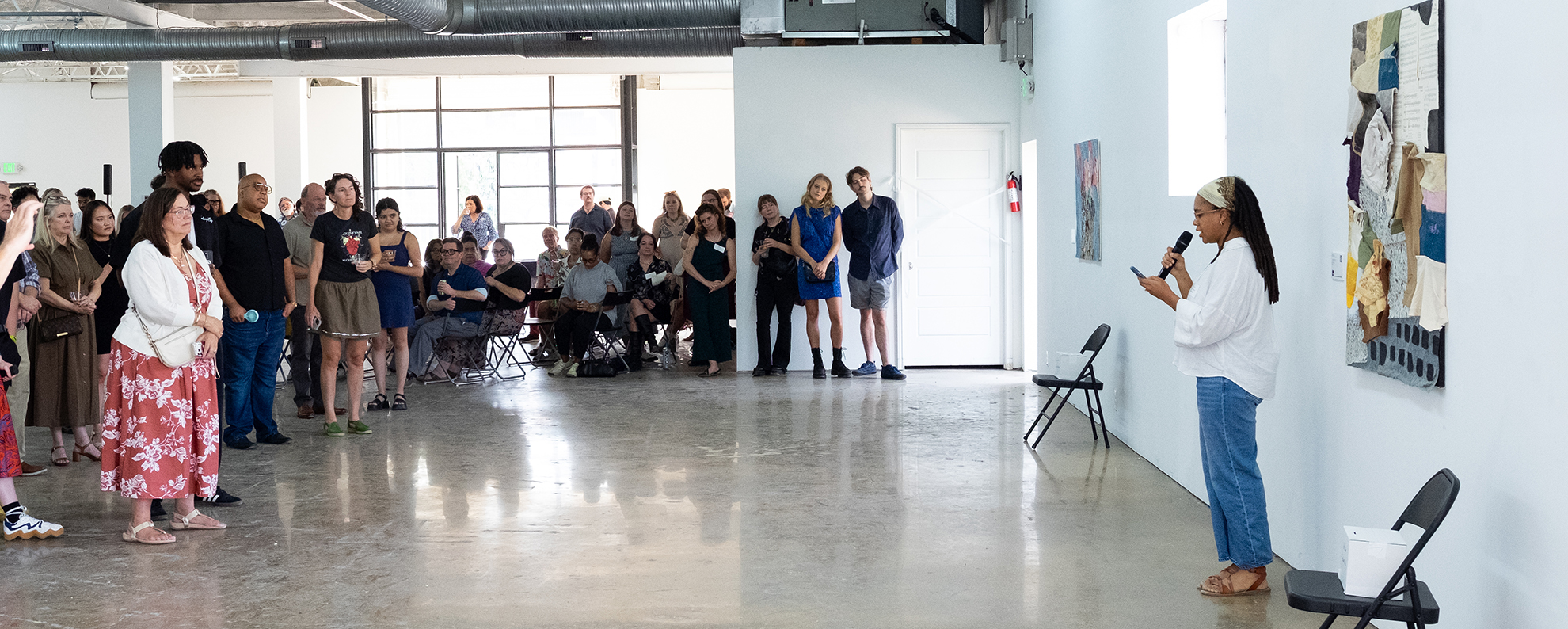
On a still-steamy late September day, the finalists showcased their pieces in the former site of the Daisha Board Gallery on Bataan Street in the Tin District. A crowd including collectors and benefactors, artists and gallerists paid $20 each to hear brief remarks about the work before voting on the winner of the $2,500 prize. And—by a landslide—that artist was 24-year-old SMU student Emmaline Landes, whose “In the Folds 1” featured a blown-up abstract floral on a gathered canvas in an eye-catching mix of painting and sculpture.
Influenced by everything from matchy-matchy domestic interiors to the work of mid-century painter Sam Gilliam, the piece was perfectly timed for our current cultural moment. Landes says her work highlights “femininity and how women are conditioned to shape themselves according to society’s expectations. I pull a lot from domestic interiors and decoration, and a vibrant palette is about the vibrancy women are expected to emit.”
Roth says the vibrancy of the winning artwork has carried over into CADD’s feelings about their newest program. “I think we’re definitely going to want to do it again,” he muses. “We experienced so much excitement at every turn, and the students were taking it seriously. It’s worth following this cohort and seeing who ends up in galleries. It’ll be interesting to see how this type of engagement stays with an artist during these formative times.”
—KENDALL MORGAN