

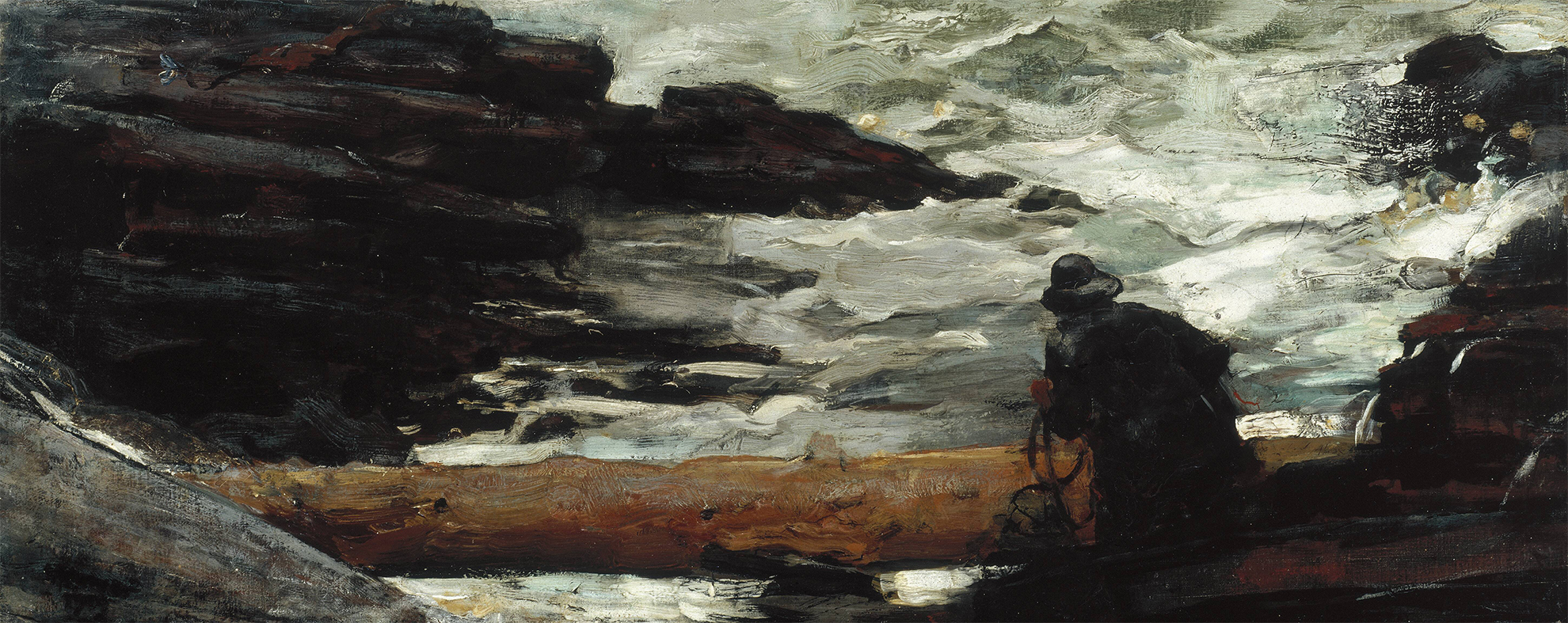

Watercolor is an unforgiving, fragile medium. Exposed to sustained light, organic pigments fade, paper discolors, and the fluid atmosphere the artist captured degrades. That chemical vulnerability is why the Museum of Fine Arts, Boston—holding the largest collection in the world of Winslow Homer’s watercolors—has kept these sheets in dark storage for nearly half a century. Managing access against long-term preservation is a delicate mathematical calculation. Bringing them into the light presents an act of visual archaeology: a rare chance to examine the nineteenth-century atmosphere before light exposure forces the paper back into the vault.

The Upper Brown galleries of the Law Building present a notorious spatial problem: soaring ceilings and high institutional volume designed to swallow massive postwar canvases. Forcing parlor-scale watercolors into that cavernous footprint requires aggressive architectural countermeasures. Kaylin Weber, the MFAH’s curator of American painting and sculpture, translates these technical constraints into physical choices—constructing full blackout perimeters, dropping sightlines to strict eye-level, and deploying deep, natural blues and greens to artificially pull the perimeter walls inward.
“We landed on very natural tones that mimic the spaces—not the spaces of the collectors, necessarily, but the spaces of the environments he was painting in,” Weber explains. “The blues and greens aren’t decorative; they are designed to bring the outside atmosphere into the gallery while compressing the sheer scale of the room.”

What this archival dark storage has protected is not a pristine artifact, but the physical record of Homer’s violence against his medium. When Boston’s conservators analyzed this collection, they found paper stock pushed past its structural threshold: wet sheets carved open with penknife blades, fibers lifted by sponge blottings, and rag paper deliberately left in harsh sunlight to force artificial aging. In conservation terms, these interventions constitute structural damage; in the gallery, the blackout curtains and low foot-candles exist to keep those compromised, oxidizing fibers stable while making that material history legible.
“When you look closely at these sheets, you see an artist who was almost brutally physical with his materials,” Weber says. “Homer wasn’t just laying down washes; he was scraping wet fibers with penknives, blotting, and exposing sheets to harsh conditions to get the exact luminosity he wanted. Our job in the gallery layout is to make that aggressive surface labor visible.”
The planned spatial arrangement proposes a specific reading of Homer’s working method. An early section focuses on the 1870s—oils and watercolors hung to highlight their simultaneous execution. Move past that decade into the Cullercoats period of the 1880s, and the sequencing marks a shift: watercolor accelerates, becoming the primary site for testing light, composition, and spatial economy before those ideas were translated to canvas.
1 ⁄8
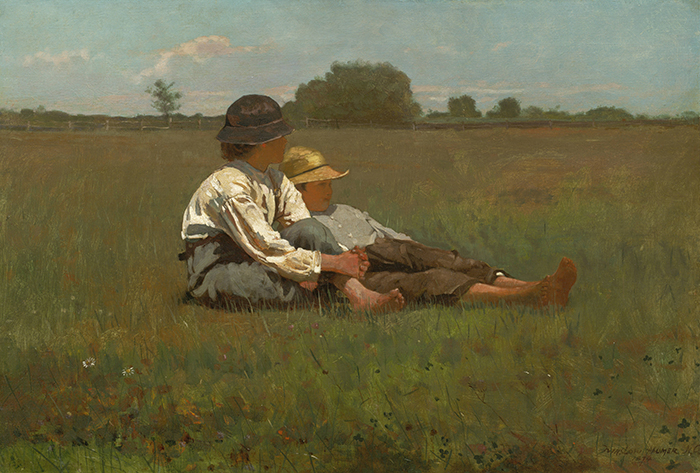
Winslow Homer, Boys in a Pasture, 1874, oil on canvas, the Museum of Fine Arts, Boston, the Hayden Collection—Charles Henry Hayden Fund. Photograph © Museum of Fine Arts, Boston
2 ⁄8
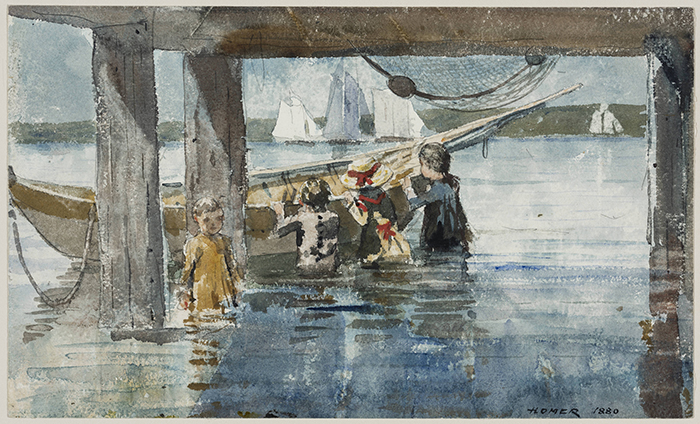
Winslow Homer, Children Playing Under a Gloucester Wharf, 1880, watercolor over graphite on paper, the Museum of Fine Arts, Boston, the Hayden Collection—Charles Henry Hayden Fund. Photograph © Museum of Fine Arts, Boston
3 ⁄8
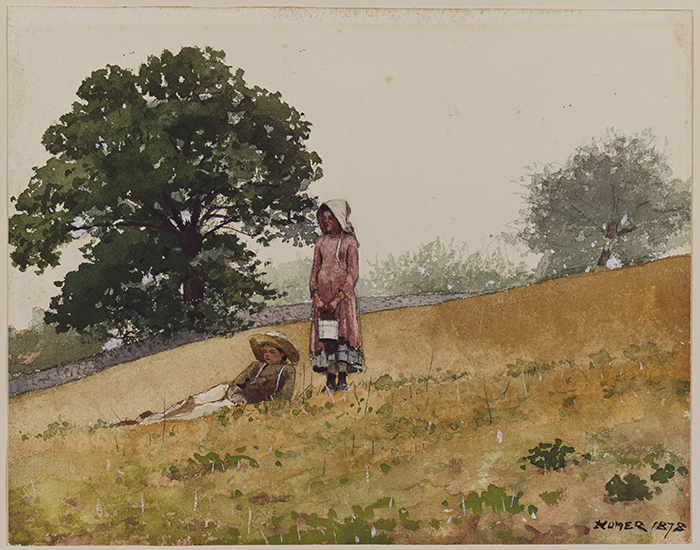
Winslow Homer, Boy and Girl on a Hillside, 1878, watercolor over graphite on paper, the Museum of Fine Arts, Boston, bequest of Katharine Dexter McCormick. Photograph © Museum of Fine Arts, Boston
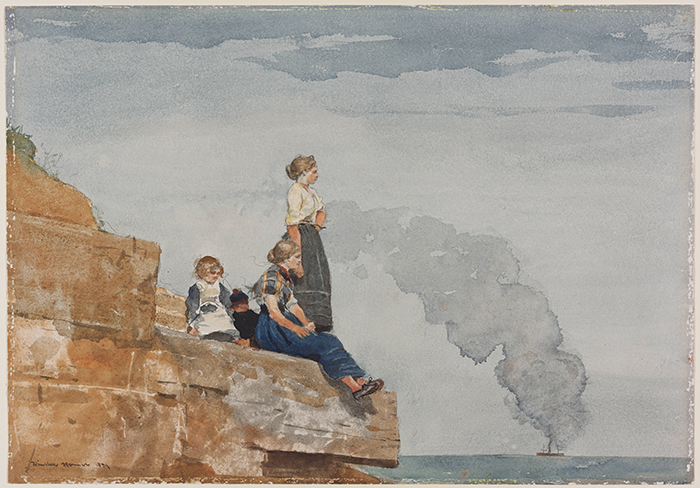
4 ⁄8
Winslow Homer, Fisherman’s Family (The Lookout), 1881, watercolor over graphite on paper, the Museum of Fine Arts, Boston, bequest of John T. Spaulding. Photograph © Museum of Fine Arts, Boston
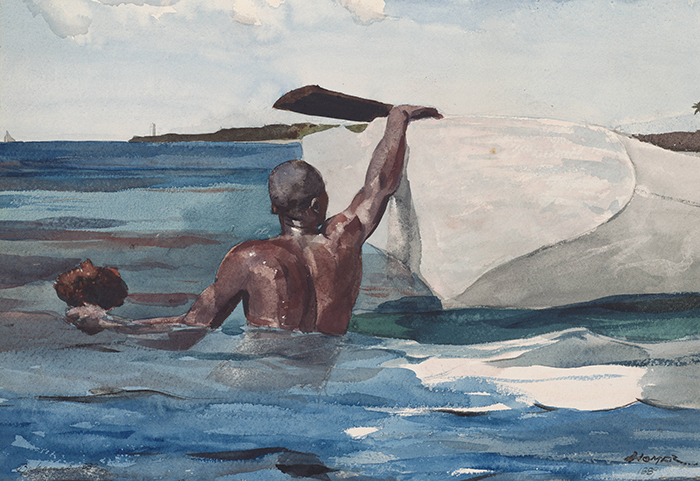
5 ⁄8
Winslow Homer, The Sponge Diver, 1898–99, watercolor over graphite on paper, the Museum of Fine Arts, Boston, gift of Mrs. Robert B. Osgood. Photograph © Museum of Fine Arts, Boston
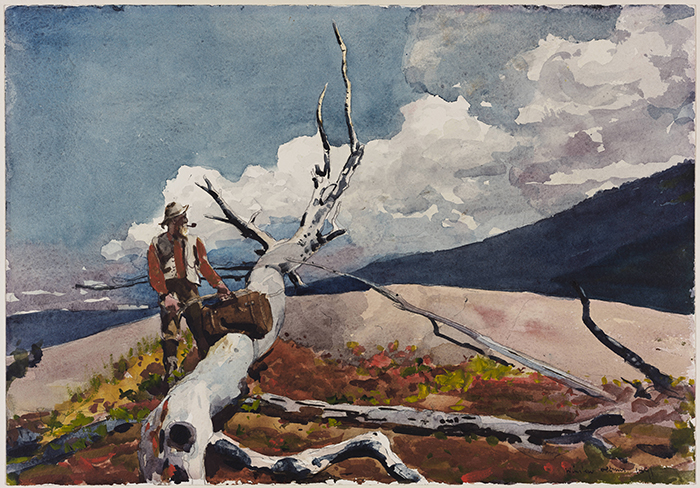
6 ⁄8
Winslow Homer, Woodsman and Fallen Tree, 1891, watercolor over graphite on paper, the Museum of Fine Arts, Boston, William Sturgis Bigelow Collection. Photograph © Museum of Fine Arts, Boston
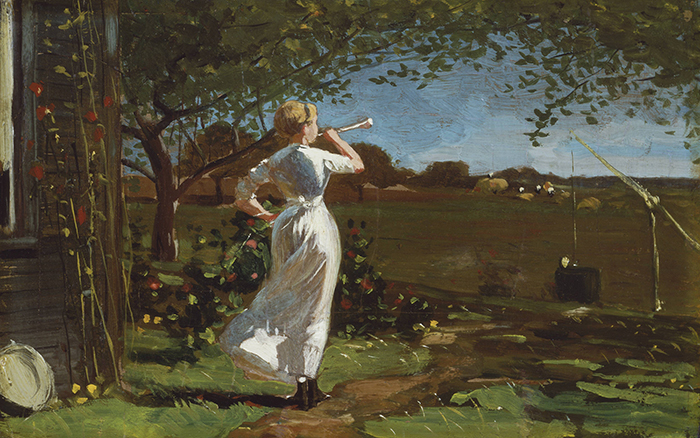
7 ⁄8
Winslow Homer, The Dinner Horn, c. 1870, oil on panel, the Museum of Fine Arts, Boston, gift of Mrs. Charles Sumner Bird (Julia Appleton Bird). Photograph © Museum of Fine Arts, Boston
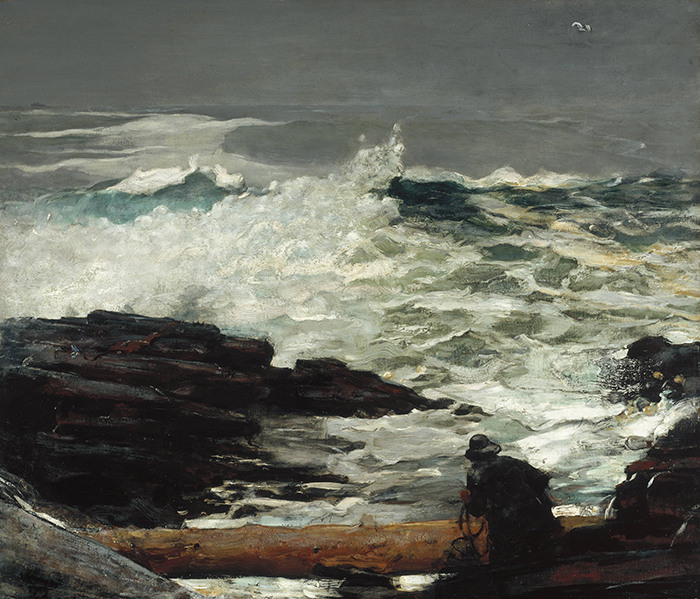
8 ⁄8
Winslow Homer, Driftwood, 1909, oil on canvas, the Museum of Fine Arts, Boston, Henry H. and Zoe Oliver Sherman Fund and funds by exchange from the gift of Maxim Karolik for the M. and M Karolik Collections of American Paintings, 1815–1865, Ellen Kelleran Gardner Fund, bequest of David P. Kimball in memory of his wife Clara Bertram Kimball, bequest of Maxim Karolik, gift of the William H. Lane Foundation, and the Hayden Collection-Charles Henry Hayden Fund. Photograph © Museum of Fine Arts, Boston
Stripping these watercolors of their New England parlor context and dropping them onto the Gulf Coast also alters their regional resonance. In Houston, images of working watermen, rising squalls, and fragile coastlines intersect with an immediate daily reality of maritime labor and environmental volatility.

—JON HOPSON