

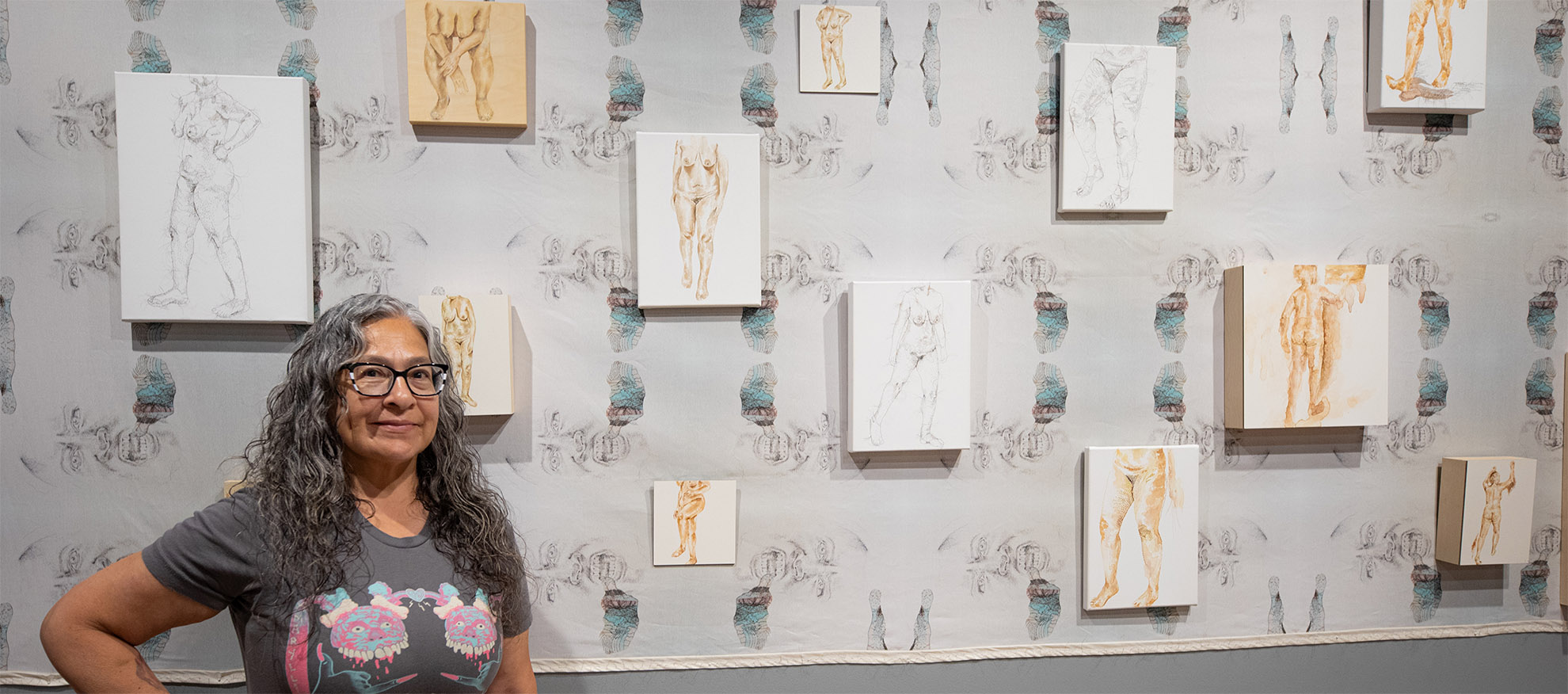

Rosemary Meza-DesPlas is among the godmothers of her craft. Since the early 2000s, the Garland, Texas native has set the standard for how to integrate human specimens in art. All she’s using is hair.

The book’s premise piqued Meza-DesPlas’s interest. “It’s this idea of being seen, being invisible when you’re in the home, but when going in public, you’re visible,” she said. Block shows how “it was so labor intensive to get the hair done and to get the right hairstyle. Preparing to be seen is just kind of an interesting idea to me.”
The American/Spanish/Indigenous artist has amassed a slew of honors, including a Latinx Artist Fellowship by the Mellon Foundation and the Ford Foundation, and a Fulcrum Fund grant. She has exhibited at the Museum of Sonoma County, Marin Museum of Contemporary Art, Art Museum of Southeast Texas, Spartanburg Art Museum, and New Mexico Museum of Art, and currently maintains a studio in Farmington, New Mexico.
As an artist, Meza-DesPlas looks at how to use hair through a cultural lens.

With Aquí, Escuchar (Here, Hear) on view at the Martin Museum of Art at Baylor University through Nov. 7, she remains focused on her longtime themes of identity, history, feminism and acts of resistance intertwined with hair.
Her primary field is drawing, which consistently impresses. In the exhibition are some of the finest representations of her work, including the ghastly Dreamer, 2025, Jane Marches #1, 2020, and Sí Se Puede, 2025. They recall her earliest work: edgy, pungent and full of life.
Trenza, a 2025 video work, is paired alongside her newer soft sculptures, and an installation, The Invisible Woman Syndrome, 2023. They round out the exhibition, which asks why some people make history and some don’t, whose life is discredited, or attributed to someone else, including in feminist history. We’re told, she said, about Susan B. Anthony, and other trailblazing white women.
“But not a lot of Latinas are in the history books, and it’s almost as if ‘wow, they’re not out there.’ But they’re out there.”
1 ⁄7
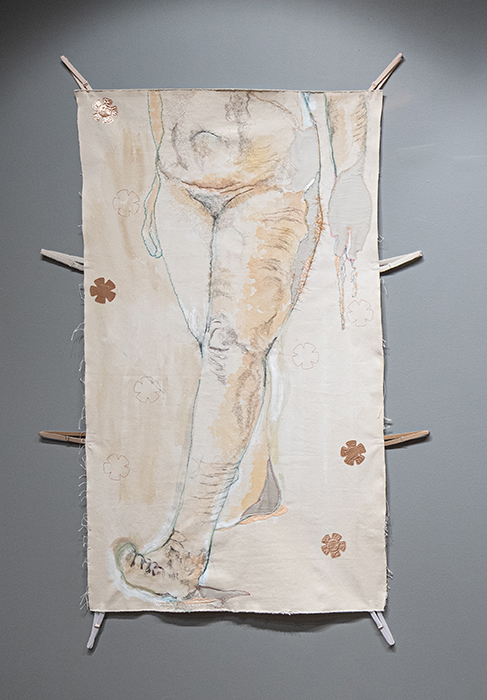
Rosemary Meza-DesPlas, Jane Marches #1, hand-sewn human hair, watercolor washes, fabric, thread and appliques on unprimed & unstretched canvas, bra straps, 60” x 36” x .5”
Photo: Martin Museum of Art.
2 ⁄7
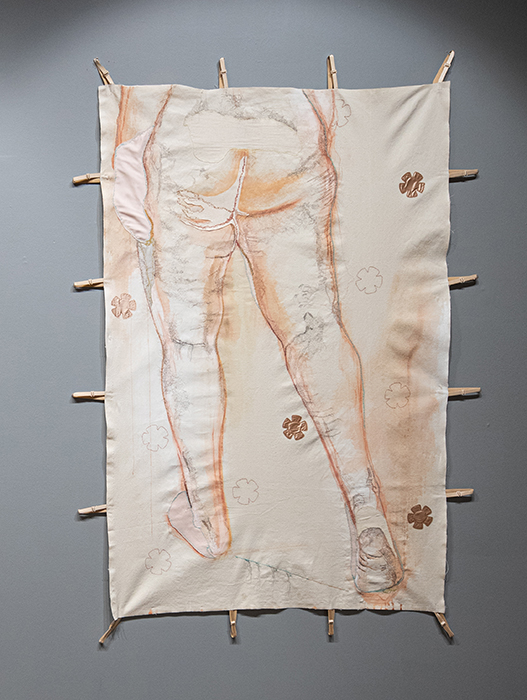
Rosemary Meza-DesPlas, Jane Marches #2, hand-sewn human hair, gesso, conte, fabric, thread & appliques on unprimed & unstretched canvas, bra straps, 61” x 39.5” x .5”
Photo: Martin Museum of Art
3 ⁄7
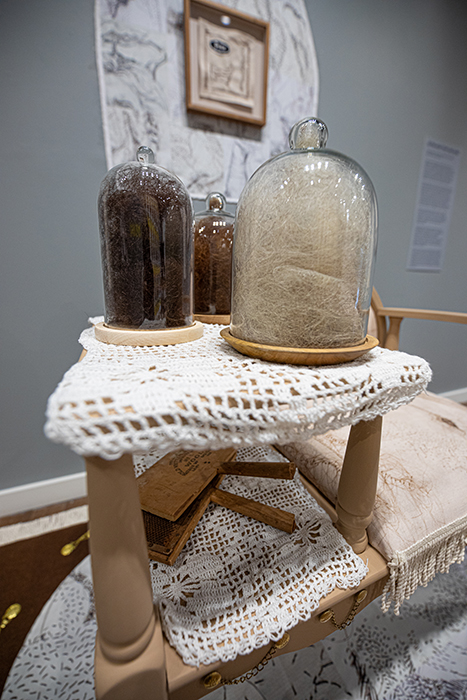
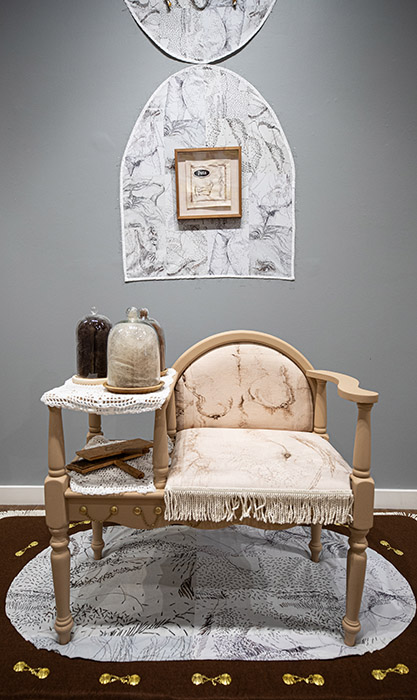
Rosemary Meza-DesPlas, Hair Domes (two), clear glass cloche domes with light wood bases, gray hair and reddish brunette hair, 10” x 7”
Rosemary Meza-DesPlas, Wool Cards, the artist’s grandmother’s wool cards 1870, 9” x 9” x 1.25”
Photo: Martin Museum of Art
4 ⁄7
Rosemary Meza-DesPlas, Están aquí, Textiles, human hair, fiber, repurposed objects, 34 3/4” x 36” x 17, Installation. Photo: Martin Museum of Art
5 ⁄7
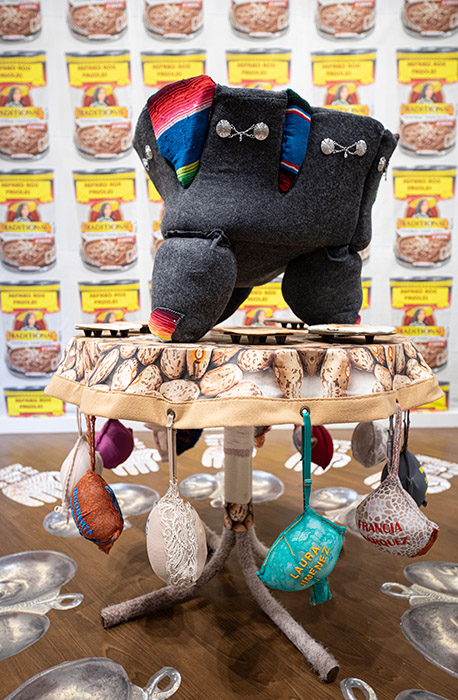
Rosemary Meza-DesPlas, The Invisible Woman Syndrome, fiber, textiles, repurposed objects, mariachi buttons, vinyl, 126” x 162” x 132”, Installation. Photo: Martin Museum of Art.
6/7
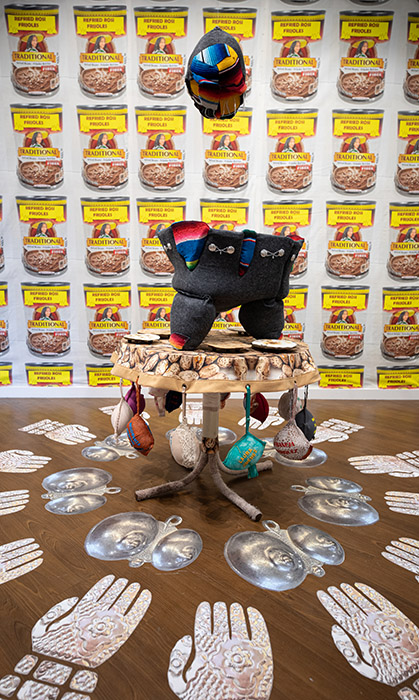
Rosemary Meza-DesPlas, The Invisible Woman Syndrome, fiber, textiles, repurposed objects, mariachi buttons, vinyl, 126” x 162” x 132”, Installation.
Photo: Martin Museum of Art
7 ⁄7
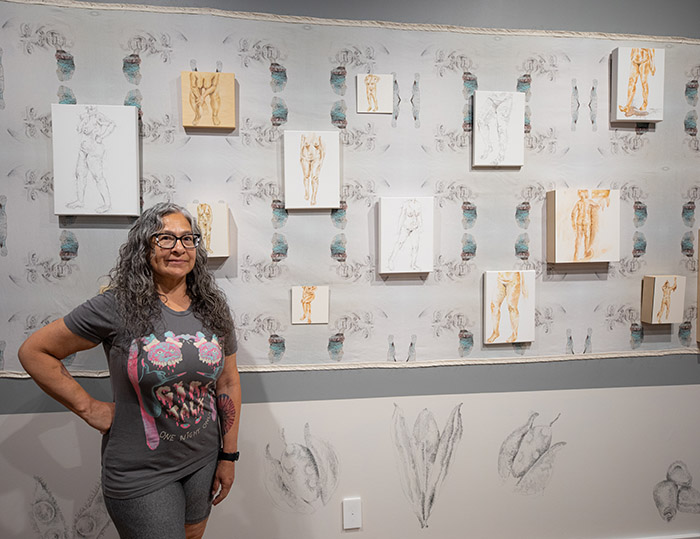
Rosemary Meza-DesPlas, Groundswell, hand-sewn human hair, watercolor, color pencil, pastels, thread, 48” x 144” x 4”, Installation with Rosemary. Photo: Martin Museum of Art.
Among the more recognizable figures is Delores Huerta, whose ally Cesar Chavez sexually assaulted women for years. ( The work was made before that news broke, and not in response to that news.) It’s a hair piece incorporating specialty fabric and a crochet piece of her mother’s. “It’s really juxtaposing Dolores Huerta with my family history.” Her mother’s family were migratory farm workers across the United States who came in from Mexico. “I’m juxtaposing family history, but also the activism of Latinas.”
With the “soft sculptures,” she takes a piece of hair, has it professionally photographed, and then chooses from the best. She sends it to a textile maker to create the fabric. “The fabric is a snippet of my hair piece, so it looks like it has hair coming off of it” to form the soft sculpture.
Among them are new experiments: objects that embody biculturalism. There are also so-called” seeds,” shaped like little seed pods.

“This idea is of seeds going into the Earth but instead of being buried, you’re resilient and the seed just grows and comes back up even stronger,” she said. And so that was why there are the seed pods in the show.
The Martin is an exemplar of the magic of university galleries. They educate and subvert. As an artist who points out what’s missing. Aquí, Escuchar (Here, Hear) is Meza-DesPlas at her prime, and the venue is the best choice to welcome her back to Texas.
—JAMES RUSSELL