

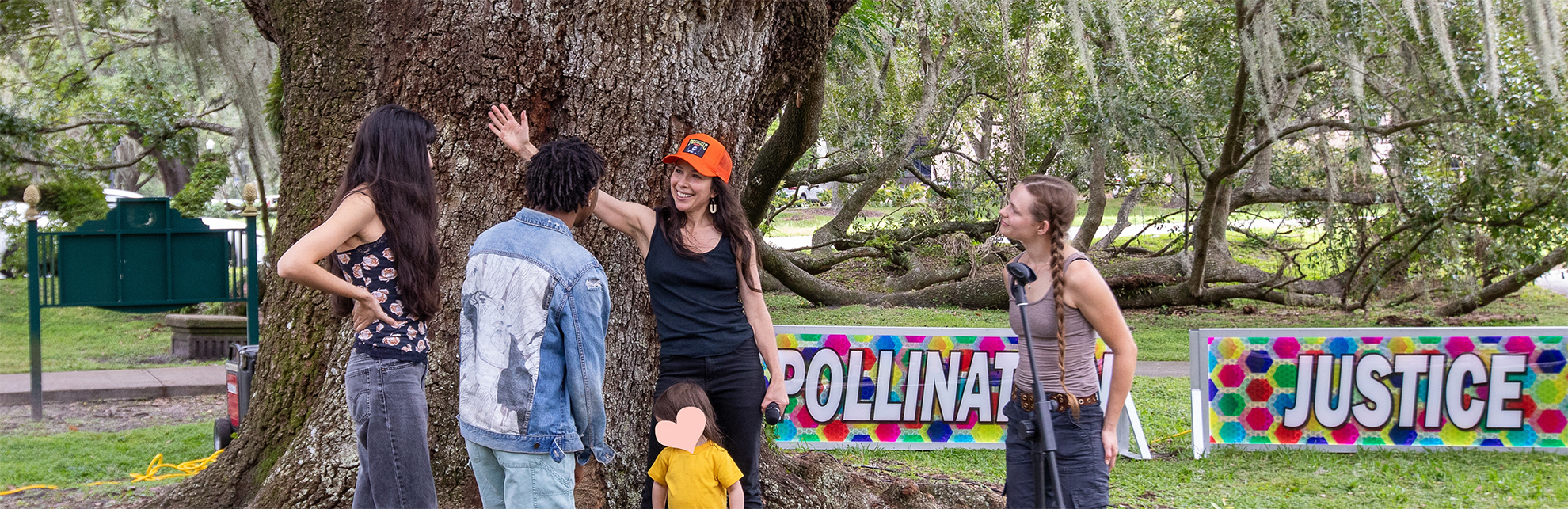

A voice travels from one homeland to another, crossing distances without collapsing them. Eighty-four quilts gather beneath a community, each holding the memory of hands, conversations, and questions stitched over more than a decade. Elsewhere, a tree enters the earth; its care extends beyond the lives of those gathered to witness it.

“For many years, I have tried to make performance works that are in relation to the world; the world outside of the theater, but also the world in relation to land and other beings,” Johnson explained. “I started to think about how we could support a resonance from a performance moving forward. That supportive architecture could be energetic, spiritual, or actual; it could be some sort of scaffold for ongoing, meaningful action in the world.”
In October, DiverseWorks in Houston hosts Overflow Radio: Šakotayišol Nunuš Constellation in conjunction with the project’s world premiere in Mni Sóta Makoce, or Minneapolis. Houston’s constellation will include an exhibition, performances, talks, skill-shares, meals, and listening gatherings synchronized with the Minneapolis broadcast. Over 24 nonconsecutive hours, audiences will hear 12 First Nations and Indigenous authors, poets, and scholars speaking live from their home territories through a low-power micro-FM transmission.
Radio carries particular significance for Johnson, who grew up in rural Alaska, where geographic distance makes broadcasting an essential structure of communal life.
Listening, in Johnson’s work, is neither passive nor incidental. It is a technology, one of several familiar practices, that Overflow Radio reorients toward collective survival. Johnson structures the project around four interdependent themes: making, body, land, and protection. These appear through performances and broadcasts, but also through food sovereignty, somatic practices, plant knowledge, and the sharing of practical skills.
The gathering takes place within 84 handmade quilts designed by Ojibwe textile artist Maggie Thompson and sewn with communities over the past decade. Individually distinct, the quilts join to create a single 4,000-square-foot design. Inscribed upon them are responses to questions about well-being, collective care, land defense, and the futures participants wish to inhabit.
“They are vessels,” Johnson said. “They hold the energy of this decade-long process of stitching and gathering, and they hold the actual thoughts, visions, and thinking of multitudes of people. We all make, but how can we make with the intention that we are creating a better future together? That might be a quilt, a drawing with your child, a tool, or a dance.”
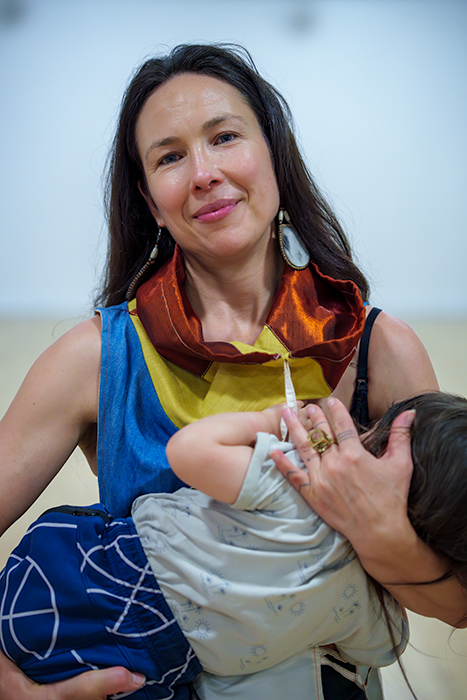
1 ⁄5
Emily Johnson, Headshot. Photo by Frederick Rhodes / flightbulb. Courtesy of Emily Johnson / Catalyst and DiverseWorks.
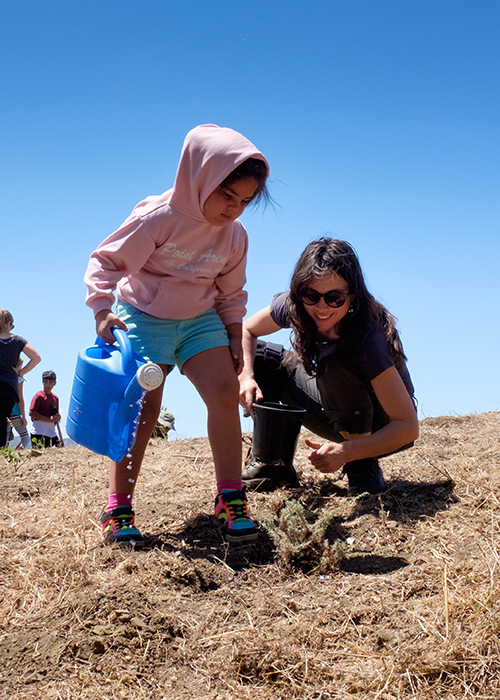
2 ⁄5
Emily Johnson / Catalyst, SHORE, Community Action. Pictured: Emily Johnson and participant. Yelamu, 2015. Photo by George Slavik. Courtesy of Emily Johnson / Catalyst and DiverseWorks.
3 ⁄5
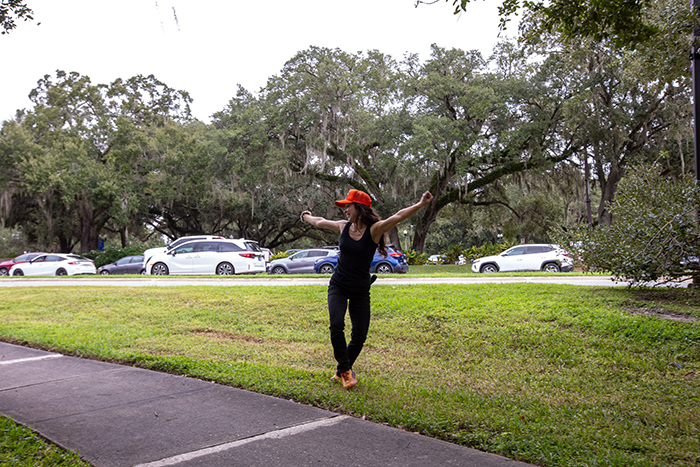
Emily Johnson / Catalyst, Art Pollination. Pictured: Emily Johnson. Orlando, Florida, October 2025. Photo by Macbeth Studio, Orlando. Courtesy of Emily Johnson / Catalyst and DiverseWorks.
4 ⁄5
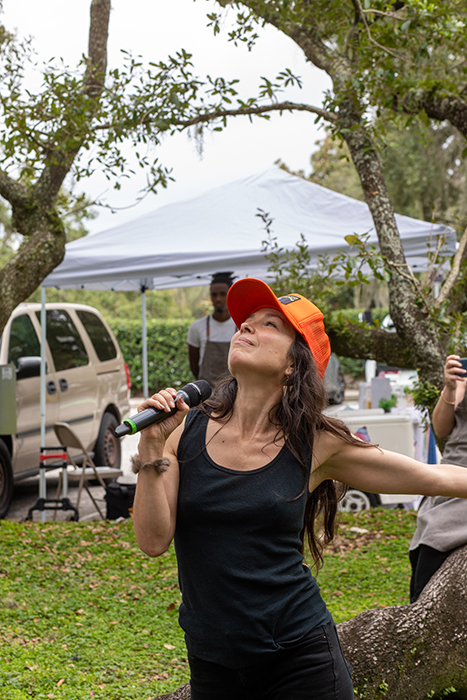
Emily Johnson / Catalyst, Art Pollination. Pictured: Emily Johnson. Orlando, Florida, October 2025. Photo by Macbeth Studio, Orlando. Courtesy of Emily Johnson / Catalyst and DiverseWorks.
5 ⁄5
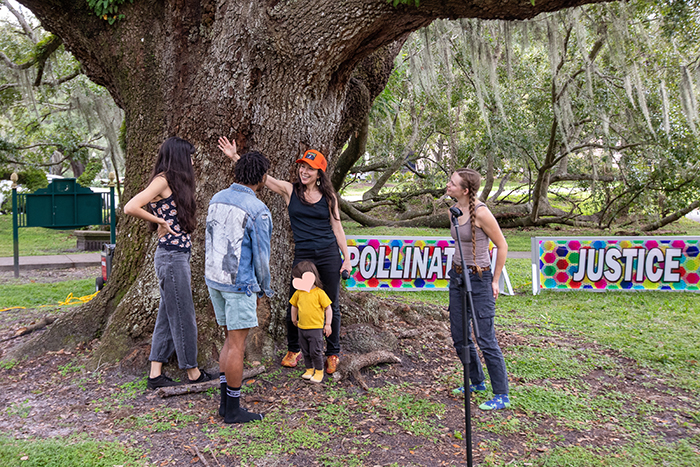
Emily Johnson / Catalyst, Art Pollination. Pictured: Emily Johnson. Orlando, Florida, October 2025. Photo by Macbeth Studio, Orlando. Courtesy of Emily Johnson / Catalyst and DiverseWorks.
Johnson is celebrated for her large-scale social choreographies, works in which dance exceeds the arrangement of bodies upon a stage. Choreography becomes an invitation into relationship, and the audience assumes some responsibility for what the gathering makes possible.
“How do we witness a dancer who is tuning all of themselves toward justice in a way that might begin to tune us toward justice as well?” Johnson asked. “There is a conversational element and an exchange that are part of the portal I need to help open, and that people have to be willing to engage in. Gathering together is the initial and most important act. Everything I make, offer, and encourage from that gathering point becomes what is possible.”
That possibility takes material root in the project’s commitment to plant 1,000 trees in each place it travels. The visible act of planting is only a beginning. Johnson imagines a network through which tree-carers can request help, exchange knowledge and recipes, document growth, and sustain relationships with the trees and one another.

Here, overflow is not excess. It is what cannot and should not be contained: a radio wave moving invisibly through the room, a question carried home, a quilt wrapped around another body, a tree outliving the moment of its planting. The artwork remains unfinished because the relationships it calls into being must continue to be lived.
—MICHAEL McFADDEN