

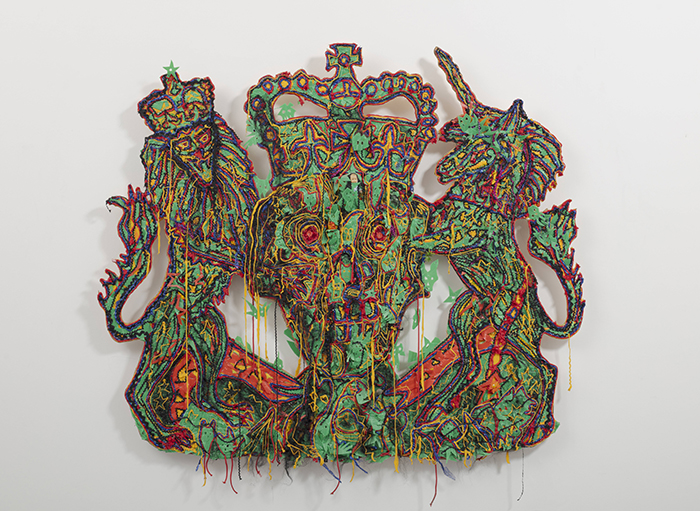
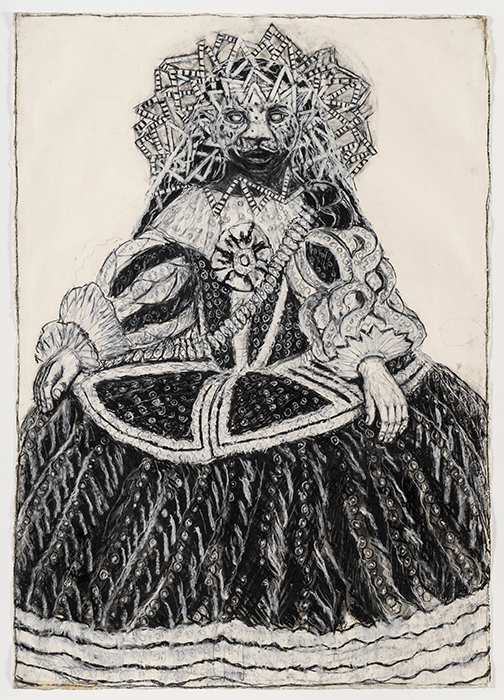
Salt-crusted hulls drift through the galleries of the Museum of Fine Arts, Houston. Royal crests swell with beads, plastic trinkets, artificial hair, medals, chains, and glittering excess. Across charcoal-blackened paper, the faces of Spanish infantas emerge from another century, pulled forward into the unstable present. In Hew Locke’s world, history does not sit still. It creaks, mutates, travels. It arrives by ship.

The exhibition’s title carries layered meanings. “I suppose it’s like the journeys through life, journeys through different sets of work, passages through different types of work I’ve done over the years,” Locke reflected. Looking back through the exhibition catalogue, he said, “I’ve gone down many routes, I suppose many passages, and I’m going, ‘God, I forgot I’d done that. I forgot I did that.’”
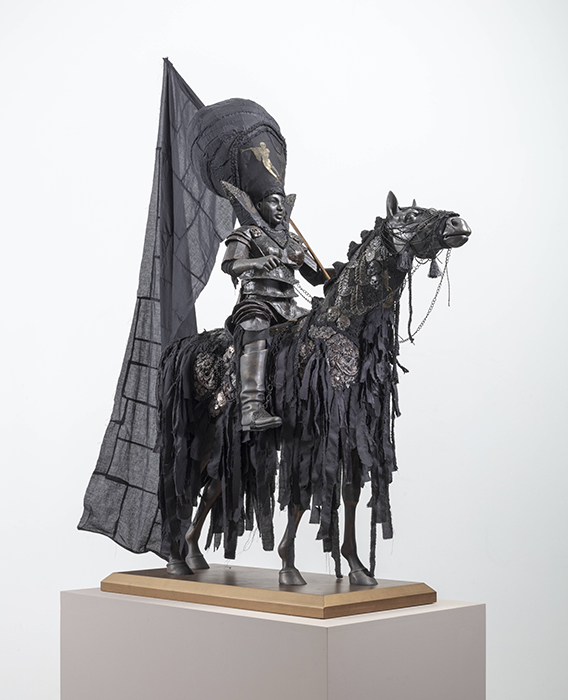
That sense of movement threads through the exhibition. Locke was born in Edinburgh in 1959, moved with his family to Georgetown, Guyana, in 1966, and returned to Britain in 1980. His work moves similarly, drifting between geographies and temporalities while tracing the routes of colonialism across five continents. Suspended ships invoke the transatlantic slave trade and contemporary refugee crises; altered royal insignias collapse systems of authority into carnivalesque excess; commemorative monuments become unstable, uncanny relics.
For Brittany Webb, curator of modern and contemporary art at the MFAH, the exhibition’s organizing principle lies in these interconnected histories. “One of the major ways we’ve been thinking about the importance of this exhibition is the way that Locke has consistently thought about nation making and nation building in concert,” she explained. “The way that his work really urges us to think about the fact that you can’t think about the history of the United Kingdom without thinking about the history of all of these colonies that have contributed to it.”
Those histories arrive materially dense and visually seductive. Webb described the exhibition as an environment meant to first overwhelm visitors with wonder. “There’s so much mixed medium materials, the photography, the found objects, the way that they come together in so many unexpected ways, that there’s a visual density to it that can appeal to you, even if you can’t necessarily tease out all of the histories that richly inform the work.”
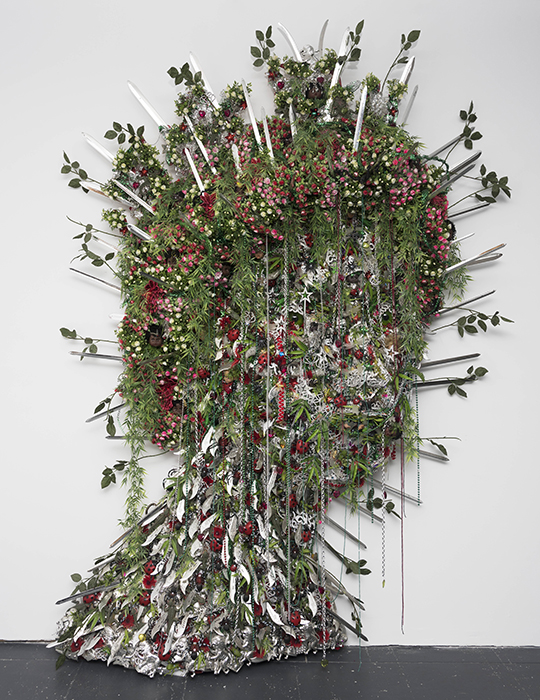
That tension between beauty and violence has long animated Locke’s practice. His works shimmer. Brass glows like gold. Beads cascade across surfaces like ceremonial armor. Toys, trinkets, tassels, medals, and synthetic fabrics accumulate into theatrical assemblages that feel celebratory until the viewer begins to recognize the histories embedded within them.
“History is messy, man,” Locke said bluntly. “People do good things and people do not such good things. And that’s just how it is.” Still, he refuses despair. “I can’t live in misery. So, I’m a big fan of beauty, you know, but it’s a messed-up form of beauty.”
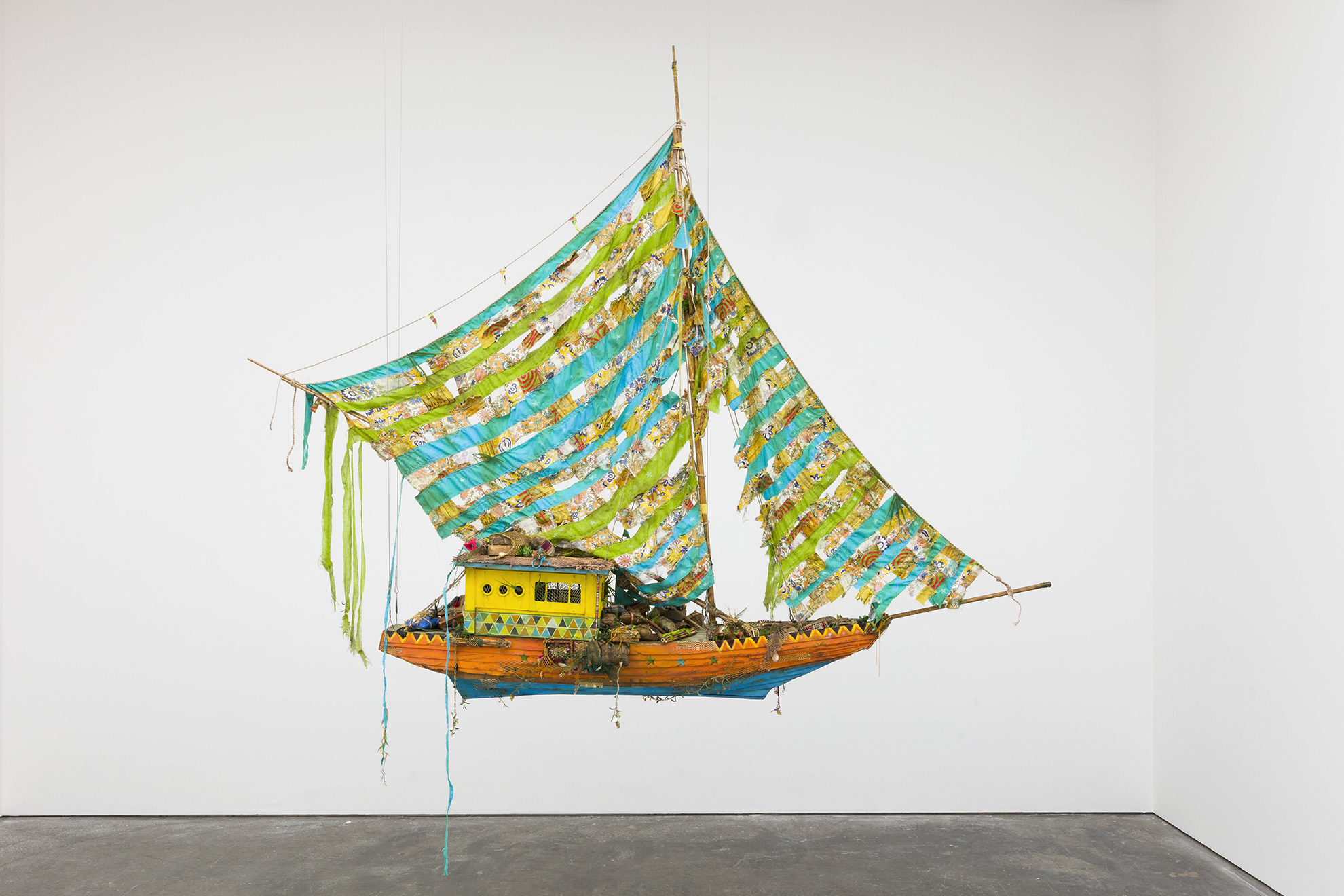
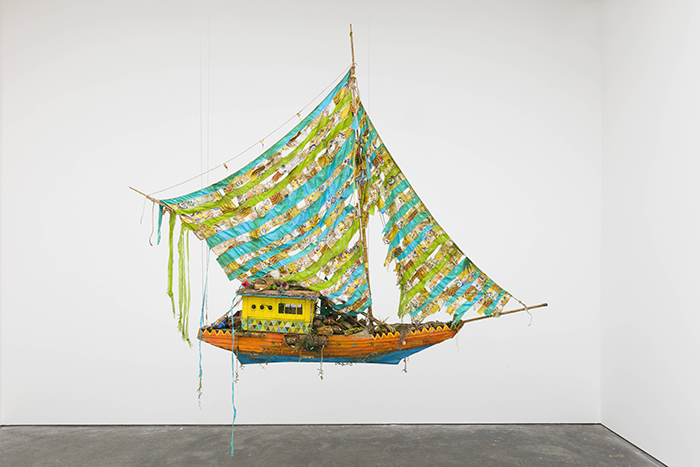
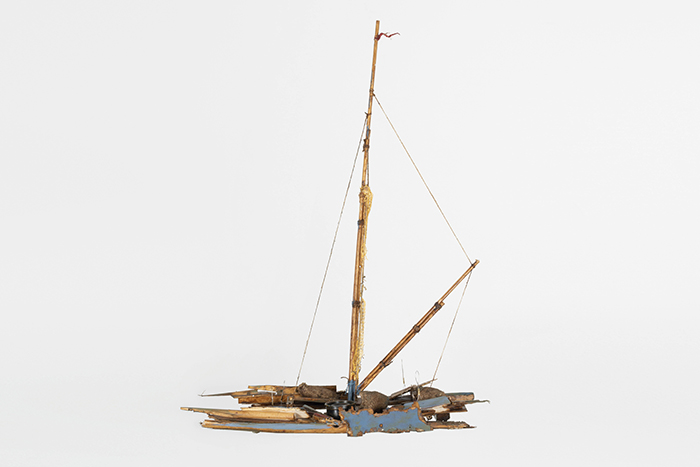
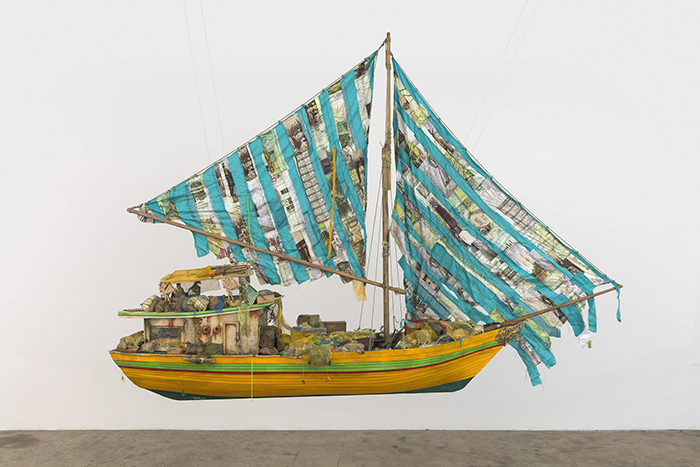
Perhaps nowhere is that tension clearer than in Locke’s recurring ship imagery. Vessels appear throughout Passages, suspended overhead or clustered together in flotillas that evoke migration, commerce, conquest, escape, and survival all at once. The ship, for Locke, is both personal and universal.
“Growing up in Guyana, which has now got obviously very close ties with Houston, Guyana, the name means, in an Amerindian word, it means land of many waters,” he explained. “And to get anywhere, you have to travel by boat.”
As a child living near Georgetown’s seawall, Locke watched ships emerge slowly over the horizon. “We’d watch boats come over the horizon and coming to port and then slowly leave and just wonder where are they going? What’s their cargo? What are they doing?” he recalled. “And it’s about dreaming, hoping. Boats are great, you know, ships are great.”
Those ships also became spiritual objects for the artist. Locke described encountering votive ship models suspended inside Portuguese chapels and European cathedrals, offerings left behind by sailors who survived storms or long voyages. The symbolism stayed with him. “The sea is a great leveler,” he said. Whether aboard a luxury cruise liner or a fragile raft, every traveler remains vulnerable to the same waters.
1 ⁄10
2 ⁄10
3 ⁄10
Hew Locke, Where Lies the Land? 2, 2019, acrylic on wood with metal, plastic, textile, enamel, and found objects, the Museum of Fine Arts, Houston, museum purchase funded by the Caroline Wiess Law Accessions Endowment. © 2019 Hew Locke; photo courtesy of the artist and Hales Gallery, © Angus Mills Photography
4 ⁄10
Hew Locke, Where Lies the Land? B, 2019, acrylic on wood with metal, plastic, textile, enamel, and found objects, the Museum of Fine Arts, Houston, museum purchase funded by the Caroline Wiess Law Accessions Endowment. © 2019 Hew Locke. photo courtesy of the artist and Hales Gallery, © Angus Mills Photography
5 ⁄10
6 ⁄10
7 ⁄10
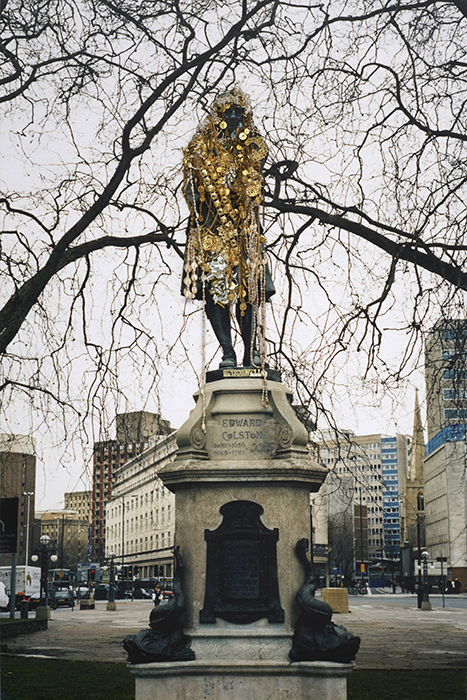
Hew Locke, Koh-i-Noor, 2005, mixed media mounted on wooded board, Brooklyn Museum, gift of Charles Diamond and bequest of Richard J. Kempe, by exchange, 2007.54. © Hew Locke
8 ⁄10
9 ⁄10
10 ⁄10
Hew Locke, The Survivor, 2018, wood and mixed media, Des Moines Art Center Permanent Collections, purchased with funds from the Ellen Pray Maytag Madsen Sculpture Acquisition Fund, 2023.23. © Hew Locke
That resonance feels especially potent in Houston, a port city shaped by migration, industry, hurricanes, and environmental precarity. Webb noted that the exhibition’s concerns mirror many of the city’s own histories. “There are so many places on this coast that are made by things coming into land and going out to sea,” she said. “That’s people, that’s sediments. The idea that the sea is a great leveler that has brought so many of us here and is something that we reckon with all the time.”
Locke’s practice often begins with curiosity rather than certainty. He repeatedly returns to symbols of monarchy and empire not to reinforce them, but to pry them open. Early in his career, he became interested in drawing Queen Elizabeth II precisely because it felt deeply unfashionable within contemporary art. “When things are unfashionable and uncool, that’s when I get interested,” he said.
The result is work that destabilizes official narratives without collapsing into didacticism. Locke approaches history less like a lecturer than a storyteller rummaging through the debris of empire. Medals, heraldry, and monuments become strange theatrical props capable of exposing how nations construct identity and authority.
That instinct gives Passages its emotional weight. The exhibition does not present history as distant or settled. Instead, Locke reveals it as something still alive inside contemporary systems of migration, trade, nationalism, and memory. The ships continue moving. The monuments still loom overhead. The sea keeps rising.
For Locke, the hope is that viewers recognize themselves somewhere within these crossings. “I’m making work to connect with human beings,” he said. “I’m trying to connect with something which is universal, at least I hope so.”
—MICHAEL McFADDEN