
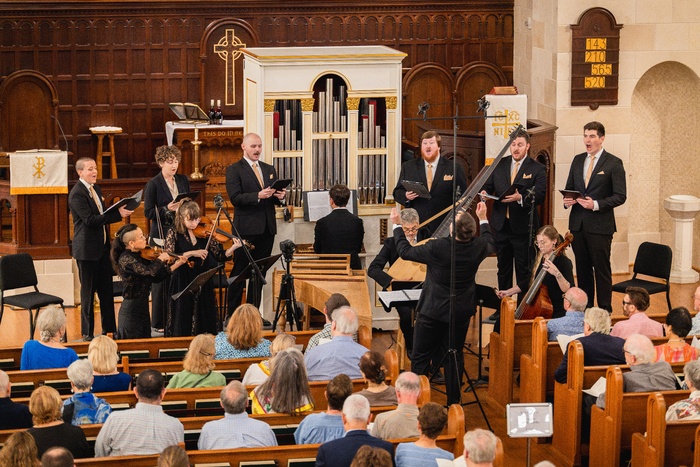
The Harmonia Stellarum concert experience is completely unique. After a succinct introduction in which Mario Aschauer, Artistic Director of this superb Houston-based ensemble, puts the music in historical context, the concert begins and the audience enters a state of flow that continues until the last note has sounded. There is no clapping between pieces or sets. For an hour, one is wholly absorbed in the rich sound world created by the musicians, whose astonishing artistry brings each piece to vivid life.

The seven programs of Harmonia Stellarum’s fifth season invite the audience to experience the festive splendor of Mozart’s “Coronation” Mass, a rediscovered opera composed by Emperor Ferdinand III, the inimitable multi-choir sound of Praetorius and Schütz, the poetic voice of Sigismondo d’India, a rarely heard composer at the radical edge of the Late Renaissance and Early Baroque, musical gems inspired by Maria Amalia of Austria, Duchess of Parma, music for evening prayer (Vespers) by Monteverdi and his Venetian contemporaries, and finally the glow of the Romantic age with Mendelssohn’s luminous Psalms.
Mozart’s “Coronation” Mass is an ideal season opener (Sept. 13, 2026). “It’s music for celebration,” says Aschauer, “and we’ve now built a little bit of a reputation with Mozart.” In seasons past the ensemble has already featured the composer’s Missa Solemnis K. 66, his Vesperae solennes de Domenica and “Organ Solo” Mass, as well as his keyboard works on the group’s new fortepiano. Mozart is one of Aschauer’s favorite composers. He even named his dog Wolfgang.
In Mozart’s time, Salzburg was ruled by Prince-Archbishop Colloredo, who was both the religious and political leader of the city. “This combines the two realms of the sacred and the secular,” explains Aschauer. “For the court celebrations, which are driven by the church calendar, the court chapel would perform and new music would be required. All the stops would be pulled out for the occasion.” By “all the stops” Aschauer means in particular the instrumentation, the use of trumpets, horns, oboes, and timpani; and the choice of key, in this case C Major. “You will have this extremely pure festivity of the trumpets with our organ in mean tone, lining up for an amazing sound experience.” The composition later became one of Mozart’s greatest hits after his death. It was played in the court chapel of Vienna and then used for coronation celebrations for multiple emperors, acquiring the nickname “Coronation” along the way.

Aschauer is spending the summer turning the existing parts into a performance score. “I don’t think there is a disparity in the quality,” Aschauer emphasizes. “If people held jobs at the time, I don’t think they wrote bad music. The whole masterworks question is not very interesting. If we give it dedication and passion, it is worth hearing. I want to create an atmosphere where people feel welcome to art, and art alone. And afterwards we celebrate it. The equation is incredibly simple. It’s very important for us to build that rapport with people so they come knowing the Harmonia experience is going to be awesome, no matter what the names are.”
Another exciting premiere on tap for this season is Ferdinand III’s Drama Musicum (Oct. 25, 2026), the earliest known opera at the imperial court of Vienna, composed in the 1640s by the emperor himself with a libretto by his brother Archduke Leopold Wilhelm. Aschauer is enchanted by the fact that “a political leader was so into the arts that he actually does it himself.” He points out that there was even correspondence between the brothers regarding the composition. Ferdinand wrote that he had shown the music to his teacher Giovanni Valentini. “He took it so seriously that although he was the emperor, he would sincerely take his teacher’s criticism into account.”
And there is an even more remarkable connection to the work. The emperor sent a copy of the manuscript to German polymath Athanasius Kircher, from whose music theory treatise (Musurgia Universalis) Harmonia Stellarum takes its name. That manuscript disappeared and was recently traced to the Library of Congress by Austrian musicologist Herbert Seifert, who happened to have been Aschauer’s thesis advisor. This performance of Drama Musicum will be the first modern presentation based on the rediscovered source. Emperor Ferdinand III’s music is already familiar to the Harmonia audience, as both he and his teacher Valentini were featured on last season’s program of madrigals, another musical thread carried forth.
1 ⁄8
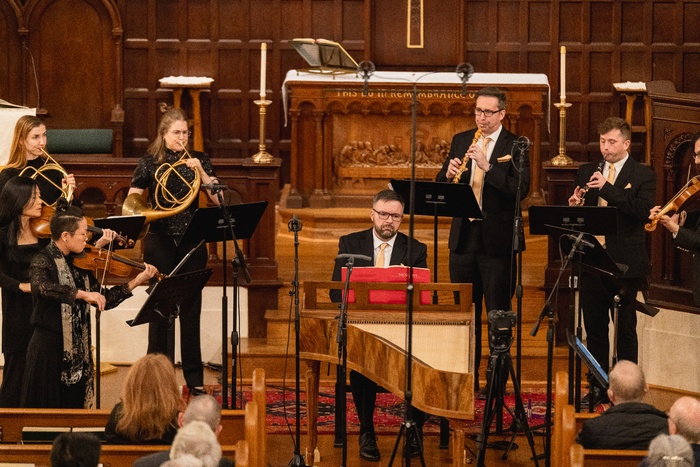
Harmonia Stellarum performs madrigals by Claudio Monteverdi and his contemporaries. Photo by Carlo Resti Ruano.
2 ⁄8
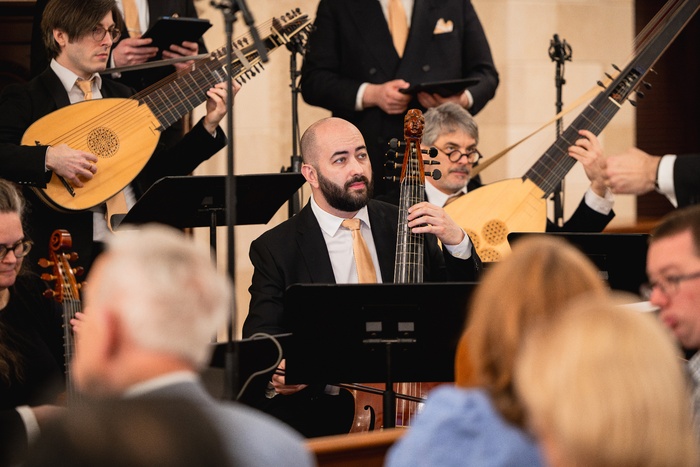
Members of Harmonia Stellarum perform on lutes and viols of various sizes. Photo by Carlo Resti Ruano.
3 ⁄8
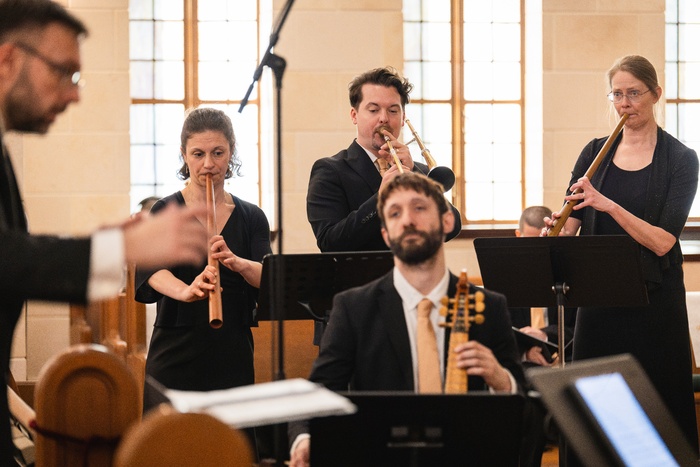
Members of Harmonia Stellarum perform on cornetto, sackbut, and viola da gamba. Photo by Carlo Resti Ruano.
4 ⁄8
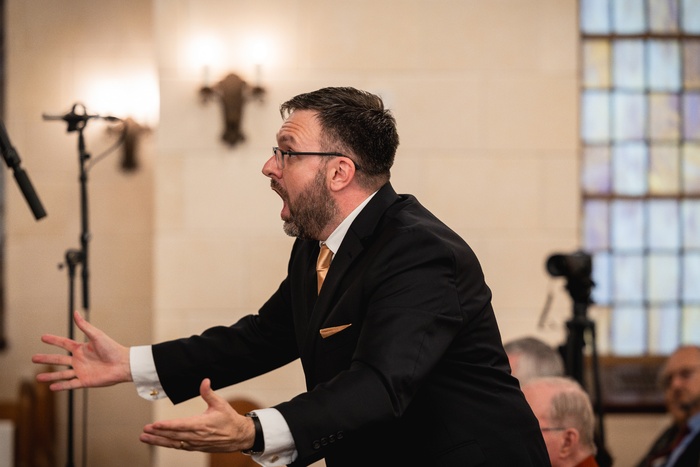
Harmonia Stellarum founder and Artistic Director Mario Aschauer. Photo by Carlo Resti Ruano.
5 ⁄8
Harmonia Stellarum performs a Mozart piano concerto on historical instruments. Photo by Carlo Resti Ruano.
6 ⁄8
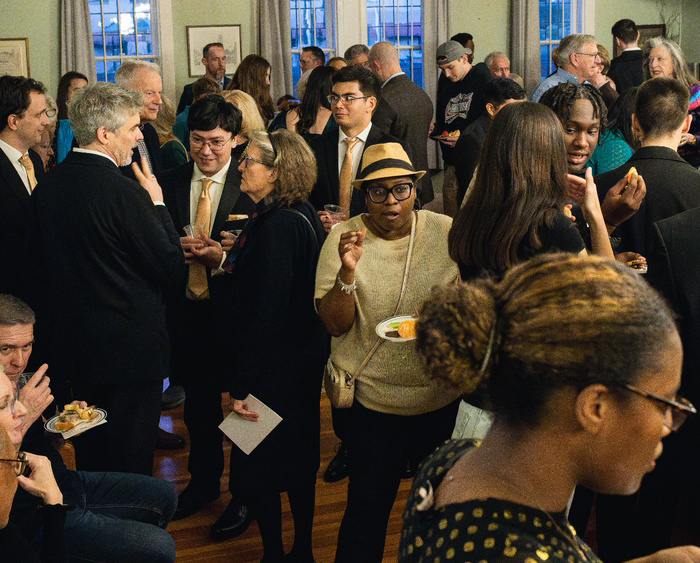
Audience members and Harmonia Stellarum musicians in lively conversation at post-concert reception. Photo by Carlo Resti Ruano.
7 ⁄8
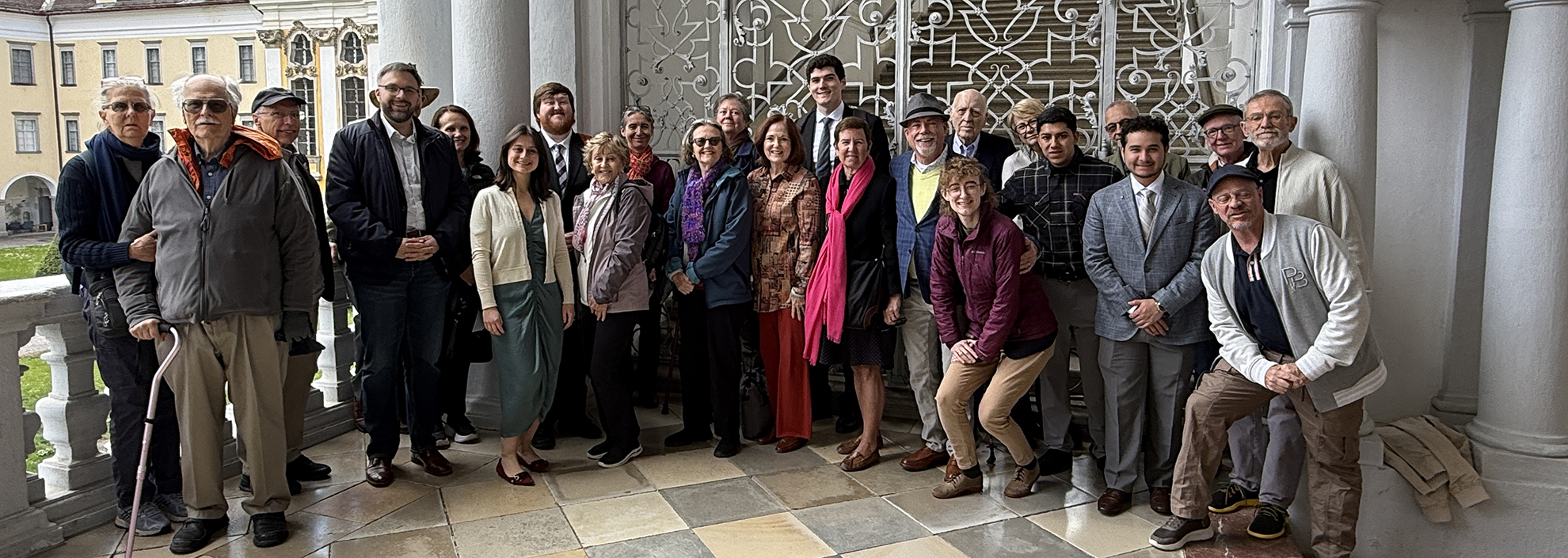
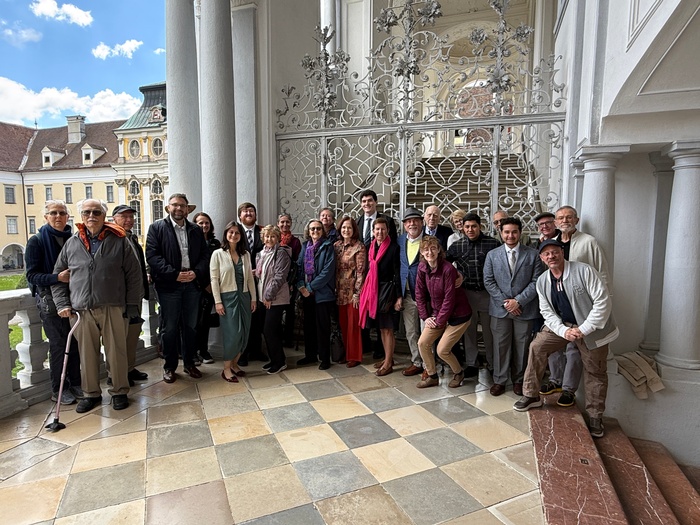
Members and supporters of Harmonia Stellarum visit the historic Augustinian Abbey of St. Florian during the ensemble’s tour of Austria. Photo courtesy of Harmonia Stellarum.
8 ⁄8
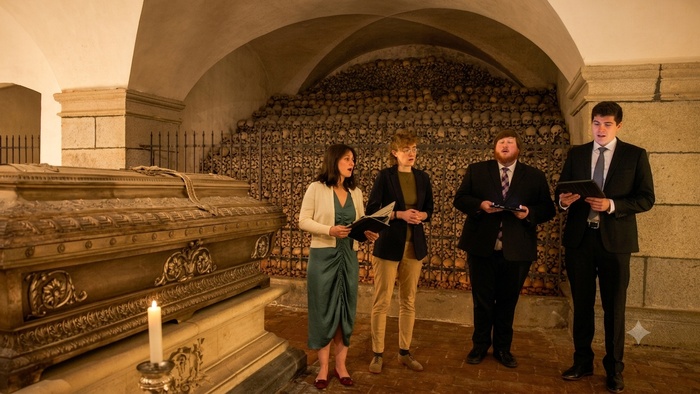
Harmonia Stellarum singers performing next to Anton Bruckner’s tomb in the crypt of the Augustinian Abbey of St. Florian during the ensemble’s tour of Austria. Photo courtesy of Harmonia Stellarum.
Chorale concertos by Praetorius and Schütz ring in the Advent season (Dec. 6, 2026). At a time when Italian sacred music, influenced by madrigals, was becoming more flamboyant and theatrical, German composers began putting their own Protestant spin on their sacred vocal works, namely the chorale.
“Most of these chorale melodies you would know by heart,” says Aschauer. “You can create incredible subtexts with these melodies because they have meaning. They are recognized.” Praetorius and Schütz used these melodies and merged them with the chorale concerto idea, creating a breathtaking, polychoral edifice of sound. Aschauer points out that over the years, more or less by coincidence, it has become a tradition for the audience to sing along in the Advent concert. “This year we are expanding on that,” says Aschauer. “Eighty high school students will be singing with us.” What a wonderful way to celebrate the Advent season.
The new year begins with an entire program of madrigals and monodies by Italian composer Sigismondo d’India, an unfamiliar name to most people (Jan. 10, 2027). “This one is all him,” says Aschauer. “I feel like sometimes you get a better idea of a person when you just let him speak. D’India is an interesting character for his musical language. He is Roman, which is much more south than all the other music we typically do from that period. So it’s really a bit of a blind spot on the map and I always think that’s exciting.”
The madrigal is essentially a genre of the 16th century, and this is the last peak when the genre becomes less flashy and much more sophisticated. D’India reshapes the music around poetry with contrasting textures, expressive chromaticism, and dramatic text-painting. “We are at a point where our audience loves the madrigal as a genre, having experienced Monteverdi’s 8th book, 6th book, and the mixed program this season. This is taking a half step towards a new goal.” D’India’s music is often found in textbooks but not as much on recordings, which led Aschauer to ask the question, “if we think he is important for the development of the madrigal, why do we not perform him?” It turns out much of his music is unedited and inaccessible, so Aschauer will take the time to make the score performance-ready himself.
Monteverdi has been an important thread for Harmonia Stellarum programming since season one (April 4, 2027). “One of my dreams is to do a Vespers service, with the whole shebang,” says Aschauer. “It’s almost theater music in that sense, with the seven coped priests, the incense, the ritual. Monteverdi was an opera composer. He knew about drama. He knew about timing. We can have this music in that context, as if accompanying something on a stage.” Aschauer will aim to bring out the theatrical in the beauty of these liturgies. “I want to at least sonically put the music back together into a setting, so that if you close your eyes, you could hear what you would have heard in 1630, [in the time of Monteverdi and his contemporaries.] It is a celebration for all the senses.”
The season finale takes the audience into the Romantic period with Mendelssohn’s Psalms for Eight Voices (May 9, 2027). These psalms will close the season by tracing a historical arc, from Renaissance polyphonic models to the contrapuntal discipline of the Baroque, Lutheran choral traditions to a new Romantic musical language. Composed for eight independent vocal lines, these psalms are ideal for displaying the sublime artistry of Harmonia Stellarum’s core singers. “This is what our singers love. They can show the more intricate details of the music and it’s more see-through. We have a group now who really likes to engage with each other. Together they yield a body of sound that is incredible. All the voices come to life.”
Aschauer recalls an unforgettable moment from this summer, when he took a group of Harmonia Stellarum singers along with patrons on a 10-day “Musical Austria” tour. Four singers stood beside Anton Bruckner’s tomb in the crypt of St. Florian Abbey and sang his motet Locus iste. It was a spontaneous and sublime moment of communion with the spirit of the composer, in the place where he lived as a choir boy, served as its organist, and now rests eternally beneath his beloved organ. Aschauer says it so well. “Moments like these remind us that great music isn’t only found in scores. It is found in places, instruments, and the lives of the people who shape them.”
—SHERRY CHENG