

The house turns before anything else does.

On view at Contemporary Arts Museum Houston through Nov. 1, 2026, Mary Ellen Carroll: How To Talk Dirty and Influence People is the artist’s first major museum survey, an exhibition that attempts to trace the sprawling, shape-shifting logic of a practice that has persistently resisted containment. Spanning works from the 1980s to the present, the exhibition gathers performance, film, architecture, photography, writing, policy interventions, and documentation into a constellation of projects that examine power, bureaucracy, sexuality, infrastructure, environmental collapse, and the unstable relationship between language and authority.
The exhibition’s title, borrowed from Lenny Bruce’s 1965 autobiography, offers an immediate clue into Carroll’s sensibility. Humor, misdirection, and provocation course through the exhibition, not as ornamentation but as operative strategy. Senior Curator Rebecca Matalon points to the title’s connection to Carroll’s 2004 work All the men who think they can be me, itself drawn from a heavily redacted page of Bruce’s autobiography.
“Bruce’s autobiography is rife with fabrications and falsehoods. Lies, misdirection, imitation—these are all ongoing themes in Carroll’s work,” Matalon explained. “Bruce and Carroll’s shared sensibility—their mischievous antics and unrelenting commitment to tell it like it is—run through their work (whether that’s stand-up comedy or visual art) and this exhibition. The title also indexes the ways in which much of Carroll’s work is bound up in forms of exchange—between people, institutions, bureaucracies—and attests to the artist’s wild and irreverent ability to put outlandish ideas into action through forms of negotiation.”

“There have been so many different waves of institutional critique over the last 100 years, if not more,” Matalon noted. “I think that Carroll is part of this legacy, particularly one that includes Michael Asher, Mierle Laderman Ukeles, Adrian Piper, and Lee Lozano. But the context in which Carroll started making work in the early 1980s and into the 1990s is important—the AIDS crisis, the Gulf War, the Culture Wars, all of these political and social crises informed their practice, just as more contemporary issues such as technological innovation, environmentalism, and immigration inform the work now. I think Carroll would say that their work is fundamentally about putting ideas into action rather than making a circle around a problem.”
That impulse animates prototype 180, perhaps Carroll’s best-known project and one deeply embedded within Houston itself. Originally conceived in 1999, the work interrogates Houston’s notoriously loose zoning laws through a series of architectural and policy interventions that continue to unfold decades later. The physical rotation of the house in 2010 became both spectacle and proposition—a gesture at once absurd and strangely elegant, exposing the mutability of private property and urban planning.
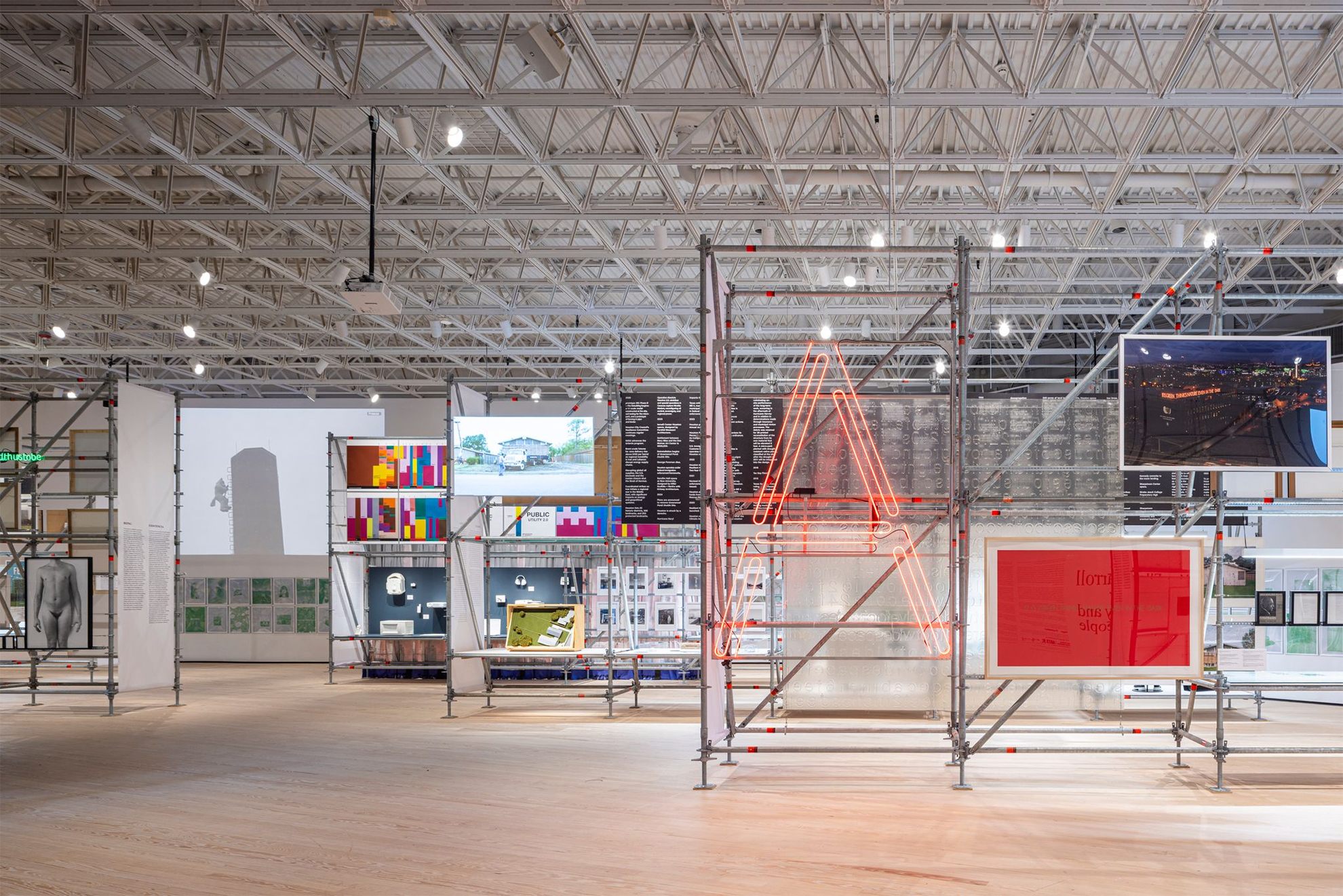
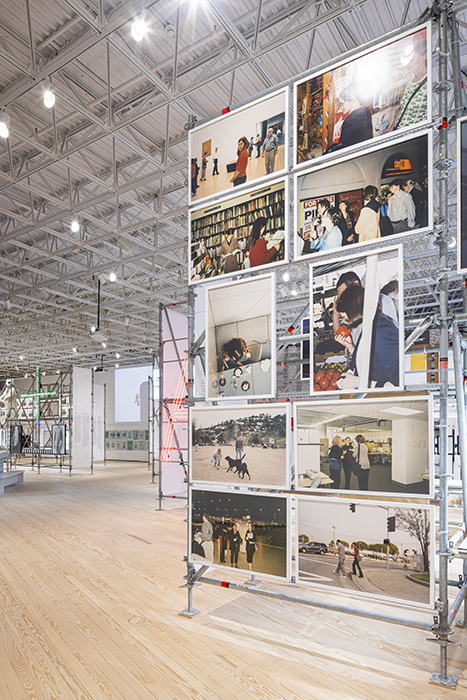
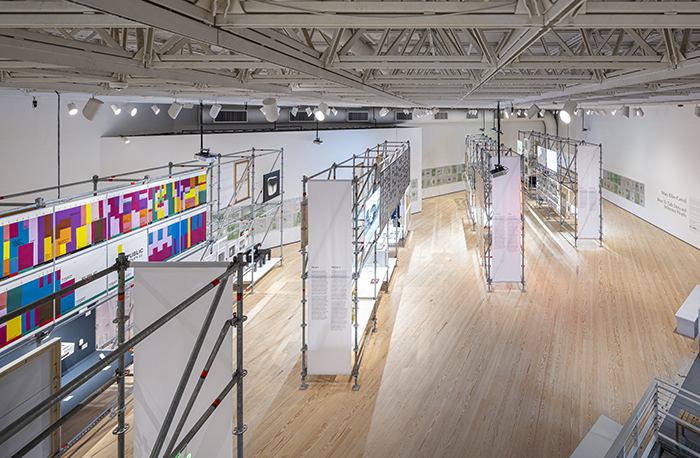
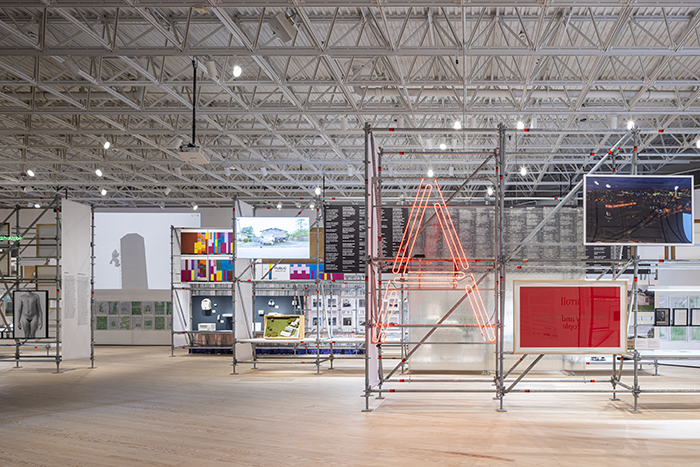
Yet the exhibition refuses to flatten Carroll’s work into singular iconic moments. Instead, Matalon and the artist have structured the survey around thematic sections—Doubling, Climate, Policy, Media, Sovereignty and Being—allowing works to echo and bleed into one another across time and medium. Industrial scaffolding replaces traditional museum walls, creating sightlines where projects remain partially visible through and beyond each other.
“We wanted to highlight the recursive, dispersed, and iterative nature of Carroll’s work,” Matalon said. “We wanted the show to have different tones and tempos, like a score or composition.”
1 ⁄3
Installation View: Mary Ellen Carroll: How To Talk Dirty and Influence People, Contemporary Arts Museum Houston, 2026. Photo: Sean Fleming.
2 ⁄3
Installation View: Mary Ellen Carroll: How To Talk Dirty and Influence People, Contemporary Arts Museum Houston, 2026. Photo: Sean Fleming.
3 ⁄3
Installation View: Mary Ellen Carroll: How To Talk Dirty and Influence People, Contemporary Arts Museum Houston, 2026. Photo: Sean Fleming.
The scaffolding itself becomes an extension of Carroll’s concerns with infrastructure and systems. It also reflects the exhibition’s ecological consciousness; rather than constructing temporary drywall partitions, the museum utilized donated scaffolding that will be returned following the exhibition’s close. The structure mirrors Carroll’s own resistance to permanence.
For Matalon, one of the central challenges was translating a practice rooted in social relations, process, and duration into the physical space of a museum exhibition without domesticating its unruliness.
“One of the important aspects of Carroll’s work is the way it troubles linearity, chronology, and historical legacy,” she explained. “It was important to bring these aspects of their work to life… We also wanted to create as little waste as possible… But it has also been essential to hold onto the wandering, ungovernable ferality of Carroll’s work. My hope is that this show asks more questions than it answers.”
That ferality emerges in works like The Doppelganger Tapes (1993–ongoing), PUBLIC UTILITY 2.0 (2008–ongoing), and indestructible language (2006–ongoing), projects that operate simultaneously as documentation, performance, philosophy, and social intervention. Carroll’s work often feels less like a collection of discrete objects than an evolving network of actions, propositions, and traces. Objects exist, certainly, but they rarely settle into singular meanings.
“The ‘broadness’ of Carroll’s work may in fact be another kind of misdirection,” Matalon observed. “It is certainly materially expansive and multidisciplinary. But their approach is highly specific—as they have themselves noted they are often asking ‘what is the problem I am trying to solve?’ The form a work takes develops in relationship to the conditions to which it responds.”
This slipperiness can feel liberating, particularly within a contemporary moment increasingly dominated by rigid systems of categorization and consumption. Carroll’s practice insists that art can inhabit radio waves, policy documents, architecture, rumor, negotiation, and disappearance. It can exist as process as much as object.
For audiences unfamiliar with conceptual or performance-based practices, Matalon hopes the exhibition opens rather than closes doors.
“I think that for many audiences there is a sense that conceptual work can be alienating—that you need a PhD to understand it,” she said. “For Carroll, one of the essential aspects of their work and this exhibition is the historical precedent that a work of art can be anything.”
“I hope that the show provides an introduction to Carroll’s work for those who might not be familiar with their practice and allow for an understanding of the ways in which conceptually rigorous work can also be visually pleasurable, humorous, and sly,” Matalon reflected. “But I also fundamentally hope that it inspires audiences to pay attention to the world around them—both what we can see and what remains invisible.”
That may ultimately be the lasting effect of Carroll’s work: not simply that it critiques systems of power, but that it teaches us to perceive them differently. A house rotates. A policy becomes sculpture. A joke reveals the architecture beneath daily life. The world shifts slightly off-axis, and suddenly everything hidden in plain sight becomes visible.
—MICHAEL McFADDEN