

Nic Nicosia’s new Nasher Sculpture Center exhibition is the artist’s first survey since 1999.

Throughout the twists and turns of his career, his work has become more philosophical and deeply personal, as even a casual stroll through his retrospective, Nic Nicosia: Everyday Surreal (on view at the Nasher Sculpture Center through August 16, 2026) can attest. Curated by chief curator Jed Morse, Everyday Surreal features more than 70 three-dimensional works, drawings, and photographs in the artist’s first survey since 1999.
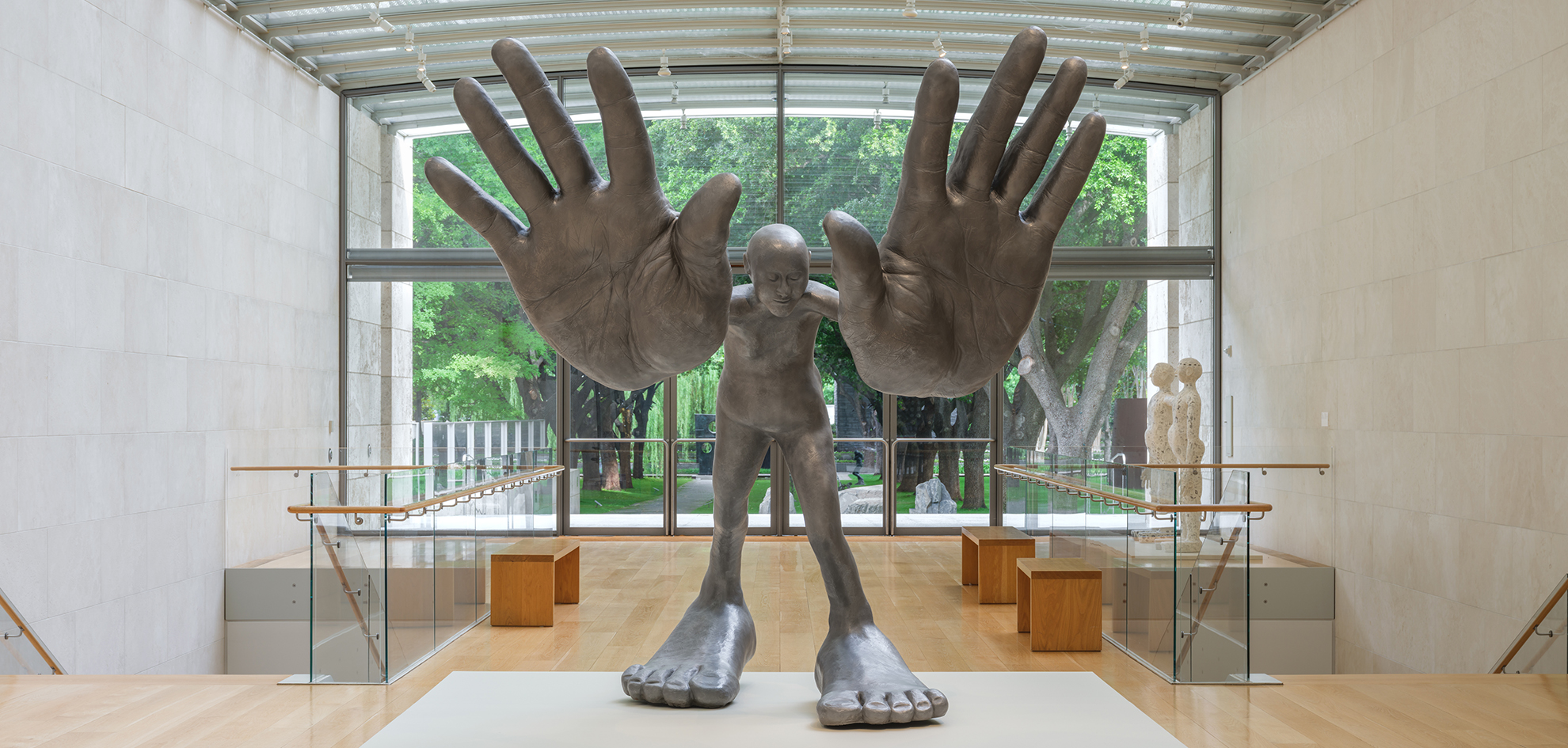
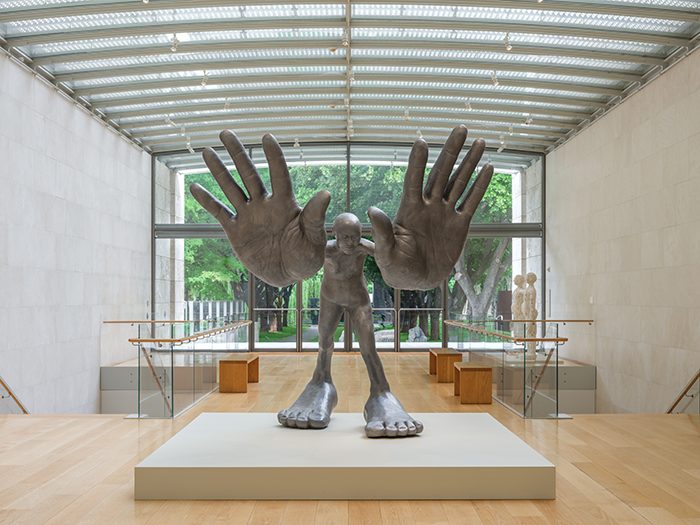
Walking into the Nasher’s airy environs, one is greeted by an eight-foot-tall stainless-steel figure with oversized cartoon hands. The sculpture known as bighands sets a humorous and confrontational tone, illustrating Nicosia’s ambiguous intent from the very start. Like many of the artist’s works, it can be examined from the most casual of perspectives as a quirky self-portrait or examined as an existential gesture. It’s all up to the viewer.
“These little characters exemplified the emotions I was having that day or a few days within making them,” Nicosia explains. “Jim Kelly (of James Kelly Contemporary Art) asked if I wanted to show my sculptures, and I said, ‘I’ve never shown my sculptures, sets or props before but I will if we make it like an installation.’ We installed them in a flat black painted space with a black scrim and no lighting, so they looked like ghost figures. The audience responded to the sculptures, and this validated what I wanted to do from that point on. I loved making things, building sets and staging photographs; however, the taking of the photograph was anti-climactic to me, it was the process of fabrication I enjoyed the most.”
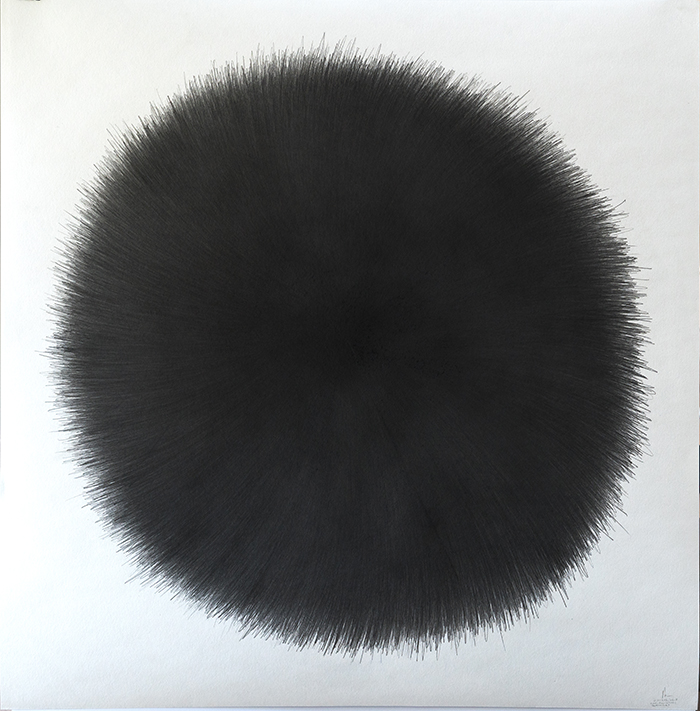
Nicosia also began exploring the nature of time through a series of drawings, including the graphite-on-paper work entitled every day—all day (86,400 seconds), pondering his own mortality during a time when he struggled with the uncertainty of an undiagnosed illness. As his spirals trace the 650-mile route from Santa Fe to Dallas or mark the seconds in a single day, these seemingly abstract drawings are some of the most personal pieces in the show.
“It’s hard to pinpoint where my work comes from because I work intuitively,” says Nicosia. “I’m influenced by where I’m living, what’s going on in my life, and how I’m feeling that day. I felt like shit for six years and went to five different doctors before I was finally diagnosed with stage 4 lymphoma. And, with the world not being in a perfect place around 2010…it all goes into the work. We all have bad times and good times, and (my work) is about this duality.”
1 ⁄7
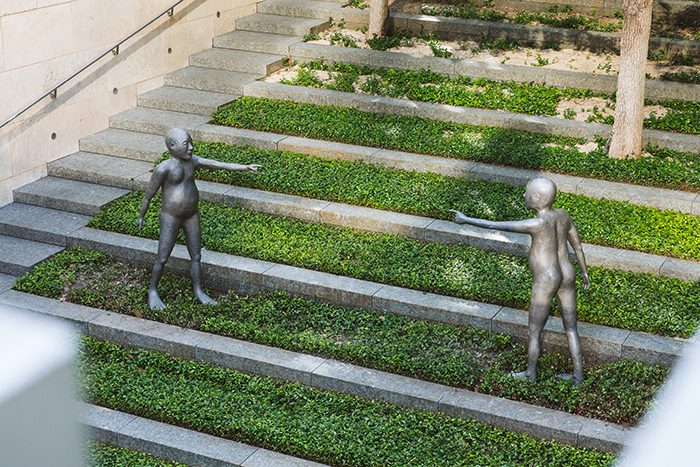
Nic Nicosia, the twins, 2018. Stainless steel. Two figures: left: 72 x 51 x 25 inches (182.9 × 129.5 × 63.5 cm), right: 71 x 48 x 23 inches (180.3 × 121.9 × 58.4 cm). Installation view of Nic Nicosia: Everyday Surreal, Nasher Sculpture Center, Dallas, Texas. May 16–August 16, 2026. Photo by Dani Holway, courtesy of the Nasher Sculpture Center.
2 ⁄7
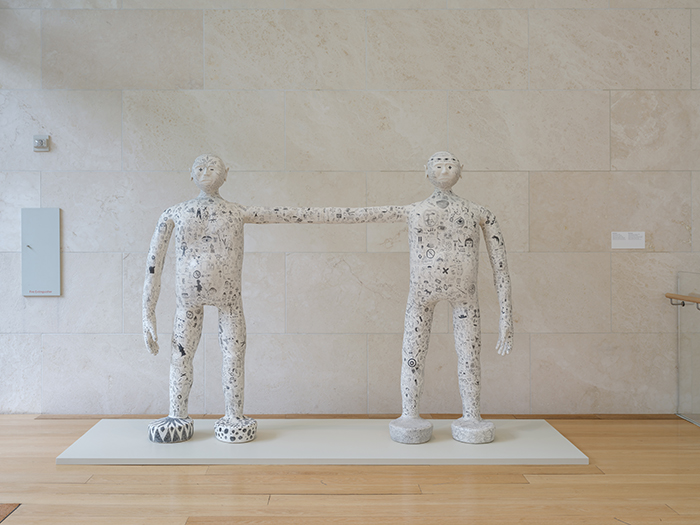
Nic Nicosia, duet, 2024–2025. Aluminum wire, rubber foam, plaster gauze, Hydrocal, Paperclay, graphite, and matte acrylic sealant. 72 x 96 x 17 inches (182.9 x 243.8 x 43.2 cm). Installation view of Nic Nicosia: Everyday Surreal, Nasher Sculpture Center, Dallas, Texas. May 16–August 16, 2026. Photo by Kevin Todora, courtesy of the Nasher Sculpture Center.
3 ⁄7
Nic Nicosia, every day-all day, 2018.
Graphite on watercolor paper
48 x 47 inches (121.9 x 119.4 cm). © Nic Nicosia. Image courtesy of the artist and Erin Cluley Gallery, Dallas.
4 ⁄7
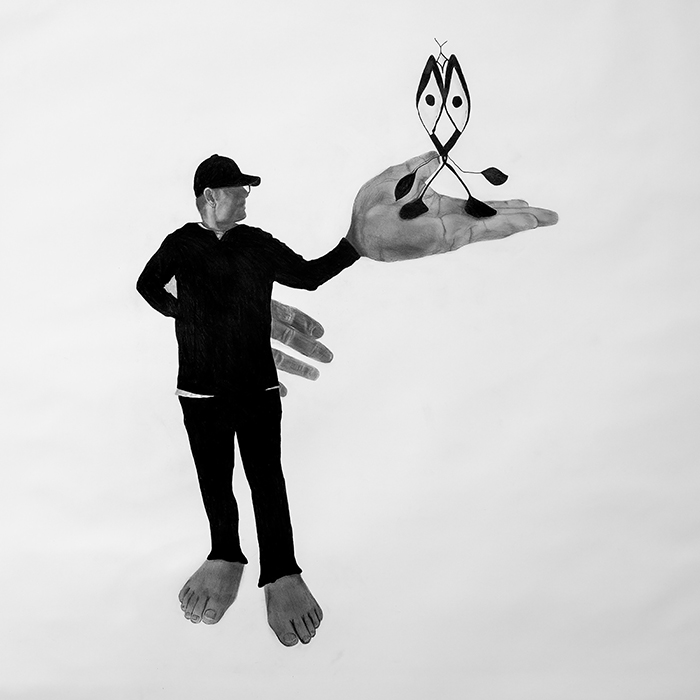
Nic Nicosia, mehands #2, 2021. Graphite and white conti on Bristol. 40 x 40 inches (101.6 x 101.6 cm). © Nic Nicosia. Image courtesy of the artist and Erin Cluley Gallery, Dallas.
5 ⁄7
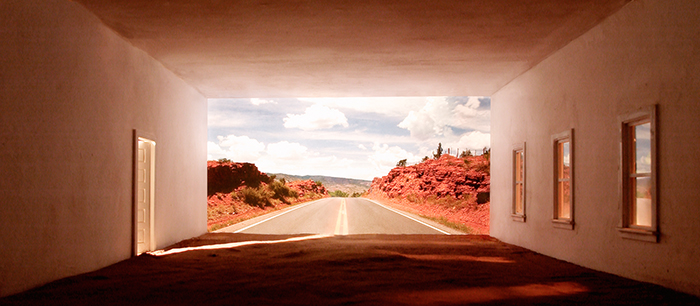
Nic Nicosia, Untitled Landscape #2, 2003. Archival inkjet on Somerset Watercolor Paper. 21 x 48 inches (53.3 x 121.9 cm). © Nic Nicosia. Image courtesy of the artist and Erin Cluley Gallery, Dallas.
6/7
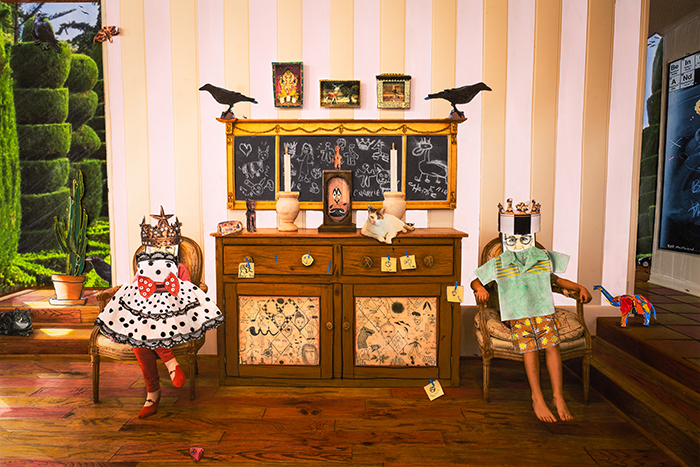
Nic Nicosia, homemade stories #14 (figure 2), 2023. Archival Inkjet. 40 x 60 inches (101.6 x 152.4 cm). © Nic Nicosia. Image courtesy of the artist and Erin Cluley Gallery, Dallas.
7 ⁄7
Nic Nicosia, bighands, 2010 (enlarged and cast 2020). 94 x 86 x 106 inches (238.8 x 218.4 x 269.2 cm). Stainless steel. Photo by Kevin Todora, courtesy of the Nasher Sculpture Center. Nasher Sculpture Center, acquired with generous support from Marguerite Steed Hoffman and Thomas W. Lentz, Charles Dee Mitchell, Cece and Ford Lacy, Travis Vandergriff, Lisa and Chuck Brown, Debbie and Eric Green, Laurie Hasty, Jeanne and Michael Klein, Jani
Having “wrecked his schoolbooks” with drawings as a child, a return to sketching was a homecoming of sorts, another step in Nicosia’s evolution from a staged photographer to a master of many mediums. After he returned to Dallas in 2015 and local gallerist Erin Cluley began representing him, he had the opportunity to craft larger metal sculptures for the Contemporary Austin Laguna Gloria. Nicosia was surprised by how willing his audience was to evolve with the practices he explored.
“The turning point was that I decided in my 60s that I was going to do whatever I wanted with my art. I didn’t have a fear of failure,” he recalls. “Collectors, curators and the audience were responding positively to the figures and the drawings, and I began to feel the possibilities in the work. I’d felt confident in the photographs and the drawings and believed in them because I was basically making them for myself.”
This philosophy is evident in the artist’s most recent homemade stories series—collaged and painted photographs of intimate spaces which close out Everyday Surreal with a hopeful note. A full-circle return of sorts to his career’s beginning, these images bring together every part of Nicosia’s practice, memorializing friends and relatives while juxtaposing life and death, joy and sorrow.

“(Once) a collector came out of an art fair, and he said, ‘Every time I see your work, it doesn’t look like your work, and it does look like your work,’” recalls Nicosia. “I looked at my dealer and she said, ‘I think that’s good.’ Hopefully it always looks fresh, and hopefully an audience is happy to see what comes next.”
—KENDALL MORGAN