

A truly unique performing arts organization has arrived on Houston’s vibrant classical music scene, a group dedicated to illuminating the sacred through music. Cor Mundi (Latin for heart of the world), is led by Founder and Artistic Director Daniel Knaggs, a well-known composer who has been commissioned by the Houston Chamber Choir and Kinetic Ensemble locally, and whose music is consistently in demand both nationally and abroad. Cor Mundi is the result of Knaggs’s decades-long journey to unite his love of sacred music, languages, and cultures in order to share works of transcendent beauty with a wide audience.

Philosophically the idea for Cor Mundi has always been there for Knaggs. After completing his D.M.A in Music Composition at Rice University’s Shepherd School, Knaggs took a teaching job at the College of Wooster in Ohio. Cor Mundi was very much on his mind. “I thought I would never forgive myself if I didn’t at least try to cut the umbilical cord and take a leap.” He moved back to Houston where he had established strong professional relationships and where the ground was fertile to make his dream come true, seeking out a group of Founding Benefactors who generously pledged annual support at a certain level for 3 years.
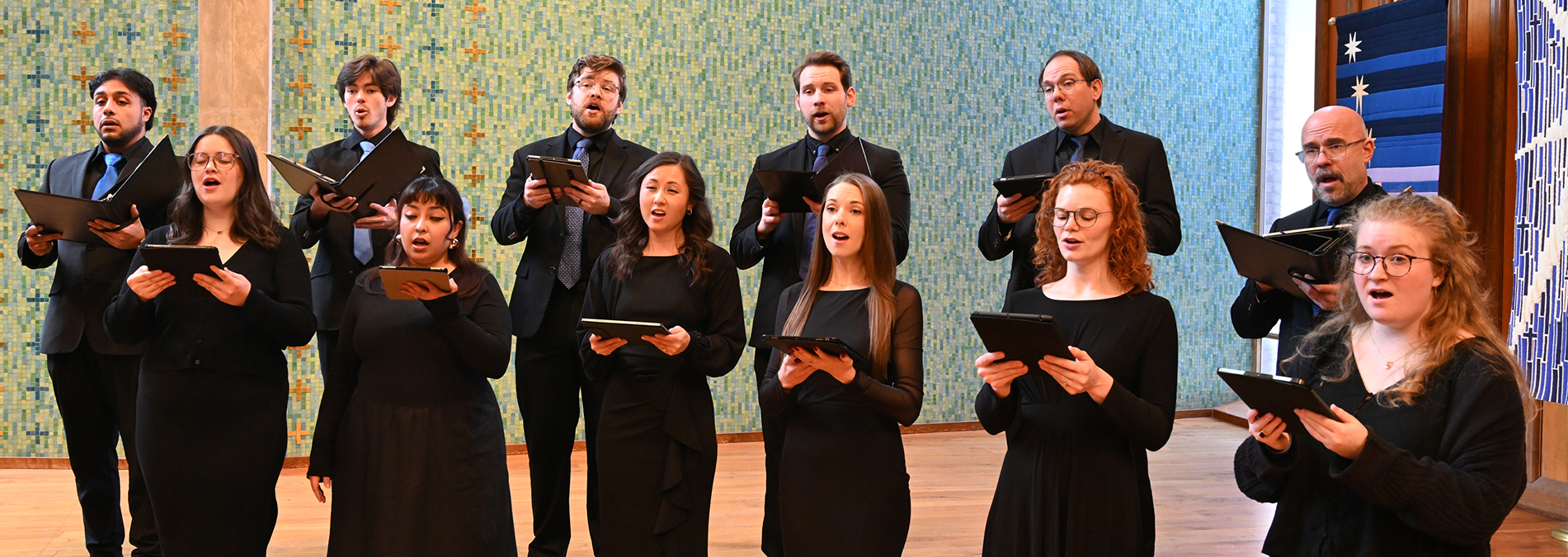
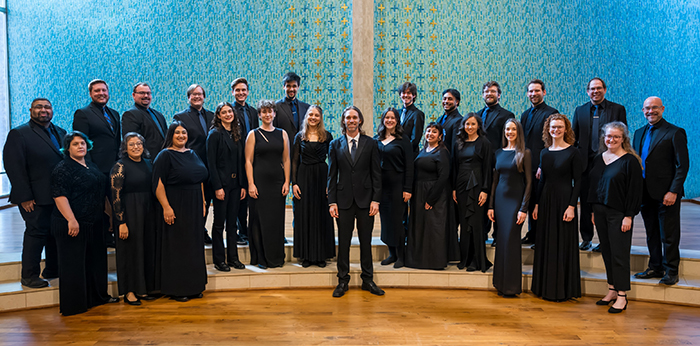
The central artistic pillar of Cor Mundi is the Cor Mundi Chamber Choir, a vocal ensemble of 24 core singers, which made its Houston debut in August of 2025. Members are selected through auditions. “Everybody re-auditions every year,” explains Knaggs. “The group I end up with any given year are people that I really want to invest in, people I believe in. We have some new voices that I think are hidden gems. Maybe they don’t even know that, and I want to help them see what they can do.” Knaggs feels fortunate to be part of the choral ecosystem in Houston that includes the Houston Chamber Choir, Houston Choral Society, Houston Masterworks Chorus, Cantare, Mercury Singers, Bach Society of Houston, as well as the HGO Chorus, the Houston Symphony Chorus, and top notch church choirs.

Cor Mundi’s first full season featured wide ranging repertoire from across centuries and lands, from ancient chant, to music from Poland, and a North America premiere of music by Ukrainian composer Galina Girgorjeva; from Renaissance motets to Knaggs’s own “After Motets,” as well as several Ave Marias from his ambitious 50-year Ave Maria Project; and finally a season finale featuring the sacred music of Sergei Rachmaninoff and Olivier Messiaen, a program in Russian and French of music that grapples with longing, grief, hope, and transcendence. Having lost my Dad this year, this final concert titled The Soul’s Ascent spoke to me in a deeply personal way. We’ve all known grief and loss, and this music reminded me that this too is a shared human experience.
For Knaggs, language is one of the most enjoyable parts of delving into the sound. Languages shape the sound of Cor Mundi. Knaggs is fluent in six languages. He completed an undergraduate degree in Spanish at the University of Michigan along with his Voice Performance degree. The voice degree gave him classes in Italian, French, and German, as well as diction classes in Czech and Russian. He also took Portuguese classes and speaks a fair amount of Polish. Languages were such an important part of Knaggs’s life that he really had trouble letting go of it. He lived in Mexico, Nicaragua, and France, and worked as a full-time Spanish teacher in a language school after graduation. This summer, he is heading to Germany for intensive German language studies, and to work with conductors there to further his training.
Beyond grammar, diction, literary understanding, and even the different muscles one uses to speak in any new language, Knaggs wants the audience to be immersed in the sound world of each language.
“German is a sound world, and that isn’t the same sound world as Spanish, and for that matter Mexican Spanish is not the same as Argentinian Spanish. If we execute it well, language-wise, people will feel not only the music and the harmonies and the rhythms, but will be actually immersed in that particular sound world. It will take them to Slovenia, or Prague, or wherever. We already stretched ourselves a lot this first season,” says Knaggs. “Next season we are going to continue stretching in a lot of different directions. Every time we do a different type of challenge, it’s good for me and good for the singers because it shows more of what we are made of and what we can do. It’s a really exciting thing.”
1 ⁄5
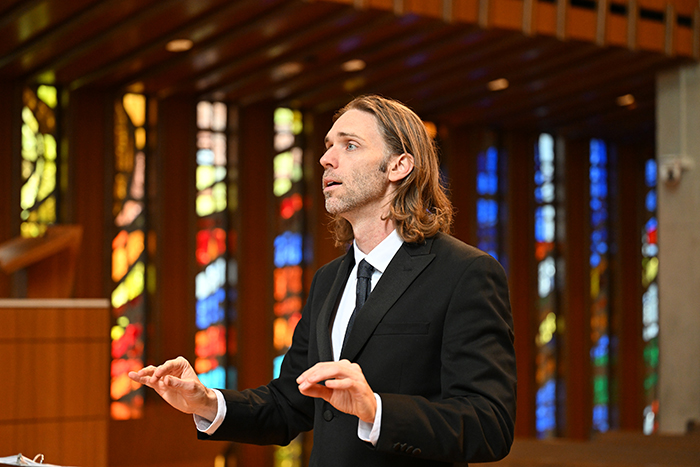
Cor Mundi Chamber Choir with founder and artistic director Daniel Knaggs conducting the “After Motets” program. Photo by Jeff Grass.
2 ⁄5
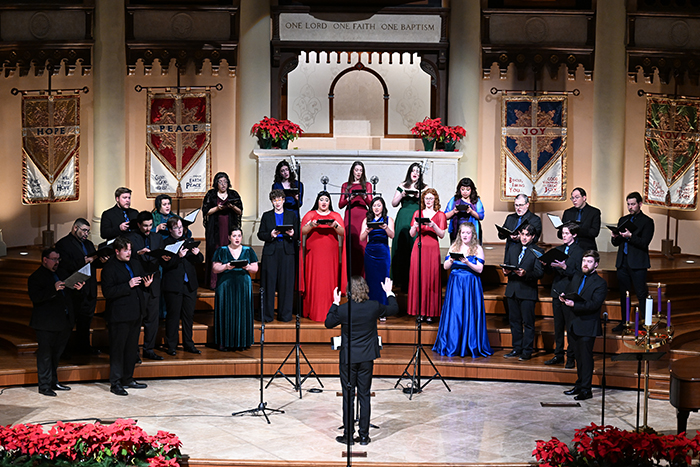
Cor Mundi Chamber Choir performing the “After Motets" program at St. Philips Presbyterian Church. Photo by Jeff Grass.
3 ⁄5
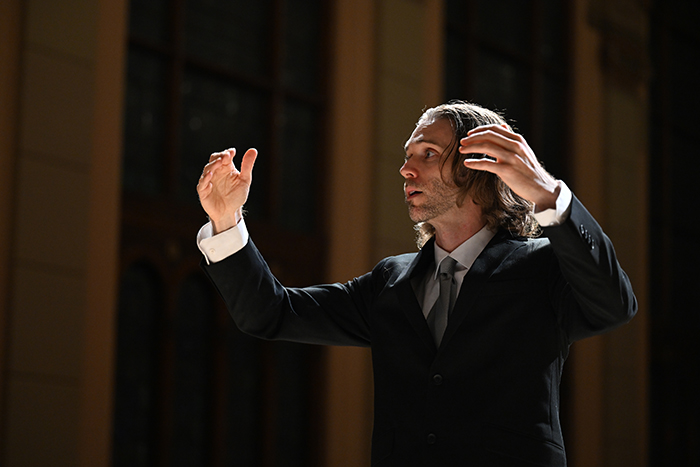
Cor Mundi Chamber Choir with founder and artistic director Daniel Knaggs conducting the “This Wondrous Child” program at South Main Baptist Church.. Photo by Jeff Grass.
4 ⁄5
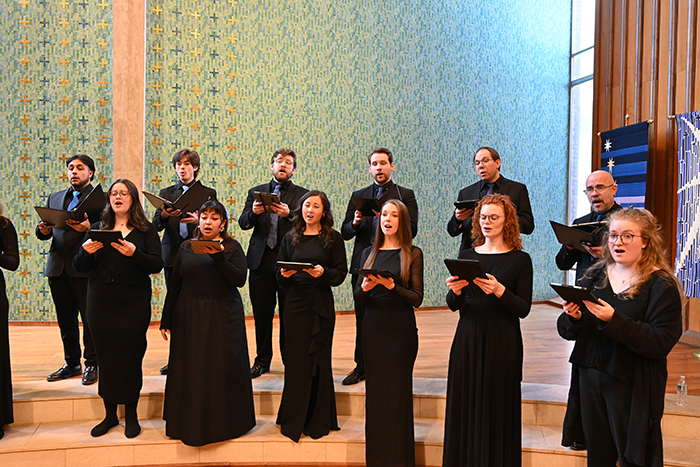
Cor Mundi founder and artistic director Daniel Knaggs conducting at the “This Wondrous Child” program. Photo by Jeff Grass.
5 ⁄5
Cor Mundi founder and artistic director Daniel Knaggs conducting the “After Motets" program at St. Philips Presbyterian Church. Photo by Jeff Grass.
Cor Mundi’s Season 2, New Worlds, New Voices, will take audiences to plenty of new places and fresh sound worlds. The season begins with a Jubilee concert celebrating the esteemed Estonian composer Arvo Pärt at 90 (Aug. 29-30, 2026). The Berliner Mass in particular is a lifetime goal piece for Knaggs.
“The first time I heard this piece, it blew my mind. It is so simple yet so deep and searching.” Knaggs thinks it will be many people’s first time hearing Pärt’s music. “He really created a new sound world that is distinctively his.” Pärt called it the tintinnabulum style, which results in a transparent sound that resembles the ringing of bells. “It hits you in a way that is indescribable. It’s utterly simple and utterly devastating,” says Knaggs. “It’s so beautiful.” The concert will be presented in collaboration with the Kinetic Ensemble. The full string orchestra will perform a movement from Tabula Rasa, with two solo violins and prepared piano. The choir will sing in Latin, English, and Old Church Slavonic.
The Christmas program is titled People, Look East (Dec. 19-20, 2026). “The idea is to look at music from America, not just the United States of America, but North America, Central America, South America, Latin America. All of us, across all these cultures, across all these languages, have a lot more in common than we think. And at Christmas we all look East together towards Bethlehem.” There are at least seven languages represented on the program (English, Latin, Spanish, French), as well as several indigenous languages such as Wyandot (spoken by the Huron tribe), Nahuatl (Mexico) and Quechua (Peru). The program also spans the ages, from the 1600s to the present day. “The bigger idea is about coming together across borders, across nations, looking toward unity.”
Land of Promise I (Feb. 6-7, 2027) is the first of a two-part series. Part 1 features American sacred music from the earliest years all the way to 1900. Knaggs is really focused on the theme when selecting music for each program. “The actual theme of the Promised Land is the idea of people from any culture, anywhere in the world, wanting a place to belong, a place to be free, to dream and to hope, and to have a life.” Spiritual symbolism plays into the theme as well, looking towards a promised land not in this life. There will be spirituals about holding on to hope, going to a place beyond suffering and harm.
The season finale Song of the Crossroads (May 1-2, 2027) takes the audience to central Europe at a time of great transition, namely the end of the Habsburg Monarchy and the dissolution of the Austro-Hungarian Empire. As countries found their individual identities, national voices began to emerge. “You can hear in these emerging voices some striking similarities, even across linguistic lines,” explains Knaggs. Among the Slovenian, Croatian, Czech, Hungarian, and German composers, there will be familiar names such as Dvorak and Liszt, less familiar names such as Janacek, Kodaly, and Rheinberger, as well as some new discoveries. “It’s going to be a stunning program,” promises Knaggs. “We are trying to be a gateway to international repertoire.”
Cor Mundi operates as a family. “My vision,” says Knaggs, “is to have the highest quality possible, work very hard, honor each others’ value, and cherish each other. There’s a ton of trust.” Knaggs also wants to bring the audience into the Cor Mundi family. “The audience brings their whole story, their whole journey, their whole life, and they build us up too. After all the work that goes into preparing for a concert, someone tells me they are going through something really difficult and this music is exactly what they needed—that makes it all worth it. The spirit behind Cor Mundi is the human quality. Music is so uniquely human that if we can channel that and connect with each other, and come together to share something beautiful, that feels so real.”
—SHERRY CHENG