

The Dallas Opera’s outgoing CEO sums up the company’s plans for next season simply. “The season as a whole is really entertainment-forward,” Ian Derrer says.

Next up will be a famously inventive director’s take on Leoš Janáček’s The Cunning Little Vixen, a picture of life and love in the Moravian forests—with most of the opera’s characters being animals portrayed by humans. Turandot, Puccini’s blockbuster about the brave suitor of a bloodthirsty princess, always boasts the sonic wow factor as its main appeal, and this time it will feature a new ending to the score, which Puccini left incomplete at his death. While entertainment may not be the main thing anyone looks for in Richard Wagner’s Lohengrin, the story of a knight of the Holy Grail who comes to a troubled nation, Dallas Opera aims to bring to the epic work a compelling cast and staging.
Opera companies are always on the lookout for up-and-coming singers, of course. Derrer notes, with satisfaction in his voice, that the season devised by him and music director Emmanuel Villaume includes three recent winners of Operalia, the international vocal competition spearheaded by veteran Placido Domingo. Two of them will take the spotlight in The Elixir of Love (Oct. 9-17).

British soprano Soraya Mafi will play Adina, the object of the rivals’ affections. When Derrer saw her as Gilda in Verdi’s Rigoletto, he recalls, he “immediately thought she should be doing Adina for us,” and it worked out. She will bring “a beautiful voice…free and easy and agile,” he adds, and a charming demeanor. Veteran Italian buffo Alessandro Corbelli, who helped close Houston Grand Opera’s season as Bartolo in Rossini’s The Barber of Seville, will round out the principals as Doctor Dulcamara, the huckster who sells Nemorino the fake elixir of the opera’s title. British director Stephen Lawless contributes the postwar staging, created for the Santa Fe Opera.
The Cunning Little Vixen (Oct. 30-Nov. 7), which Dallas Opera last staged in 2000, will reintroduce the company’s audiences to a composer they haven’t encountered since 2004.
In both lifespan and style, Janáček straddles the 19th and 20th centuries. His works draw on Romantic-period lushness as well as modern pungency, and he’s virtually unique in his music’s conciseness: He can conjure a mood, situation or character in moments. Even a surge of glowing melody can deliver its message in a single, short phrase. The Cunning Little Vixen centers on a female fox that’s captured by a gamekeeper, then escapes and goes on a spree through farmyard and forest. She eventually pairs up with a male fox and starts a family.
The story “has so many layers to it,” Derrer says. It touches on topics such as “what is true love? It’s also a statement about the relationships not only between creatures, but also between the earth and those dwelling upon it.”
1 ⁄4
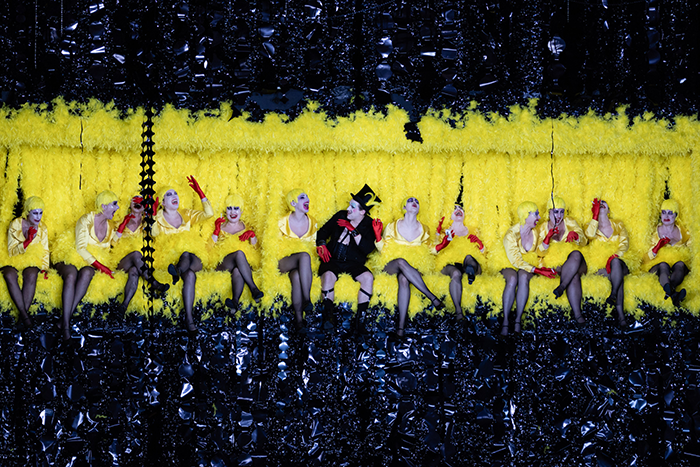
The Cunning Little Vixen at the Bayerische Staatsoper. Photo by Geoffroy Schied.
2 ⁄4
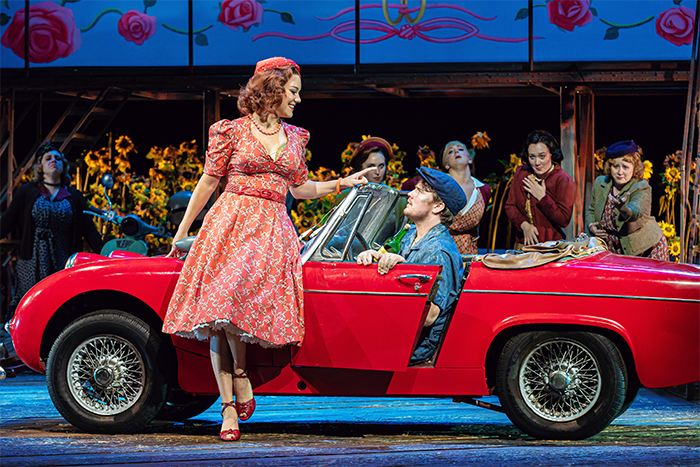
The Elixir of Love at Santa Fe Opera. Photo by Curtis Brown Photography.
3 ⁄4
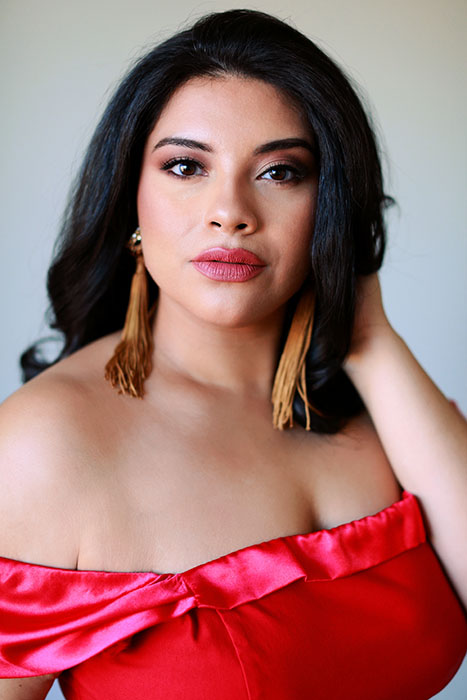
Gabriella Reyes. Photo by Dario Acosta.
4 ⁄4
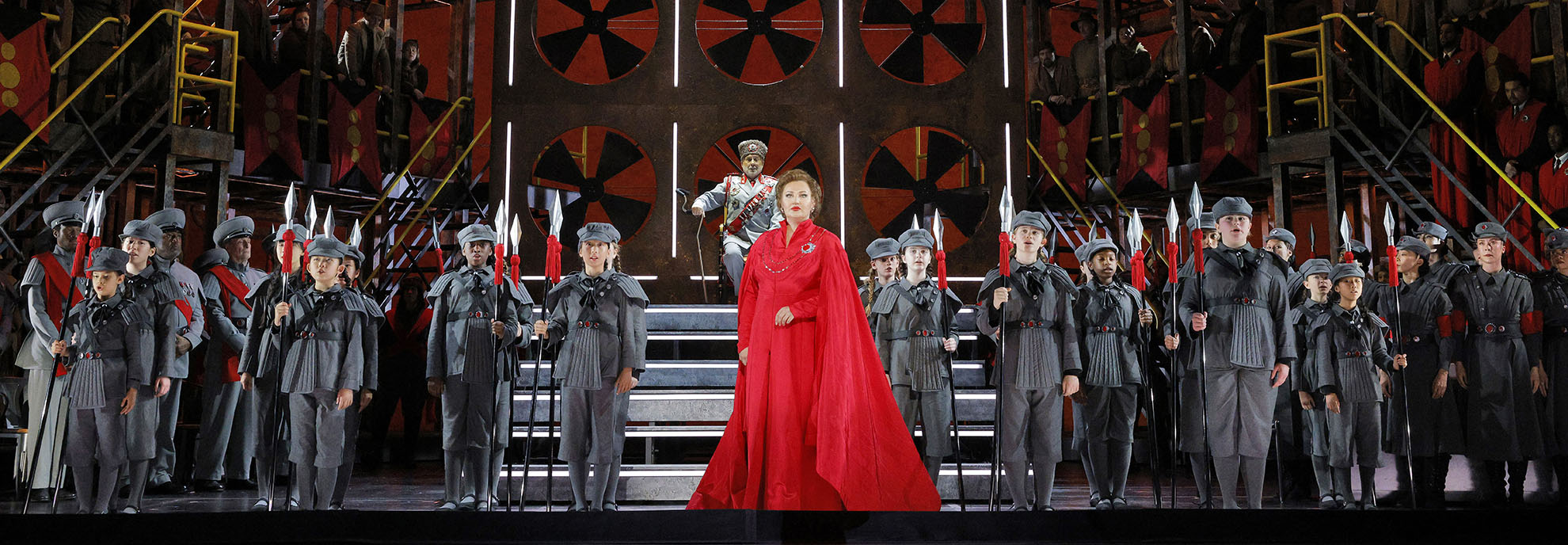
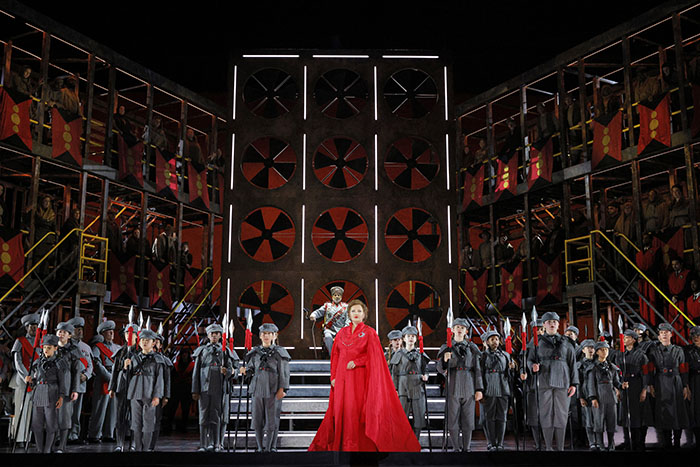
Washington National Opera production of Turandot. Photo by Cory Weaver.
Turandot’s fearsome title character is a showpiece for full-throated soprano, and Dallas’ performances (Feb. 12-20) will star Anna Pirozzi, who has played the role at the Metropolitan Opera, Royal Opera, La Scala and other leading houses. Derrer ranks her as “one of the great Italian sopranos of our generation,” adding that her voice “not only is big—and it’s big—but it’s beautiful.”
As the intrepid suitor Calaf, Dallas has enlisted Venezuelan tenor Jorge Puerta, whose voice is “heroic,” Derrer says, as well as attractive. Gabriella Reyes, a young soprano who is debuting with one major company after another, will play Liù, the slave girl in love with Calaf.
Because Puccini died before finishing Act 3 of Turandot, other composers have crafted completions for it, and Dallas will showcase the latest. Its music is by Christopher Tin, who has composed works for classical ensembles as well as a Grammy-winning choral piece used in the video game Civilization IV. In a statement released by Dallas Opera, Tin described how he and librettist Susan Soon He Stanton approached their job: “We tried to stay true to Puccini’s legacy by giving Princess Turandot the ending she deserves: one where she controls her own destiny.” The duo’s completion premiered at Washington National Opera in 2024.
As the season finale, Dallas Opera will bring back Lohengrin after a 20-year wait (March 5-13). Tenor Saimir Pirgu, who played the hotheaded Don José in last year’s production of Bizet’s Carmen, will return as Wagner’s valiant knight. Pirgu’s voice is growing heftier and “interesting in different repertoire,” Derrer says, and he’s “an artist of incredible caliber, and such a committed actor. So we’re really looking forward to having him back for that.”

In the midst of the company’s mainstage series, the annual Titus Family Vocal Recital will feature the young German soprano Christiane Karg (Jan. 31). “She is a consummate musician,” Derrer says, and he thinks back to hearing her in a recital in Italy. “Every single language that she sang in, there was such refinement and nuance and finesse,” he recalls.
While Derrer had a leading role in planning the season, he won’t be around to see it through: On July 1, he takes a new job as general director of the Canadian Opera Company in Toronto. Thus concludes his third stint in Dallas, where he first studied voice at Southern Methodist University, graduating in 1996; then, after going into opera management, served as Dallas Opera’s artistic administrator from 2014 to 2016; and ultimately came back to the company as CEO in 2018. David Lomelí, who served the company for a decade—helping found the Hart Institute for Women Conductors, among other projects—then moved on to the Santa Fe Opera and Bavarian State Opera, returns to Dallas to take the helm.
Helping lead Dallas Opera has been “one of the greatest honors of my life,” Derrer says. He takes pride in programming the company’s first productions of such landmark works as Gluck’s Orpheus and Eurydice, Debussy’s Pelleas et Melisande and Poulenc’s The Dialogues of the Carmelites. “These were all based on conversations Emmanuel and I had over the years—pieces that were on our dream lists, but also…incredible works in the repertory that all needed to be done in Dallas.”
Of course, one of the defining experiences of his tenure was the confrontation with you-know-what.
“I don’t think any of us knew, when COVID hit, the extent of what that would mean for the performing arts,” he recalls. “It was an amazing journey for us all to go through together. I was really in awe of what the community did in order to step up and support all of the arts organizations here in North Texas and in Dallas—and particularly the Dallas Opera family. And I’m in awe of what the staff was able to do. Being able to find creative solutions with very little time and unknown resources was a huge challenge. I am so proud of that.”
—STEVEN BROWN