


Early in Sir Tom Stoppard’s Rosencrantz and Guildenstern Are Dead, the Player King attempts to explain the nature of theater to Rosencrantz. In a play full of bangers (as the kids say), the lines: “We do on stage the things that are supposed to happen off. Which is a kind of integrity, if you look at every exit being an entrance somewhere else” have always stood out to me as Stoppard’s philosophy on playwriting.

Unless there’s a posthumous, undiscovered work floating in the cloud somewhere–and I wouldn’t put it past the man–a family gathering in December, 1899 at a prominent Vienna businessman’s home will be the final entrance we get from Stoppard. But even into his eighties when he wrote Leopoldstadt–now at Main Street Theater through May 3– Stoppard was still at the height of his creativity.
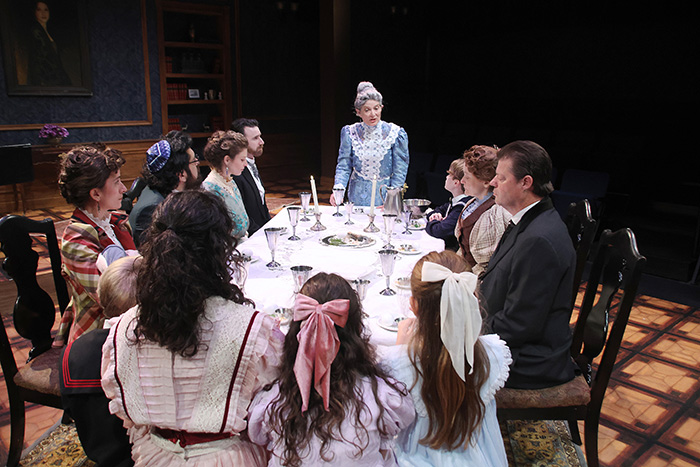
So the family gathering on the cusp of the 20th century is Jewish. The gaggle of children decorating a Christmas tree are attempting to put a Star of David at the top. Nearby their fathers are debating issues of math, psychology, politics, and assimilation, and the mothers and grandmothers are attempting to label the photos in an album in order to document the past before it is forgotten. These are the sprawling Merz and Jakobovicz families, united by culture, tradition, and one marriage. We will follow them over five decades through romance, affairs, business maneuvers, births, and deaths. We watch their lives with knots in our stomachs as we know what awaits them and the world at their entrance into the later 1930s.
1 ⁄5
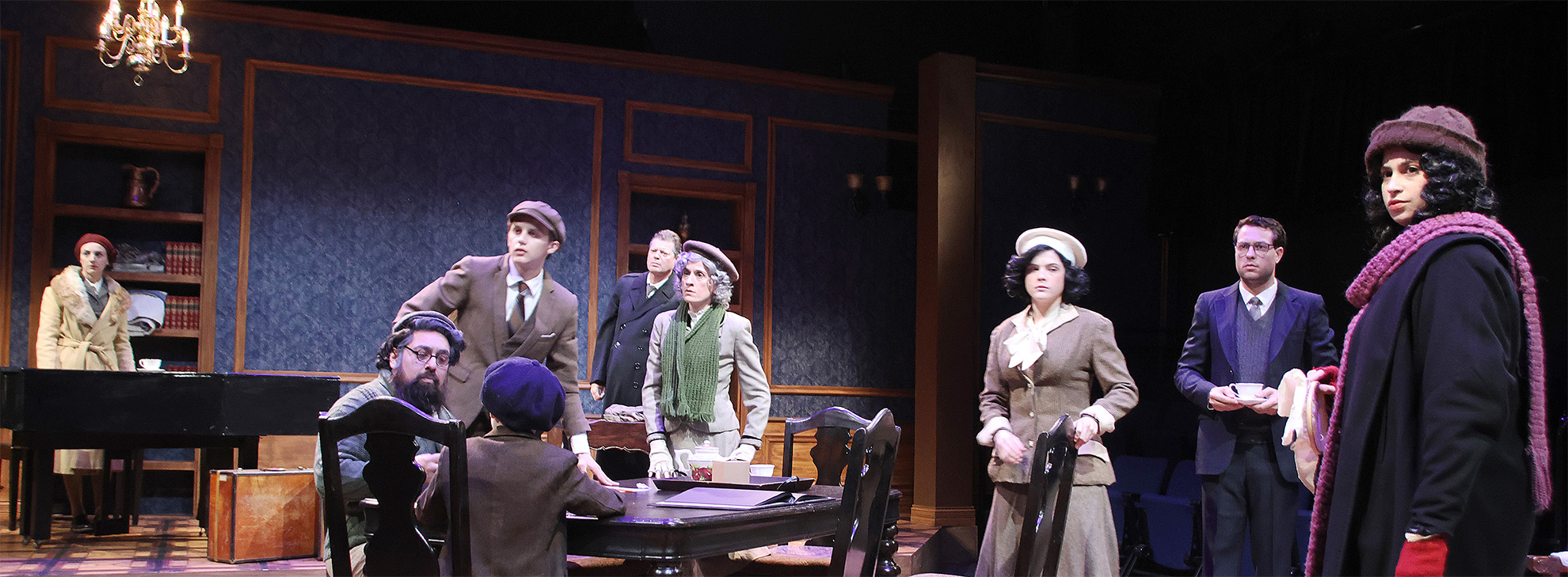
The cast of the Main Street Theater production of Leopoldstadt by Tom Stoppard. Photo by Pin Lim / Forest Photography.
2 ⁄5
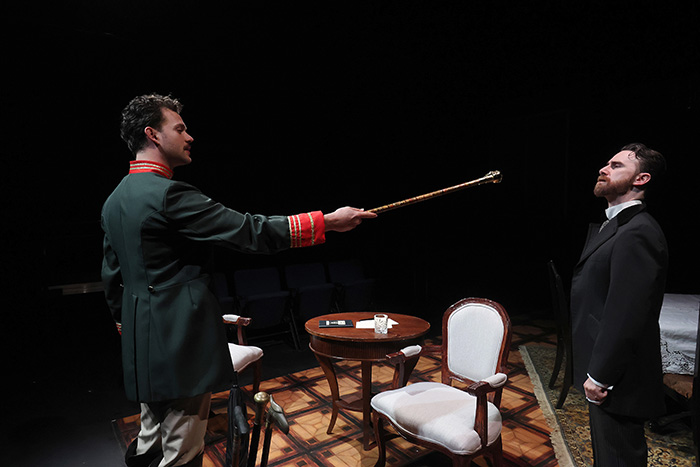
James Cardwell as Fritz and Dain Geist as Hermann in the Main Street Theater production of Leopoldstadt by Tom Stoppard. Photo by Pin Lim / Forest Photography.
3 ⁄5
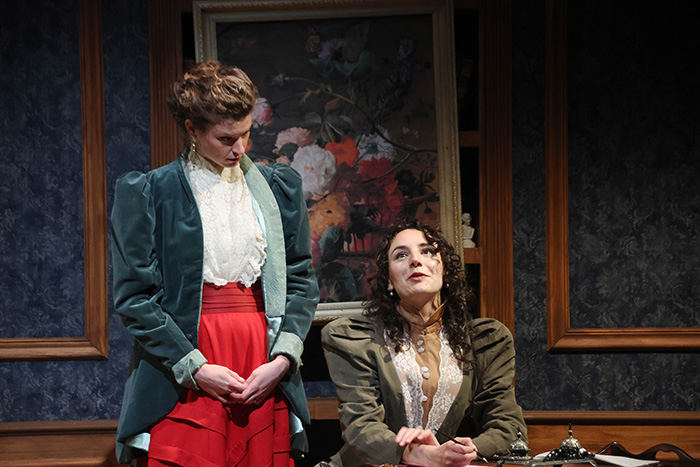
Meg Rodgers as Gretl and Nadia Diamond as Hannah in the Main Street Theater production of Leopoldstadt by Tom Stoppard. Photo by Pin Lim / Forest Photography.
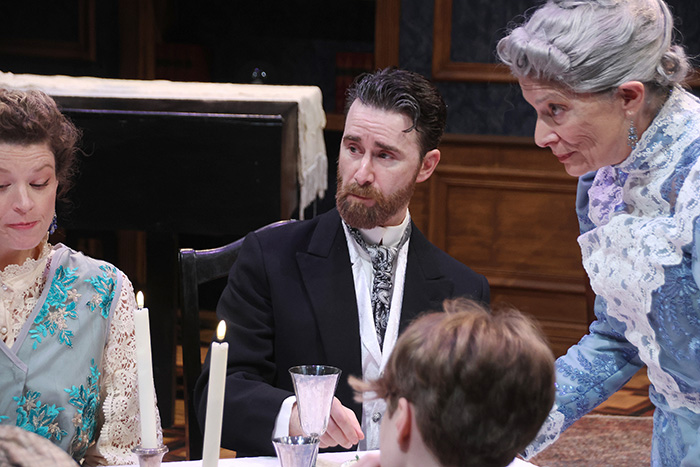
4 ⁄5
Meg Rodgers as Gretl, Dain Geist as Hermann, and Karen Ross as Emilia in the Main Street Theater production of Leopoldstadt by Tom Stoppard. Photo by Pin Lim / Forest Photography.
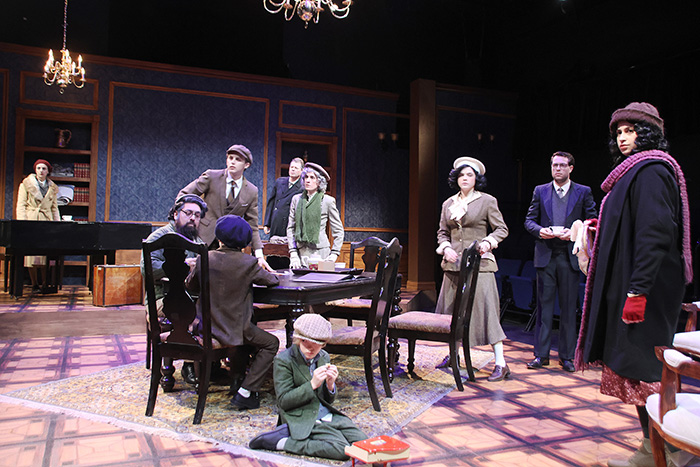
5 ⁄5
The cast of the Main Street Theater production of Leopoldstadt by Tom Stoppard. Photo by Pin Lim / Forest Photography.
A few years ago, I saw the Tony winning Leopoldstadt production on Broadway, where the set designer could reproduce all the opulence of the wealthy Merz’s home, project family trees and timelines, and the cast was full of many recognizable New York theater and television stars. That production deserved all the awards and accolades, yet I find Main Street’s production an even more powerful experience.
MST artistic director Rebecca Greene Udden has programmed many a Stoppard play over the years, and as Leopoldstadt director she understands that the closer the audience is to Stoppard’s dazzling words and characters the more we connect.
Udden, with support from set designer extraordinaire, Afsaneh Aayani, who extends the patterned flooring and furniture within inches of the audience, puts us right on the edge of the dining room and parlor, as if we too are distant cousins invited into the family intimacy. This is not an immersive play, but with the MST production, the audience will likely feel fully entered into this somewhere else.
And while the actors might not be television stars doing theater while on hiatus, this huge and stellar Houston cast delivers all the nuance and richness these roles deserve, and they do it a few feet from the audience. The production is full of MST regulars and some young newcomers, who make each character distinct, including some double roles, a feat in such a large cast.
A recurring moment of comedy is when one character tries to explain to another how they are related to each other. They are sometimes as confused as the audience. Perhaps this is the point. Genetics are not as important as family ties when they celebrate in good times and find brief refuge together when on the brink of losing everything.

Stoppard whisks us through decades, as we reenter the home at pivotal moments in family and world history. We might become dizzy in the rush, but Udden and her cast have a firm hand on the language and movement of characters, so Stoppard’s resonating images and words are never lost in the cacophony of brutal history. An early marital betrayal becomes a possible route for survival late in the play. A light moment when all the children voice distaste for the bitter herbs of Passover Seder echoes into the final moments. A child’s finger cut on a broken cup becomes a scar that will trigger a transcendent moment of memory.
The ending is bitter indeed and contains less light than some of Stoppard’s other works, but there is something a bit like hope that remains in the form of a mathematician, a psychologist, and a writer. Culture survives. Much has been made of the resemblance of Stoppard’s own history and the writer character of Leo (Austin Atencio), a lost sheep of the family. Raised to be a good, stiff-upper-lip Englishman, he has forgotten his past and family. Leo is not an exact match for Stoppard’s own life. But Leo does hear the voices of rediscovered family, then remembers and imagines. Perhaps in some possible future he too might open a door to another somewhere else.
—TARRA GAINES